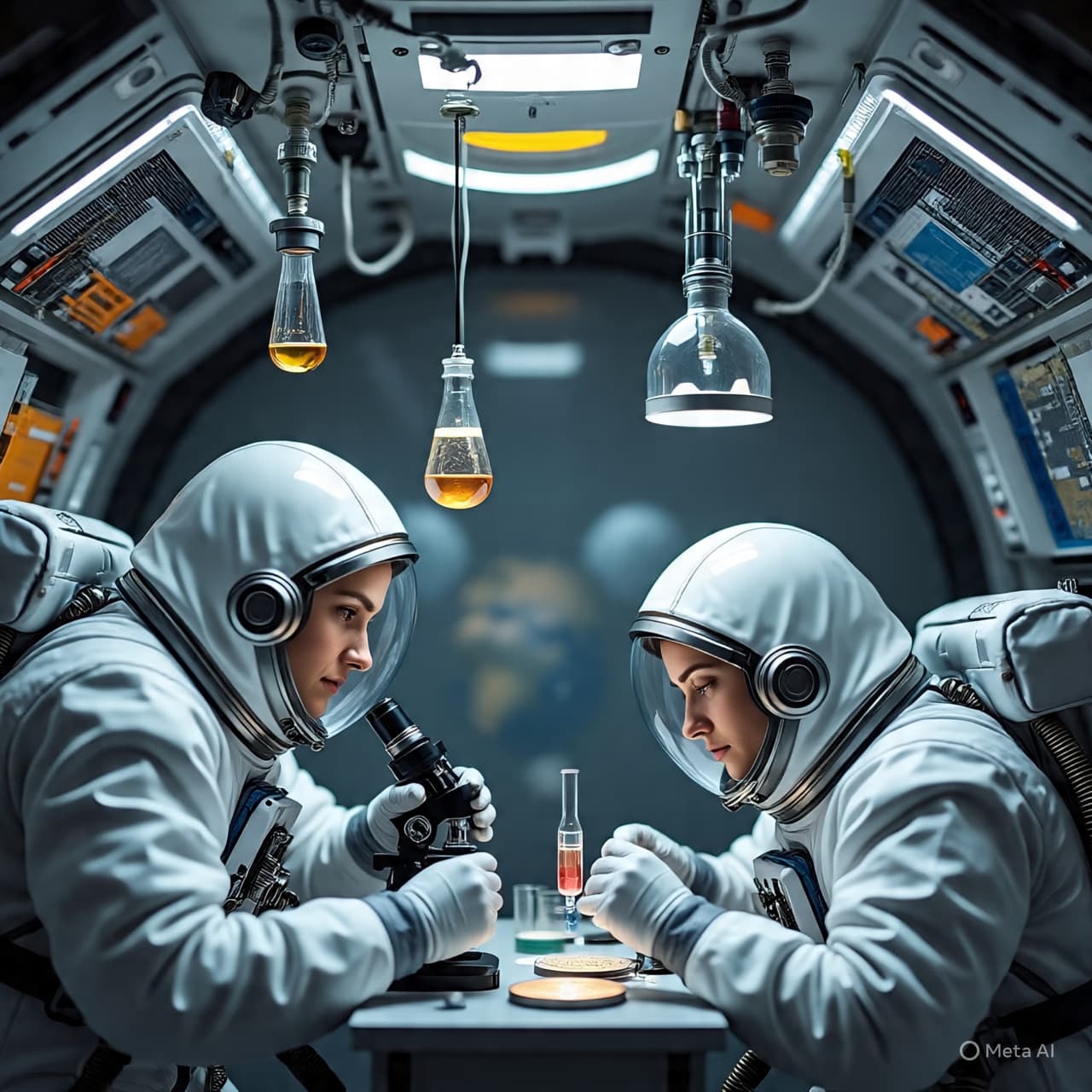
When the Journey Home Comes Sooner: A Quiet Turn in Orbit
Astronaut Mike Fincke revealed his own medical issue led to an unprecedented early end to his ISS mission, highlighting NASA’s health-first approach in human spaceflight.

Astronaut Mike Fincke revealed his own medical issue led to an unprecedented early end to his ISS mission, highlighting NASA’s health-first approach in human spaceflight.

NASA confirmed astronaut Tracy Dyson became the first to require a medical evacuation from the ISS, returning early aboard Soyuz MS-25 as a precautionary measure.

Deep beneath Antarctic ice, the IceCube detector captures elusive neutrinos, offering rare clues about cosmic explosions, black holes, and the fundamental nature of the universe.

China’s sweeping military purges, removing many senior PLA officers for alleged corruption or disloyalty, have created leadership gaps and may undermine command cohesion and readiness.

Artemis II’s giant moon rocket is rolling back to its hangar for repair after a helium system issue, delaying the crewed lunar mission until at least April.

A new, unprecedented image of the Milky Way’s core shows swirling gas clouds in vibrant hues, revealing star‑forming regions previously hidden from view.

Astronomers have released the largest ALMA image yet of the Milky Way’s core, revealing intricate swirls of cold gas around the galaxy’s center and deepening our understanding of star birth.

Aboard the ISS, astronauts blend human research and advanced tech tasks while packing science samples and hardware ahead of the SpaceX Dragon’s scheduled departure.

South Mississippi may see a total lunar eclipse — a “blood moon” — early March 3, 2026 before dawn, weather permitting, as Earth’s shadow casts a reddish glow on the Moon.

Scientists observed faint electrical coronae on tree leaves during thunderstorms for the first time, confirming a long‑suspected atmospheric electric phenomenon.

Astronomers find that stellar rotation significantly shapes how stars mix elements and evolve over time, revealing a subtle but powerful influence on their life cycles.

Astronomers captured a young Sun‑like star, HD 61005, blowing a bubble of hot gas in the Milky Way, revealing how stellar winds shape star environments and early planetary systems.

The ISS faces its gravest threat from space debris and structural vulnerabilities; emergency protocols exist, but catastrophic hull breaches could force evacuation or abandonment.

A tiny asteroid, 2025 TF, passed just 428 km above Earth unnoticed, highlighting how small near-Earth objects can evade detection despite modern surveys.

Scientists reveal the Great Unconformity — a billion-year gap in Earth’s geological record — caused by tectonic shifts and erosion, reshaping our understanding of the planet’s deep past.

Engineered bacteria developed by University of Waterloo researchers may one day consume solid tumors from the inside out, using natural traits and synthetic biology to target cancer.

NASA’s James Webb Space Telescope reveals detailed infrared images of the PMR 1 “Exposed Cranium” nebula, showing structures around a dying star that evoke a brain‑like form.

Earth’s magnetic field shows a weakening patch over the South Atlantic, now half the size of Europe, affecting satellites but not life on the surface.

Physicists have devised a new gravitational‑wave‑based method — the stochastic siren approach — to measure the universe’s expansion rate, offering fresh constraints on the Hubble constant.

In Tokyo Bay, artificial night lighting correlates with ecological and genetic separation between two coastal isopod species, showing how human light can shape species boundaries.

A video of a 33‑year‑old Atlantic harbor seal named Reggae at the New England Aquarium playing with rubber duckies has charmed audiences and highlights cognitive enrichment in animal care.

New research suggests Jupiter’s Galilean moons may have inherited complex organic molecules — precursors to life — during their formation, potentially enriching their habitability.

Scientists have observed faint electrical corona discharges on tree leaves during thunderstorms for the first time, revealing invisible ultraviolet glow under stormy skies.

NASA’s Chandra Observatory has captured the first clear X‑ray image of a sun‑like star’s astrosphere, revealing a wind‑blown bubble of hot gas and offering new insights into early stellar evolution.