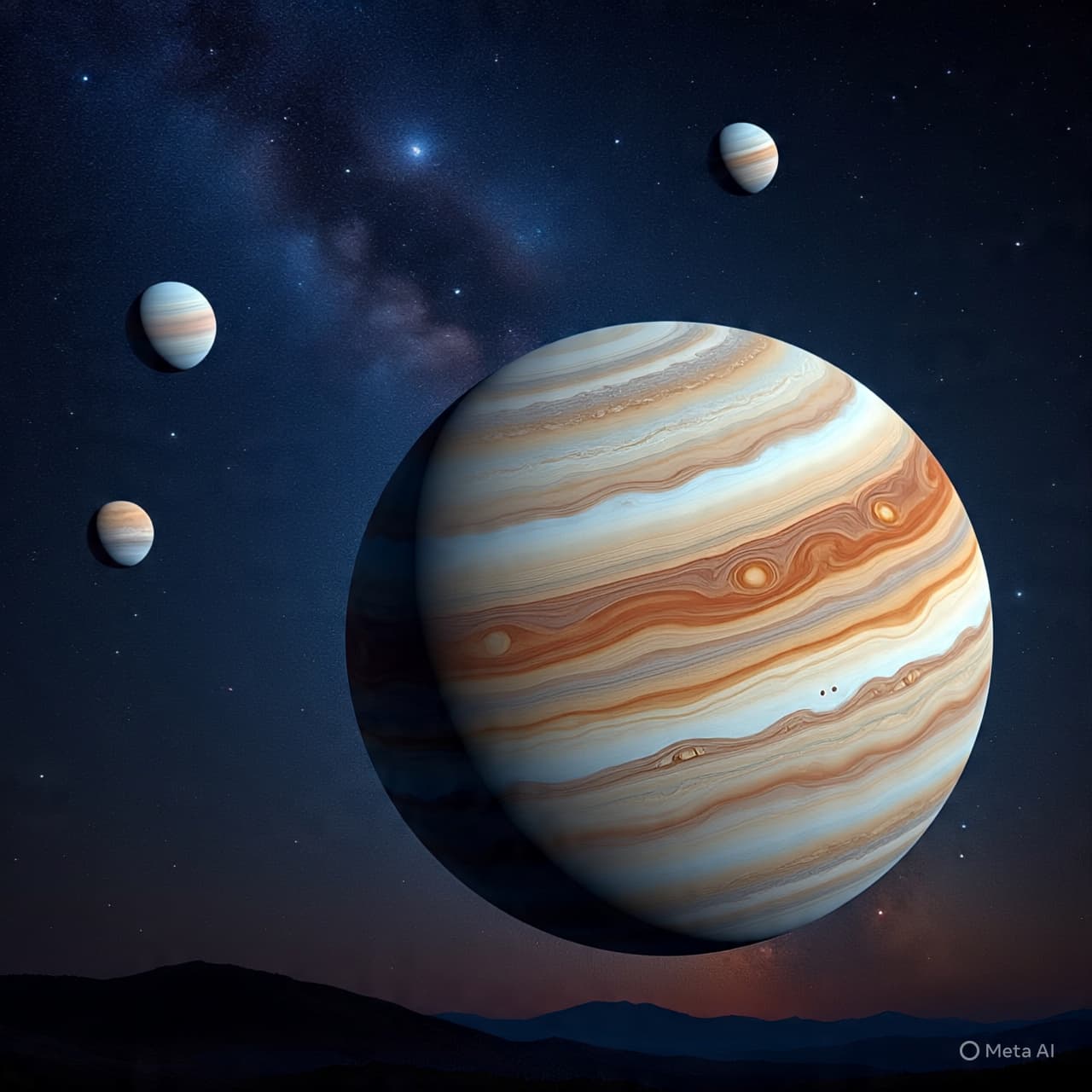
There are moments in science that feel almost like glimpsing an old manuscript in a new light — familiar, yet revealing a fresh possibility. In the vastness of our solar system, the largest moons orbiting Jupiter have long captured both scientific curiosity and the human imagination. Europa, Ganymede, Callisto, and even the volatile Io each tell a different story about formation, water, and geology. Now, new research suggests another part of their narrative may have been written at the very beginning — not long after the swirling disk of gas and dust that birthed Jupiter spun into motion.
A collaborative team of planetary scientists has modeled how complex organic molecules (COMs) — carbon‑rich compounds that contain elements such as oxygen and nitrogen — could have formed in the early protoplanetary disk and then been incorporated into the nascent Galilean moons as they took shape billions of years ago. These molecules are considered key precursors to life because they can lead to amino acids, nucleotides, and other building blocks vital to the chemistry of living systems.
The research draws on detailed simulations of how icy grains moved through the disk of material around the young Sun and into the local circumplanetary environment surrounding Jupiter. As these grains migrated, they were exposed to ultraviolet radiation and moderate heating that could trigger chemical reactions forming COMs on or within the ice. In some modeled scenarios, nearly half of these grains carried newly created organic compounds into the very zone where Europa, Ganymede, and Callisto were accreting — without significant chemical alteration along the way.
This picture contrasts with earlier views that organic materials might have arrived only after the moons formed, delivered later by comets, asteroids, or other sources. Instead, these findings suggest that the seeds of complex chemistry were woven into the moons’ icy cores from the start. It’s an idea that adds nuance to our understanding of how the essential ingredients for life might be distributed among planetary bodies.
Europa, with its vast subsurface ocean beneath a crust of ice, has long been regarded as one of the most promising places in the solar system to search for conditions suitable for life. Ganymede and Callisto, too, are believed to conceal large amounts of water beneath their surfaces. If these worlds also inherited organic chemistry from the very beginning, then the interplay between liquid water, energy sources such as tidal heating, and molecular building blocks could create environments where prebiotic processes might eventually unfold.
Of course, the presence of building blocks does not equate to life itself, and researchers are careful to distinguish between prebiotic chemistry — the assembly of molecules that might lead toward life — and the emergence of living organisms. Yet understanding whether the organic inventory was present from the outset or delivered later has profound implications for models of habitability. It reframes the Jovian moons not as chemically barren objects shaped solely by later impacts, but as worlds whose initial formation was rich with ingredients now thought to be central to life’s chemistry.
These insights arrive at a time when exploration of the Jovian system is entering a new phase. NASA’s Europa Clipper and the European Space Agency’s JUpiter ICy moons Explorer (JUICE) are en route to study these moons up close, aiming to characterize their chemistry, structure, and potential habitability in unprecedented detail. The researchers hope that future measurements of surface and subsurface composition will help test the models predicting early incorporation of organic molecules.
In the gentle arc of cosmic history, these findings remind us that the foundations of chemical complexity may be older and more widespread than once thought — laid down during the building of worlds, long before telescopes or spacecraft ever gazed upon them.
AI Image Disclaimer Illustrations were produced with AI and serve as conceptual depictions.
Sources
Phys.org The Daily Galaxy Knowridge Science Report Astrobiology.com (Research published in The Planetary Science Journal and Monthly Notices of the Royal Astronomical Society)
Published by Banx Network. This article is part of the Banx decentralized media programme, powered by the BXE token on the XRP Ledger.