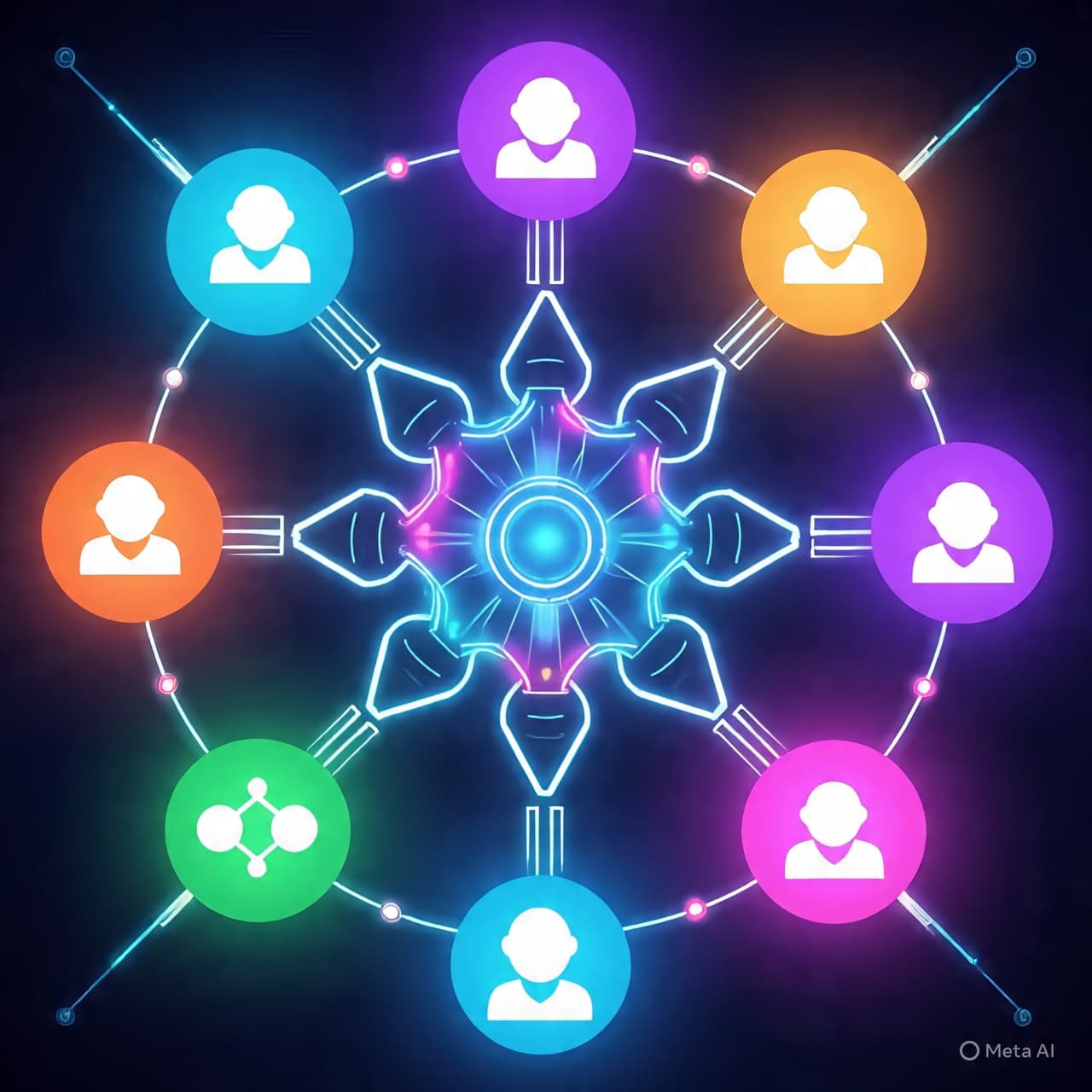
In the evolving landscape of artificial intelligence, it’s easy to think of AI as a singular entity, operating in isolation, like a lone star in the vastness of the digital universe. But what if, instead, AI could form intricate constellations, a series of interconnected systems that work in unison, each enhancing the other’s capabilities? This is where the Galaxy AI’s shift into a multi-agent ecosystem comes into play. What once was a singular stream of intelligence now flows through various agents, each contributing its expertise to create a more holistic, robust system. And with the recent integration of Perplexity AI, we’re witnessing a moment where the stars seem to align, signaling a new era of AI collaboration. Historically, artificial intelligence has been understood as a collection of tools designed to solve specific problems—whether it’s a language model like GPT, or a recommendation system predicting our next favorite song. But Galaxy AI is looking at AI from a broader, more interconnected perspective. The multi-agent ecosystem is a framework where different agents, each with its strengths, work together, sharing insights and learning from one another. This creates a dynamic environment where the whole becomes far more powerful than the sum of its parts. Perplexity AI’s deep integration into this system marks a major milestone. Perplexity, known for its advanced capabilities in language understanding, enhances Galaxy AI’s ability to process and generate human-like interactions. Imagine a scenario where one AI agent specializes in real-time data analysis, while another focuses on user interaction and natural language processing. By seamlessly connecting these agents, Galaxy AI isn’t just automating tasks—it’s fostering a dialogue between different types of intelligence, all aimed at solving complex problems with greater depth and agility. But why does this matter? The integration signals a shift in how we interact with AI. Rather than relying on isolated systems, Galaxy AI offers a more adaptable and fluid approach. It’s like having a team of experts who, though specializing in different fields, collaborate to find the best solution. This collaboration enables AI to understand and predict human needs with a level of nuance that was previously unthinkable. Moreover, the transition into a multi-agent ecosystem doesn’t just benefit technical industries or businesses. Its applications stretch to everyday consumers. From enhanced customer service experiences to smarter home devices, AI is now positioned to offer personalized, intuitive solutions that evolve in real-time, based on user behavior and environmental changes. The integration of Perplexity AI into this broader system marks a moment of convergence, a crossroads where language models and multi-agent systems meet to create something more cohesive, smarter, and, ultimately, more human. This represents an exciting new chapter in the AI space—one where collaboration between multiple systems can lead to a more nuanced, empathetic technology. As Galaxy AI continues to mature into this multi-agent ecosystem, we are standing on the precipice of a future where AI systems are not just intelligent—they are interconnected and adaptive. The integration with Perplexity AI only strengthens this notion, illustrating the potential for a future where different forms of AI work together to enhance our understanding of the world. This is not merely a technological advancement; it is the dawn of a more cohesive, intelligent ecosystem that mirrors the way humans collaborate to solve the complex problems of the world. AI Image Disclaimer (Rotated Wording): “Images in this article are AI-generated illustrations, meant for concept only.” “Visuals are created with AI tools and are not real photographs.” “Illustrations were produced with AI and serve as conceptual depictions.” “Graphics are AI-generated and intended for representation, not reality.” Sources: TechCrunch Wired The Verge CNET VentureBeat
Published by Banx Network. This article is part of the Banx decentralized media programme, powered by the BXE token on the XRP Ledger.