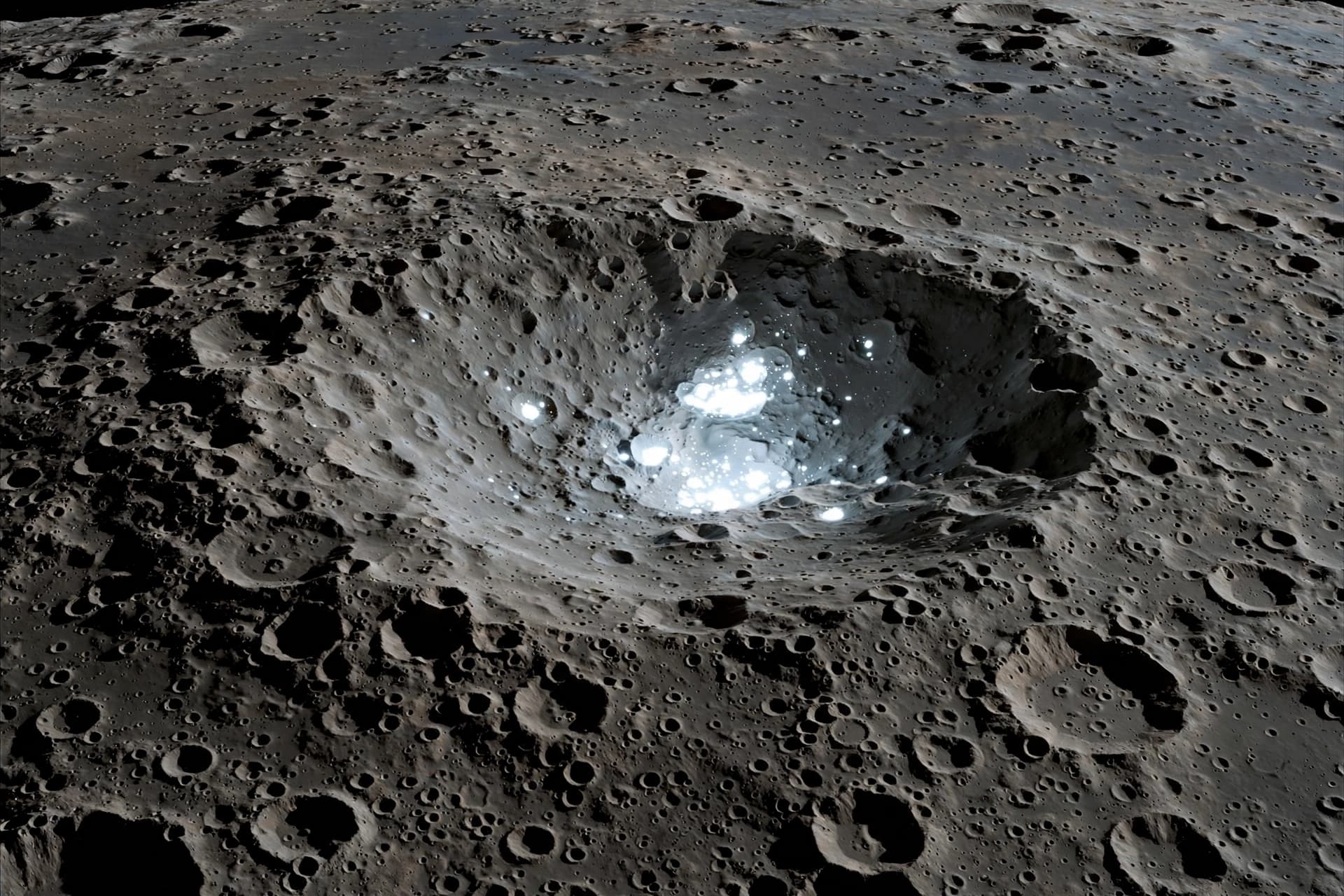
There is a particular kind of deception that ice can practice, subtle and slow, hiding what lies beneath by simply being present. On the dwarf planet Ceres, the largest object in the asteroid belt between Mars and Jupiter, this deception has been unfolding for eons. NASA's Dawn spacecraft, which orbited Ceres from 2015 to 2018, saw bright spots on its surface—reflective patches that scientists identified as salt deposits, remnants of briny water that had sublimated away . But a new study suggests that those bright spots may be telling only part of the story. The salt beneath them may be far more abundant than the observations suggested, masked by the very water ice it was mixed with.
The research, published in the Journal of Geophysical Research: Planets, comes from a pair of researchers at Caltech. They combined Dawn's data with computer models to trace how water ice and salt deposits evolve on Ceres' surface over time. The central mechanism is sublimation: when salty ice is exposed at the surface, the water vapor escapes into space, leaving the salt behind. Over time, this process enriches the surface in salt. But the process is not uniform, and the ice does not simply vanish at a steady rate .
What the researchers found is that the salt deposits may be hidden by the water ice they are mixed with. Because ice is bright and reflective in its own right, a mixture of ice and salt can appear less salty than it actually is. When the researchers modeled the evolution of these deposits, they concluded that the actual salt content could be 30 to 50 percent greater than the earlier estimates based on Dawn's observations . The bright spots are not the whole deposit; they are the visible fraction of something larger.
The model also explains how the bright spots form in the first place. Landslides—mass wasting, in geological terms—expose fresh water ice from beneath the surface. That ice, mixed with salt, begins to sublimate. The salt within the mixture causes the ice to evaporate more readily, and as the ice departs, the remaining material becomes progressively saltier. This creates a feedback loop: the saltier the deposit becomes, the more efficiently it sheds its ice, and the brighter it appears. The bright spots are not primordial salt beds. They are the end product of a process, the residue of loss .
This resolves a paradox that had troubled scientists. Earlier observations suggested that surface ice on Ceres should have a geologically short lifetime—it should sublimate away in a relatively brief period. Yet Dawn detected ice on the surface repeatedly. How could ice persist on a body with no atmosphere, exposed to the vacuum of space? The answer, the researchers propose, is replenishment. Ice is continually exposed by landslides and other surface processes, and the salty ice mixtures sublimate in ways that leave behind the salt-rich deposits we see. The ice we observe is not ancient; it is recently exposed, a fresh layer revealed by the slow churn of the dwarf planet's surface .
The finding adds to a portrait of Ceres that has been growing since Dawn's mission. The dwarf planet is not a static, dead world. It has a layered interior, a history of water activity, and a surface that continues to evolve through sublimation, mass wasting, and the slow chemistry of salty ice. The bright spots in Occator crater, the most famous of Ceres' features, are not mere curiosities. They are windows into a process that has been shaping the dwarf planet's surface for billions of years, and will continue to shape it long after our brief observations have ended .
There is something quietly instructive in this. Ceres has been hiding its salt in plain sight, behind a veil of ice that made the deposits appear smaller than they are. The lesson is not that Dawn was wrong, but that remote sensing always sees through a glass, darkly. The data are real, but the interpretation requires models, and models change as understanding deepens. What appeared to be a modest deposit is now understood as something larger, and the dwarf planet's inventory of salt—and its history of water—has grown accordingly. Ceres, it seems, has more to tell us than we thought.
Image Disclaimer: The image with this article was created using AI generation tools and does not depict actual Dawn spacecraft data.
Sources: Universe Today, Journal of Geophysical Research: Planets, Caltech, AGU Publications
Published by Banx Network. This article is part of the Banx decentralized media programme, powered by the BXE token on the XRP Ledger.