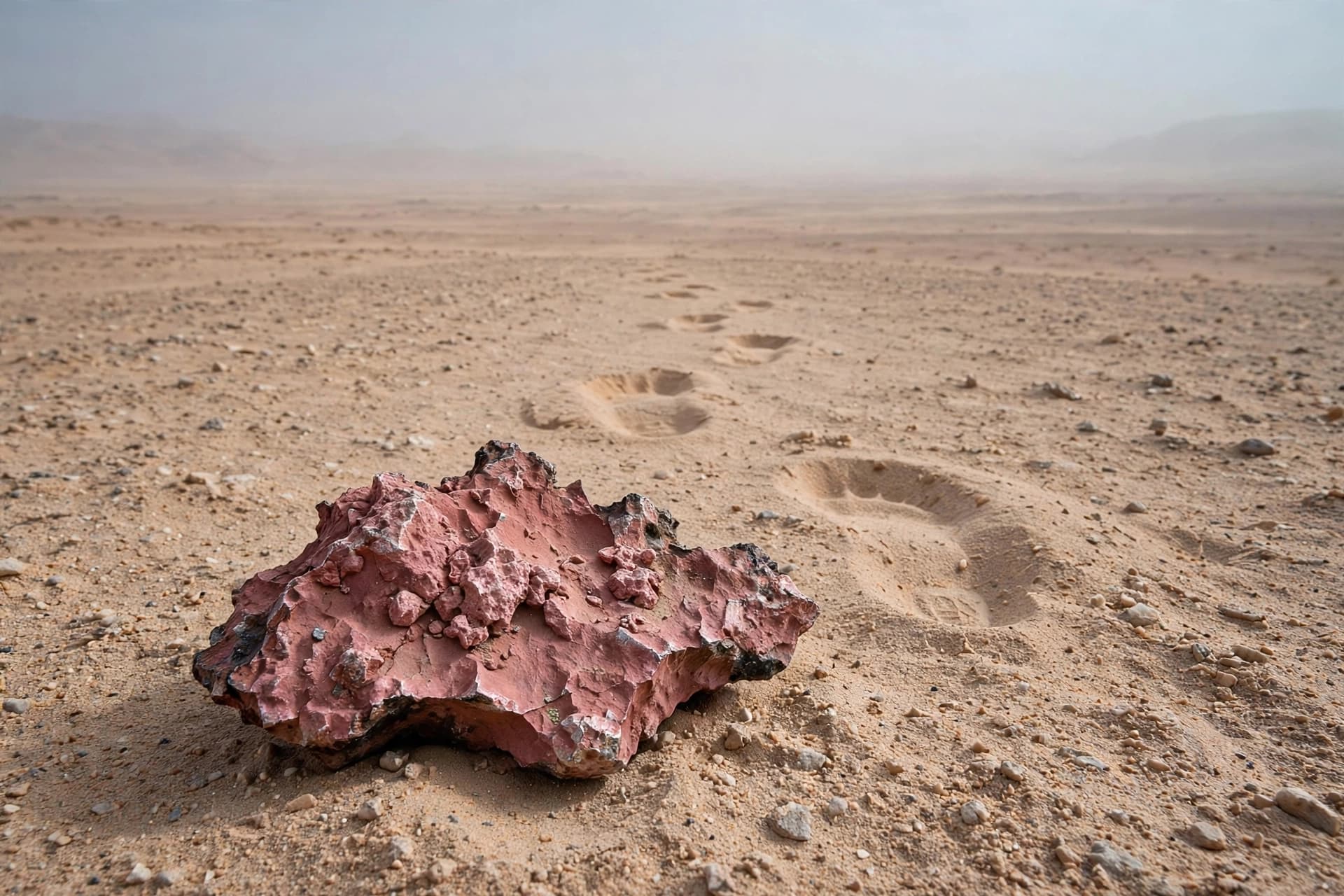
In 2022, in the vast salt plain of the Sahara, a rose-colored stone was found. It weighed nearly two pounds, unremarkable to the eye, another piece of desert rock among countless others. No one knew its age or its origin. It sat in a collection, waiting. Then scientists began to look closely, and the stone began to speak of a world billions of years away, a world that was once wet and warm and geologically restless. The rock, now known as Teghaza 001, has been dated to more than 4.1 billion years ago, making it one of the oldest Martian meteorites ever found on Earth .
The name comes from the salt plain in Mali where it was discovered, a flat expanse that has yielded many treasures from the sky. Teghaza 001 is one of roughly 435 known Martian meteorites, but its age places it in rare company . Only two other meteorites from the Red Planet are known to be older than four billion years: Allan Hills 84001, discovered in Antarctica in 1984, and the meteorite nicknamed Black Beauty, which contains individual mineral grains of great antiquity but assembled into a rock more recently . Teghaza 001 is the third member of this exclusive club, and in some ways, the most informative.
What distinguishes Teghaza 001 is its mineralogy. Unlike Allan Hills 84001, which is composed almost entirely of a single mineral, Teghaza 001 contains a mix of igneous minerals that tell a more complex story . These minerals formed as magma cooled, then were later altered by subsurface water. The rock preserves a record of the interaction between water and rock on early Mars, and perhaps even an imprint of the planet's atmosphere as it was losing its water . One of the study's authors described it as a Rosetta Stone for Mars, a phrase that captures both its rarity and its interpretive power .
The dating itself required careful work. Researchers at the University of New Mexico initially identified the meteorite as Martian by analyzing its oxygen isotopes, which serve as geochemical fingerprints . It appeared to belong to the shergottite class, the most common type of Martian meteorite. But there were unusual textures and minerals that warranted a closer look. Zircon crystals were discovered within the rock, tiny timekeepers that preserve clues to formation. A novel in-situ rubidium-strontium dating technique, developed by researchers at Caltech, allowed scientists to analyze individual mineral grains using a fragment smaller than a fingernail, preserving most of the rare sample for future study .
The results placed the meteorite's formation at more than 4.1 billion years ago. Water altered the rock around that time, suggesting it originally formed even earlier . The meteorite's distinctive mineralogy matches what NASA's Mars Reconnaissance Orbiter has observed in the planet's cratered southern highlands, though the exact location of its origin on Mars will never be known . Several potential locations have been identified that match its chemistry and mineralogy.
There is a larger significance to this small stone. Most Martian meteorites found on Earth are no more than about two billion years old. Teghaza 001 offers a window into a period of Martian history that is otherwise represented by only one other sample. As one planetary scientist observed, we have doubled our old meteorites . That doubling matters, because a single sample can only tell so much. With two samples from the same ancient era, scientists can begin to compare, to distinguish what is typical from what is peculiar, to build a more robust picture of early Mars.
The meteorite also carries implications for the planet's watery past. Hydrogen trapped in its minerals provides a tracer for water, and the ratio of hydrogen to its heavier isotope, deuterium, closely matches measurements from Allan Hills 84001 . Both indicate that early Mars contained more water than it does today, and that the planet was already losing that water billions of years ago. The story of Martian water is not one of a single cataclysm, but of a long, slow departure.
Teghaza 001 now rests in pieces, its main mass held by the Maine Mineral and Gem Museum, with small samples distributed to laboratories for study . It is a fragment of another world, carried across the void by an impact that blasted it from the Martian surface and sent it tumbling toward Earth. It arrived in the Sahara, where it lay unknown for an unknown time, until human hands picked it up and human curiosity began to ask what it was. The answers are still unfolding. As one researcher put it, we have only scratched the surface .
Image Disclaimer: The image with this article was created using AI image generation tools and does not depict the actual meteorite.
Sources: Science, NASA Jet Propulsion Laboratory, BBC, Anadolu Agency, University of Maine, Science
Published by Banx Network. This article is part of the Banx decentralized media programme, powered by the BXE token on the XRP Ledger.