Key Highlights
- Voyager 1 is approaching a distance of one light-day from Earth, approximately 16 billion miles.
- The spacecraft experienced a two-day communication silence in October due to orientation thruster issues.
- On November 18, 2026, Voyager 1 will become the first human-made object to cross the one light-day threshold.
NASA's Voyager 1, launched in 1977, is nearing a significant milestone as it approaches a distance of one light-day from Earth, which is roughly 16 billion miles or 26 billion kilometers. This distance represents the span that light travels in twenty-four hours. On November 18, 2026, Voyager 1 will officially become the first human-made object to cross this threshold, marking a poignant moment in space exploration history. However, this milestone comes on the heels of a recent communication scare that has raised concerns about the spacecraft's ongoing mission.
In mid-October, Voyager 1 went silent for nearly forty-eight hours, from October 18 to 20. This unexpected loss of contact was attributed to an automatic response from the probe's onboard systems, triggered by issues with its orientation thrusters. For a mission that has endured decades of wear and tear, such a silence is more than just an inconvenience; it underscores the fragility of the connection between Earth and its most distant emissary. The spacecraft relies on radioisotope generators for power, which diminish over time, necessitating the gradual shutdown of instruments to conserve energy.
Fortunately, Voyager 1 managed to restore communication on its own, showcasing the robust engineering of the spacecraft, which was designed with redundancy and autonomy in mind. This incident occurred shortly after NASA completed a delicate power-saving operation, further complicating the situation for the team managing a spacecraft whose systems are older than many of the engineers working on it today. With communication delays approaching two full days, diagnosing any anomalies becomes increasingly challenging.
The significance of the upcoming light-day milestone lies not in any operational changes aboard Voyager 1, which will continue to coast outward at approximately 38,000 miles per hour, but rather in the implications for communication. After November 18, every command sent from Earth will take over twenty-four hours to reach the spacecraft, and responses will take an additional day to return. This means that a simple inquiry and its answer will span nearly forty-eight hours of silence, requiring mission planners to adopt a longer-term perspective and accept that real-time problem-solving is no longer feasible.
Currently, Voyager 1 is in interstellar space, having crossed the heliopause in 2012. It carries the Golden Record, a gold-plated copper disk that contains greetings in fifty-five languages and a portrait of Earth, intended as a message to potential extraterrestrial finders. The spacecraft is headed toward a faint star known as Gliese 445, which it will pass within about 1.7 light-years in approximately 40,000 years. The vast distances involved are staggering; Voyager 1 is nearly six times farther from Earth than Neptune, while the nearest star beyond the Sun is over four light-years away, more than 1,500 times farther.
Despite the challenges, Voyager 1 continues to return scientific data from its magnetometer and plasma wave subsystem. Its cameras have been inactive since 1990, and the cosmic ray instrument was turned off in 2025, followed by the low-energy particle instrument in April 2026. Each shutdown signifies a small farewell, a recognition of the finite power supply and the reality that the mission's end, while not imminent, is becoming increasingly tangible. NASA has yet to announce a definitive date for when Voyager 1 will cease operations entirely.
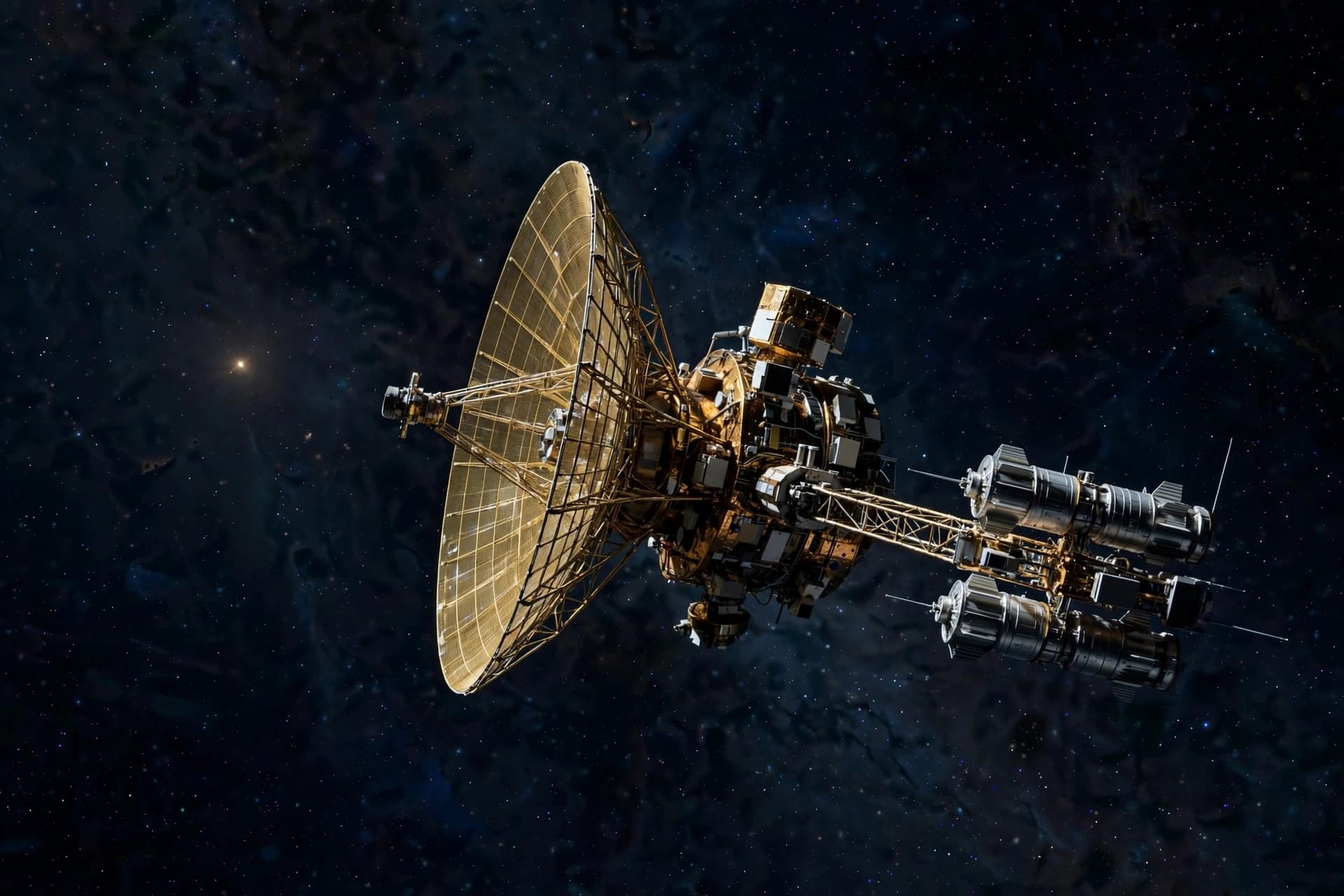
AI Image Disclaimer: The visuals accompanying this article are generated by artificial intelligence and are intended for illustrative purposes only; they do not depict the actual Voyager spacecraft or the specific events described.
Published by Banx Network. This article is part of the Banx decentralized media programme, powered by the BXE token on the XRP Ledger.