Key Highlights
- Discovery:A new fossil species, Masripithecus moghraensis, found in Egypt.
- Age:The fossil dates back 17 to 18 million years.
- Implication:This find may change the understanding of ape origins.
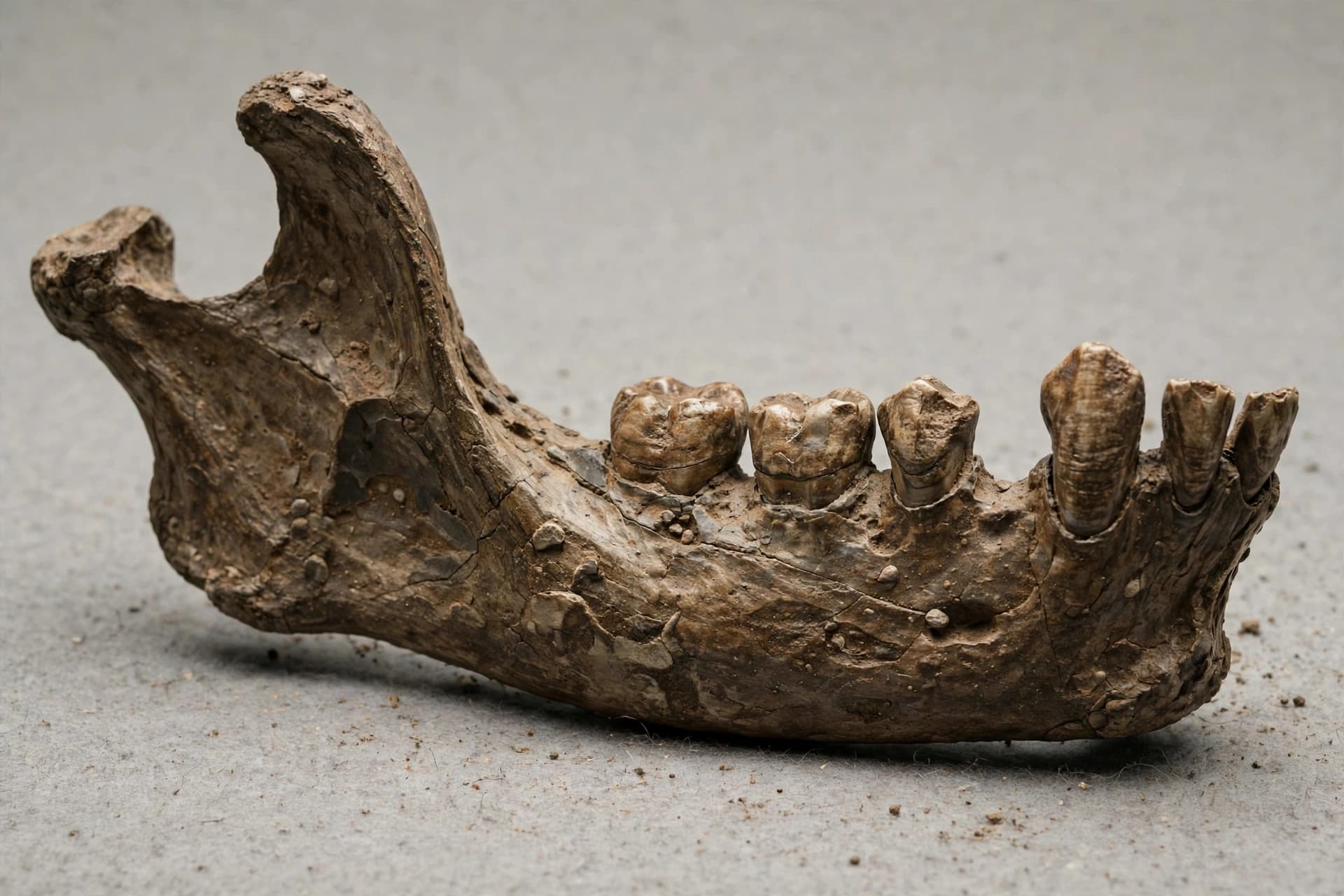
A remarkable discovery in northern Egypt has unveiled a fossil that could significantly alter the narrative of ape evolution. Dated to approximately 17 to 18 million years ago, this fossil belongs to a previously unknown species named Masripithecus moghraensis. The fossil, which includes a lower jaw and several teeth, was unearthed from the Wadi Moghra region, an area that had not previously yielded evidence of early apes. This finding challenges long-held beliefs about the geographical origins of modern apes, including humans.
Traditionally, the story of ape evolution has been centered around East Africa, where most early Miocene ape fossils have been discovered. However, the new evidence suggests that the ancestors of all living apes may have originated in northern Afro-Arabia or the eastern Mediterranean, rather than solely in East Africa. Shorouq Al-Ashqar, a paleontologist at Mansoura University and the lead author of the study published in the journal Science, emphasized that the previous narrative was based on a limited geographical area. “The entire story of early ape evolution was told by only a small corner of the continent,” Al-Ashqar stated.
The timing of the Masripithecus fossil is particularly significant, as it coincides with a period when Afro-Arabia was becoming connected to Eurasia. This connection allowed for the movement of species between continents, which may have influenced the evolutionary paths of various primates. The fossil exhibits distinct features, such as strong jaws and large canine teeth, indicating that it occupied a unique branch of the primate family tree, one that would eventually lead to modern apes.
The scientific community has reacted with a mix of enthusiasm and caution to this discovery. Ellen Miller, a paleoanthropologist at Wake Forest University who was not involved in the study, acknowledged the potential of this finding to reshape our understanding of early ape evolution. However, she also cautioned that the limited material available—a jaw and teeth—means that further evidence is needed before any definitive conclusions can be drawn. “A new find such as this is always the beginning of the work, not the end,” Miller remarked.
Despite the limitations, the discovery of Masripithecus moghraensis expands the geographical scope of where researchers should look for the origins of modern apes. For decades, the focus has been primarily on East Africa, driven by both logistical considerations and historical precedent. The Wadi Moghra fossil suggests that the evolutionary story may be more complex and widespread across northern Africa than previously thought.
In conclusion, while Masripithecus remains a singular point of discovery in the vast landscape of paleontology, it raises important questions about the origins of modern apes. This fossil does not provide a definitive answer but encourages scientists to explore new avenues in their research. The jawbone from Wadi Moghra serves as a reminder of the many fragments that contribute to our understanding of evolutionary history, each piece revealing more about the intricate tapestry of life on Earth.
Published by Banx Network. This article is part of the Banx decentralized media programme, powered by the BXE token on the XRP Ledger.