Key Highlights
- Voyager 1 will cross the one light-day threshold on November 18, 2023.
- The spacecraft has been traveling through space since its launch in 1977.
- NASA encourages a symbolic wave of light to celebrate this milestone.
On November 18, 2023, at 5:16 a.m. Eastern Time, Voyager 1 will achieve a remarkable milestone, becoming the first human-made object to be one full day of light away from Earth. This distance, approximately 16 billion miles or 25.9 billion kilometers, represents a significant boundary in our understanding of space and our relationship with the cosmos. To commemorate this event, NASA is inviting people to step outside after sunset on November 17 and create a symbolic wave of golden light, which will take 24 hours to reach the spacecraft, if it could perceive it.
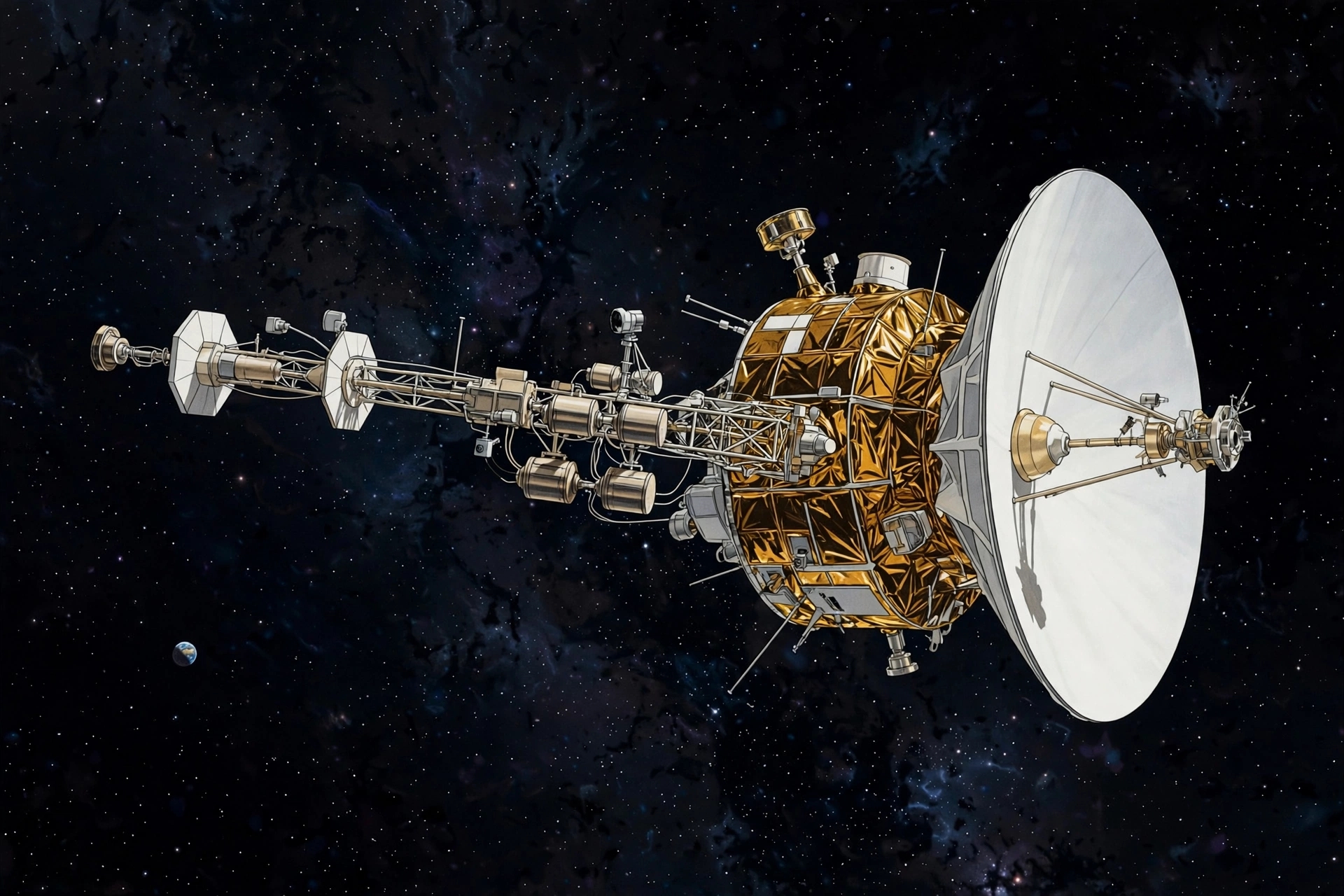
Launched in 1977, Voyager 1 was initially designed for a mission lasting only a few years. However, it has defied expectations, traveling for nearly five decades and continuing to send back valuable data. The spacecraft is powered by radioisotope thermoelectric generators, which convert the heat from decaying plutonium into electricity. When Voyager 1 launched, these generators produced about 470 watts of power, but that output has dwindled to approximately 215 watts today, declining by about four watts each year. To extend the mission's life, engineers have turned off eight of the ten original instruments and recently completed a delicate operation known as "The Big Bang," which involved shutting down three devices while activating three lower-power alternatives.
The significance of this milestone extends beyond mere numbers. Voyager 1 crossed into interstellar space in 2012, becoming the first spacecraft to leave the heliosphere, the protective bubble of solar wind surrounding our sun. Since then, it has been traveling through the vastness of interstellar space at a speed of roughly 38,000 miles per hour, a velocity achieved through a gravitational assist from Saturn in 1980. Voyager 1 is currently headed toward a star named Gliese 445, which it will pass within about 1.7 light-years in roughly 40,000 years.
As the mission progresses, engineers have been transparent about the eventual end of Voyager 1's journey. The spacecraft is expected to shut down its final science instrument in the 2030s and lose contact with Earth by 2036, when its power will fall below the threshold needed to transmit signals. The one-light-day milestone may represent its last major achievement while still able to communicate with us. The golden light that NASA encourages people to create is not a signal that Voyager will receive; rather, it serves as a gesture for humanity, a way to acknowledge a distance that exists primarily as a number.
There is a poetic symmetry in this event. A spacecraft that has spent half a century moving away from Earth will be honored by a planet sending light in its direction, even if that light is metaphorical. The wave will take 24 hours to travel the distance Voyager has covered, meaning that by the time it "arrives," the moment of celebration will already be a day in the past. This illustrates how time and distance, at such vast scales, refuse to align neatly.
Voyager 1 carries a golden record, a phonograph disk containing sounds and images of Earth, intended for any civilization that might one day discover it. This record serves as a message to the unknown, while the wave proposed by NASA is a message to ourselves, a way of acknowledging that we noticed and marked the day when a machine built by human hands became a full day of light away from home. Although the spacecraft will not be aware of this gesture, the people participating in the wave will share a moment of connection with the cosmos.
AI Image Disclaimer: The images accompanying this article are AI-generated illustrations and do not represent actual spacecraft imagery or the proposed light wave.
Published by Banx Network. This article is part of the Banx decentralized media programme, powered by the BXE token on the XRP Ledger.