Key Highlights
- New research reveals ice giants' magnetic fields may shift significantly over decades.
- Voyager 2's observations of Uranus and Neptune may already be outdated.
- Understanding these magnetic fields requires new missions to the ice giants.
[Understanding Ice Giants' Magnetic Fields]
Earth's magnetic field is a familiar and stable phenomenon, guiding navigators and scientists alike. Its dipole structure, with a north and south pole, is a comforting constant in our understanding of planetary magnetism. However, when we look beyond our planet, particularly at the ice giants Uranus and Neptune, the story becomes far more complex. Recent research published in Communications Physics sheds light on these enigmatic worlds, revealing that their magnetic fields may behave in unpredictable ways, challenging our long-held assumptions.
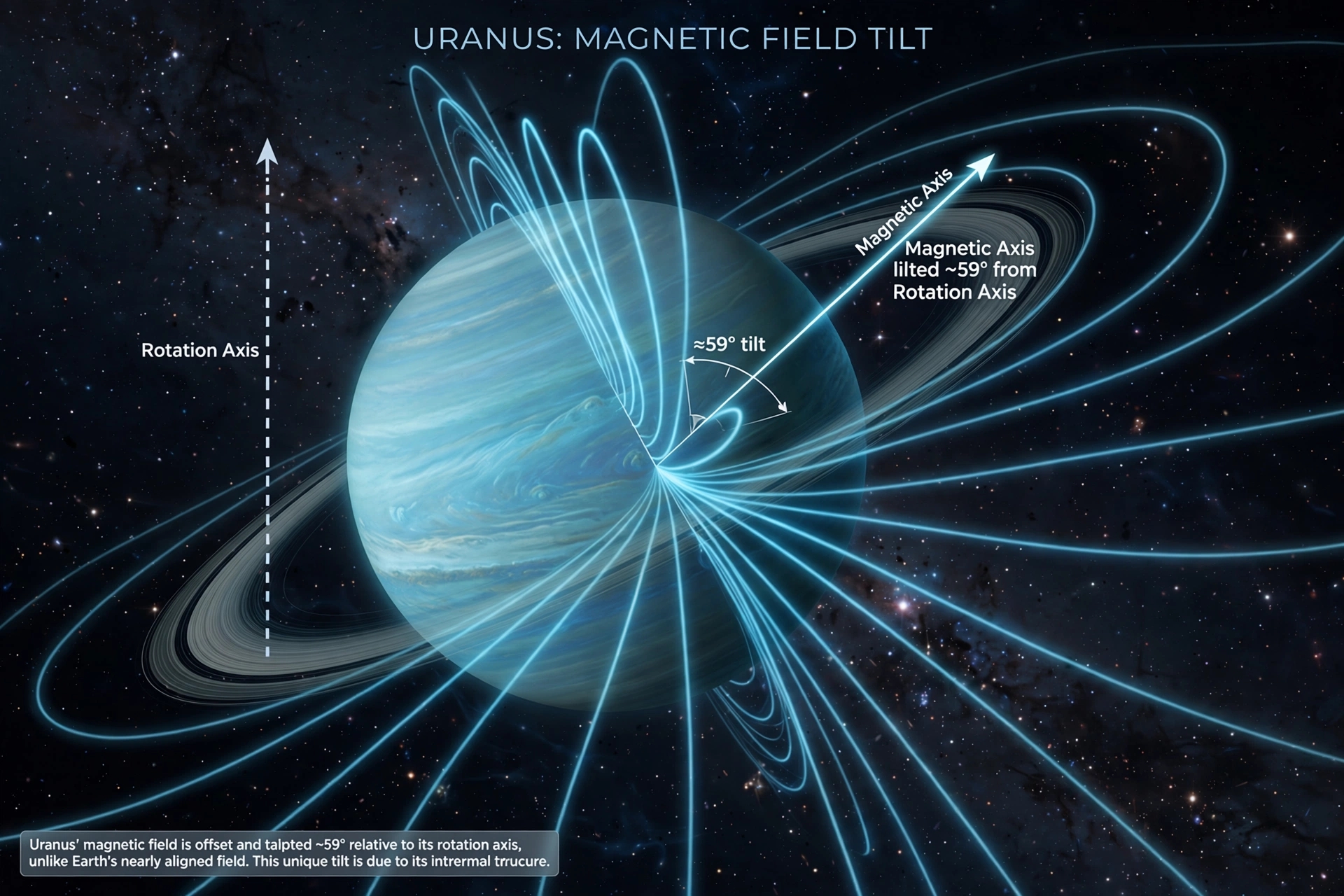
In the 1980s, Voyager 2 provided the first close-up images of Uranus and Neptune, uncovering magnetic fields that defied conventional understanding. Unlike Earth's orderly dipole, Uranus' magnetic field is tilted at an astonishing fifty-nine degrees from its rotational axis, while Neptune's is tilted forty-seven degrees. These peculiarities have puzzled scientists for decades, prompting further investigation into the underlying mechanisms that govern these distant worlds.
The recent study, led by Chi Yan at the University of Texas at Austin, utilized advanced computer simulations to explore how electrical conductivity varies with depth within the ice giants. The research indicates that under the extreme conditions present in their interiors, water molecules can dissociate into ions, resulting in increased conductivity as one delves deeper. This layered conductivity, combined with the planets' rotation and fluid dynamics, may account for the unusual magnetic fields observed by Voyager 2.
One of the most striking implications of this research is its impact on our understanding of time and magnetic field stability. While Earth's magnetic tilt changes gradually—approximately one degree over fifty years—the simulations suggest that the ice giants could experience dramatic shifts in their magnetic orientation, with some models indicating swings of tens of degrees within mere decades. This raises the possibility that the snapshot captured by Voyager 2 may no longer represent the current state of these planets, highlighting the dynamic nature of their magnetic environments.
The findings also underscore the limitations of our current knowledge. Voyager 2 remains the only spacecraft to have visited Uranus and Neptune, and the data it collected is now over three decades old. The James Webb Space Telescope is currently observing the auroras of these planets, which may provide additional insights into any changes in their magnetic fields since the 1980s. However, as the researchers emphasize, a comprehensive understanding of the ice giants' interiors will necessitate new exploratory missions—endeavors that have been proposed but remain unfunded.
The mystery surrounding the magnetic fields of Uranus and Neptune serves as a reminder of the vast unknowns that still exist within our solar system. While Earth's magnetic field is a reliable guide, the ice giants present a more complex and less understood reality. Their magnetic behaviors challenge our perceptions and remind us that even in the familiar realm of planetary science, there is still much to learn about the forces that shape our universe.
AI Image Disclaimer: The images accompanying this article are AI-generated illustrations and do not depict actual spacecraft imagery.
Published by Banx Network. This article is part of the Banx decentralized media programme, powered by the BXE token on the XRP Ledger.