Key Highlights
- Yellowstone National Park is home to a supervolcano that has produced some of the largest eruptions in Earth's history.
- The last major eruption occurred approximately 631,000 years ago, with the most recent volcanic activity being a lava flow 70,000 years ago.
- Scientists continuously monitor Yellowstone to distinguish between normal geological activity and signs of a potential supereruption.
[The Supervolcano Beneath Yellowstone]
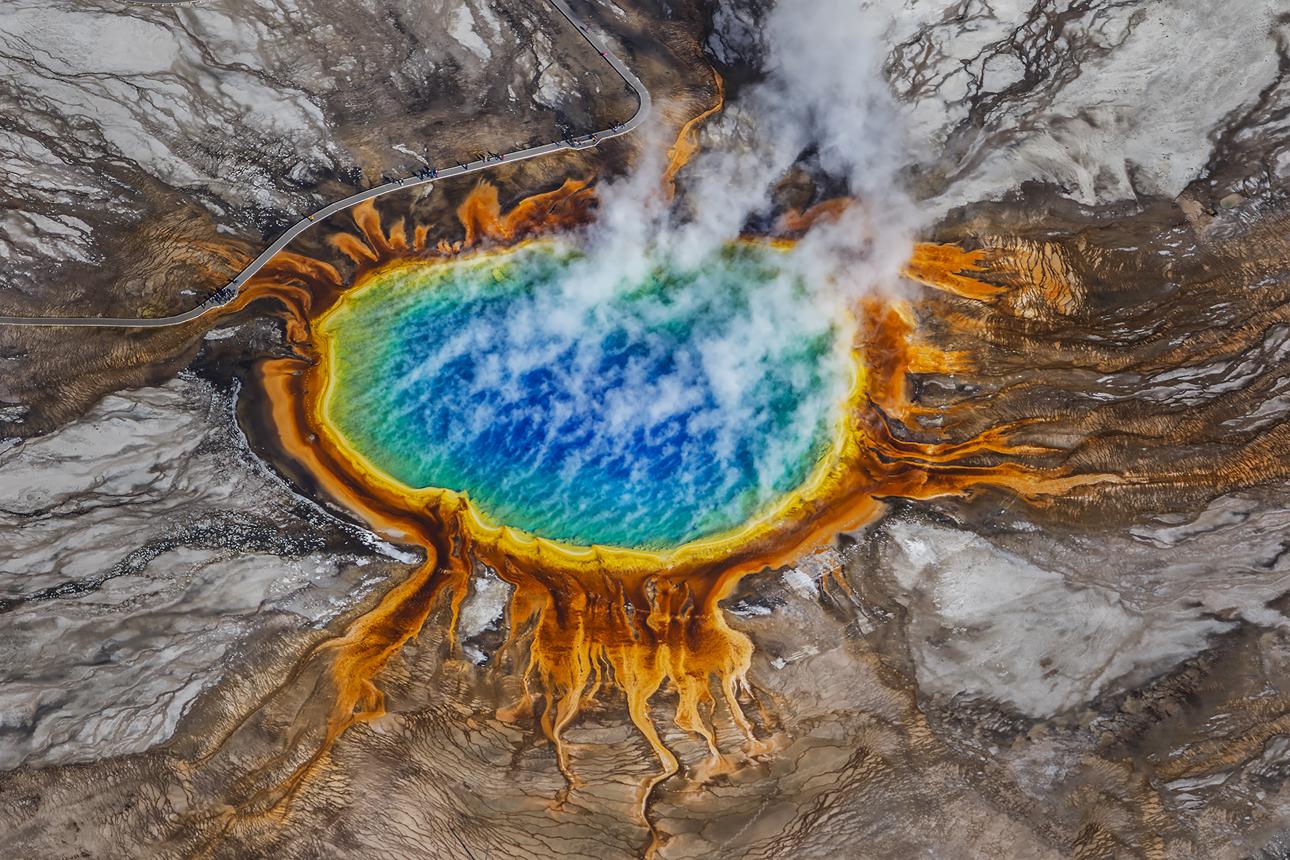
Yellowstone National Park is renowned for its stunning geysers, hot springs, and diverse wildlife. However, beneath its picturesque surface lies a powerful geological feature: an active volcanic system known as a supervolcano. This term refers to a volcanic center that has produced an eruption of magnitude 8 on the Volcanic Explosivity Index (VEI), releasing over 1,000 cubic kilometers of volcanic material. Such eruptions are exceedingly rare and can have far-reaching effects on the environment and climate.
The Yellowstone supervolcano is associated with a hotspot, where molten material from deep within the Earth contributes to volcanic activity. As the North American tectonic plate moves over this hotspot, it has left a geological trail across parts of the western United States, resulting in the formation of an extensive volcanic system beneath Yellowstone.
Despite the presence of a supervolcano, experts emphasize that a catastrophic eruption is not imminent. The United States Geological Survey (USGS) continuously monitors the area, distinguishing between normal geological activity and the unusual conditions that would indicate a major eruption is developing. This monitoring is crucial for understanding the volcano's behavior and potential risks.
[Yellowstone's Three Enormous Eruptions]
Yellowstone's notoriety stems from three significant explosive eruptions that occurred over the past 2.1 million years. The first major eruption, approximately 2.1 million years ago, created the Huckleberry Ridge Tuff and released an immense volume of volcanic material. The second eruption occurred around 1.3 million years ago, forming the Henry's Fork Caldera, followed by the third eruption about 631,000 years ago, which created the Yellowstone Caldera itself.
These eruptions were so powerful that they deposited volcanic material across vast regions of North America. A caldera forms when a substantial quantity of magma is removed from an underground reservoir, causing the ground above to collapse and create a large depression. Today, Yellowstone's caldera measures approximately 30 by 45 miles.
However, these three massive eruptions do not encapsulate Yellowstone's entire volcanic history. The region has experienced numerous smaller eruptions, including extensive lava flows, with the most recent volcanic activity being a lava flow approximately 70,000 years ago. This ongoing activity highlights that while Yellowstone is a supervolcano, it has not produced another supereruption in recent history.
[What Lies Beneath Yellowstone National Park?]
One of the most intriguing aspects of Yellowstone is its underground structure. Scientists have identified extensive regions of hot and partially molten rock beneath the park, which supply the heat responsible for its geothermal features. However, popular descriptions often mislead the public into thinking there is a vast lake of liquid magma directly beneath Yellowstone.
In reality, the volcanic system is complex, containing a mixture of solid rock, partially molten material, and hot fluids at varying depths. According to the USGS, the upper rhyolite magma reservoir beneath Yellowstone is estimated to be only around 5–15% molten, with much of the remaining material being solid but extremely hot. This distinction is crucial, as the existence of a large underground volcanic system does not guarantee that there is enough liquid magma available to trigger a supereruption.
Researchers utilize seismic imaging, geological surveys, and measurements of ground movement to investigate these underground structures. As scientific understanding continues to evolve, monitoring efforts remain vital to assess the potential risks associated with Yellowstone's supervolcano.
Published by Banx Network. This article is part of the Banx decentralized media programme, powered by the BXE token on the XRP Ledger.