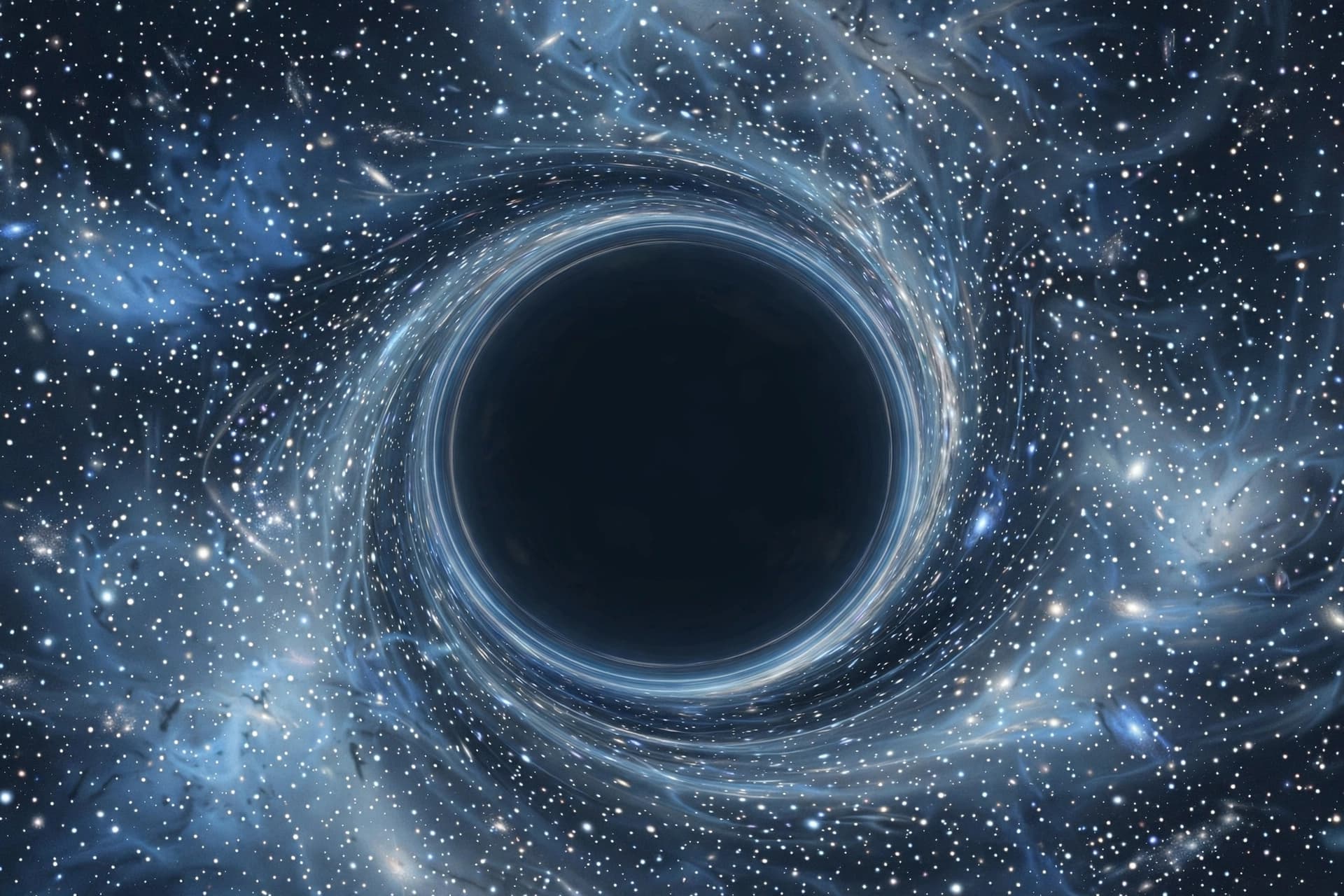
There is a particular kind of loneliness to a black hole that drifts alone through the galaxy—invisible, silent, unseen by any telescope. It does not devour stars or emit X-rays. It simply exists, bending the light of distant suns as it passes, leaving behind a signature so faint that only the most patient eyes can find it. And now, scientists are asking for your help.
According to stellar evolution models, the Milky Way should contain hundreds of millions of black holes. So far, astronomers have confirmed only about 70 . Most are invisible because they are not actively feeding on nearby matter; they are solitary wanderers, detectable only through the subtle distortion of light predicted by Einstein's theory of general relativity.
The phenomenon is called gravitational self-lensing. When a black hole orbits a companion star that it is not actively consuming, its gravity bends the star's light in a repeating pattern—a periodic brightening that can be detected if you know what to look for . The Black Hole Hunters project, a citizen science initiative from the University of Southampton, is searching for exactly that signature.
The project originally used data from the SuperWASP survey, but ground-based observations were too noisy and interrupted by weather. Dr. Adam McMaster, who leads the project, moved to NASA's TESS space telescope, which captures light curves of hundreds of thousands of stars every few minutes—a dataset perfectly suited to the search . A machine learning algorithm now classifies these light curves into “interesting” and “boring” categories, filtering millions of possibilities in days rather than decades . But the AI can be fooled by sunspots, pulsating variables, and instrumental glitches. The final determination requires human eyes.
That is where volunteers come in. The task is simple pattern recognition—no astronomy degree required. “The data's easy to understand, it's just pattern recognition, and you don't need a degree in astronomy to read it,” said Grace Clarke, a 20-year-old physics student and project volunteer . Participants examine graphs and animations, flagging anything that catches their eye.
So far, nearly 23,000 volunteers have contributed almost 12 million classifications since October 2021. The project is about 43 percent complete . The goal is to identify promising targets for follow-up observations with more advanced telescopes.
Dr. McMaster put the opportunity plainly: “You'll be narrowing down precisely where we need to point our telescopes next and you might be the one to discover a black hole” . In a galaxy of hundreds of millions of invisible objects, the next discovery might come not from a professional observatory, but from someone sitting at a laptop, looking at a graph, and noticing something that no one else has seen.
AI Image Disclaimer: The images accompanying this article are generated by artificial intelligence and are intended for illustrative purposes only.
Sources: Universe Today, Daily Echo, Mirage News, Overclockers.ru, BBC Sky at Night Magazine
Published by Banx Network. This article is part of the Banx decentralized media programme, powered by the BXE token on the XRP Ledger.