There is a cloud on Mars that appears every morning, stretches longer than the distance between New York and Miami, and then vanishes by noon. It has puzzled scientists since its discovery in 2018, and attempts to model it consistently failed. Now, researchers say the cloud can only be explained by a process that, while described in textbooks, has never before been observed in any planetary atmosphere.
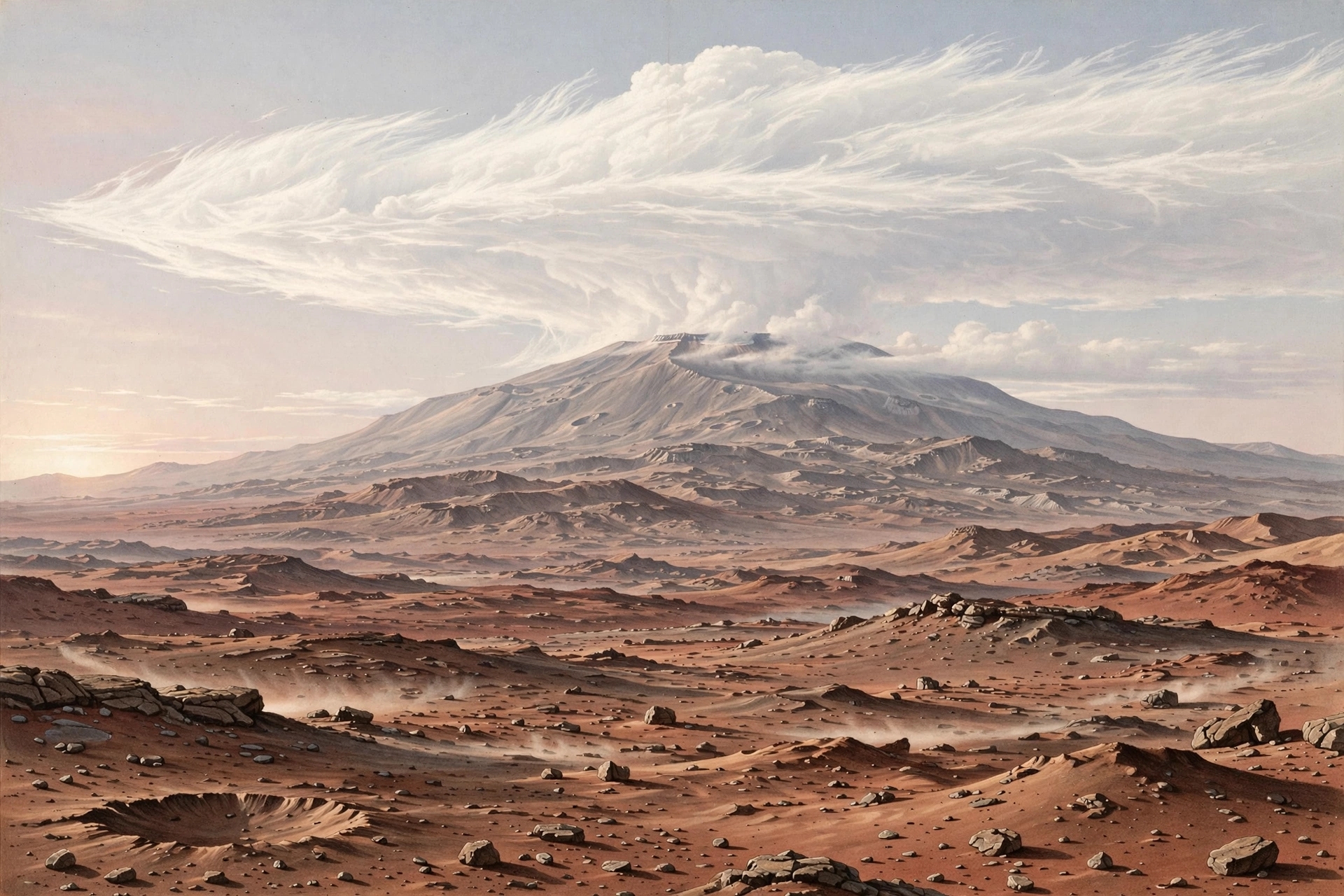
The Arsia Mons Elongated Cloud, or AMEC, forms downwind of Arsia Mons, a volcano more than twice the height of Mount Everest. It emerges at dawn, grows to over 1,800 kilometers in length, and evaporates within hours as the sun warms the air. This cycle repeats nearly every morning during Mars’s spring and summer .
On Earth, clouds form when water vapor condenses around tiny particles—dust, pollen, salt, or soot. This is called heterogeneous nucleation, and it is the standard mechanism for cloud formation on both Earth and Mars. But when researchers tried to model the AMEC using this process, the simulations simply did not match what the Mars Express spacecraft observed .
The breakthrough came when the team included a different kind of physics: homogeneous nucleation, in which water vapor freezes directly into ice crystals without any particle to cling to. “It’s akin to droplets of condensation appearing in the middle of a room, rather than on a window,” said lead author Jorge Hernández-Bernal of LMD/CNRS/Sorbonne Université. “We call this homogeneous nucleation, and we’ve never seen it before in a planetary atmosphere. It’s wholly unexpected” .
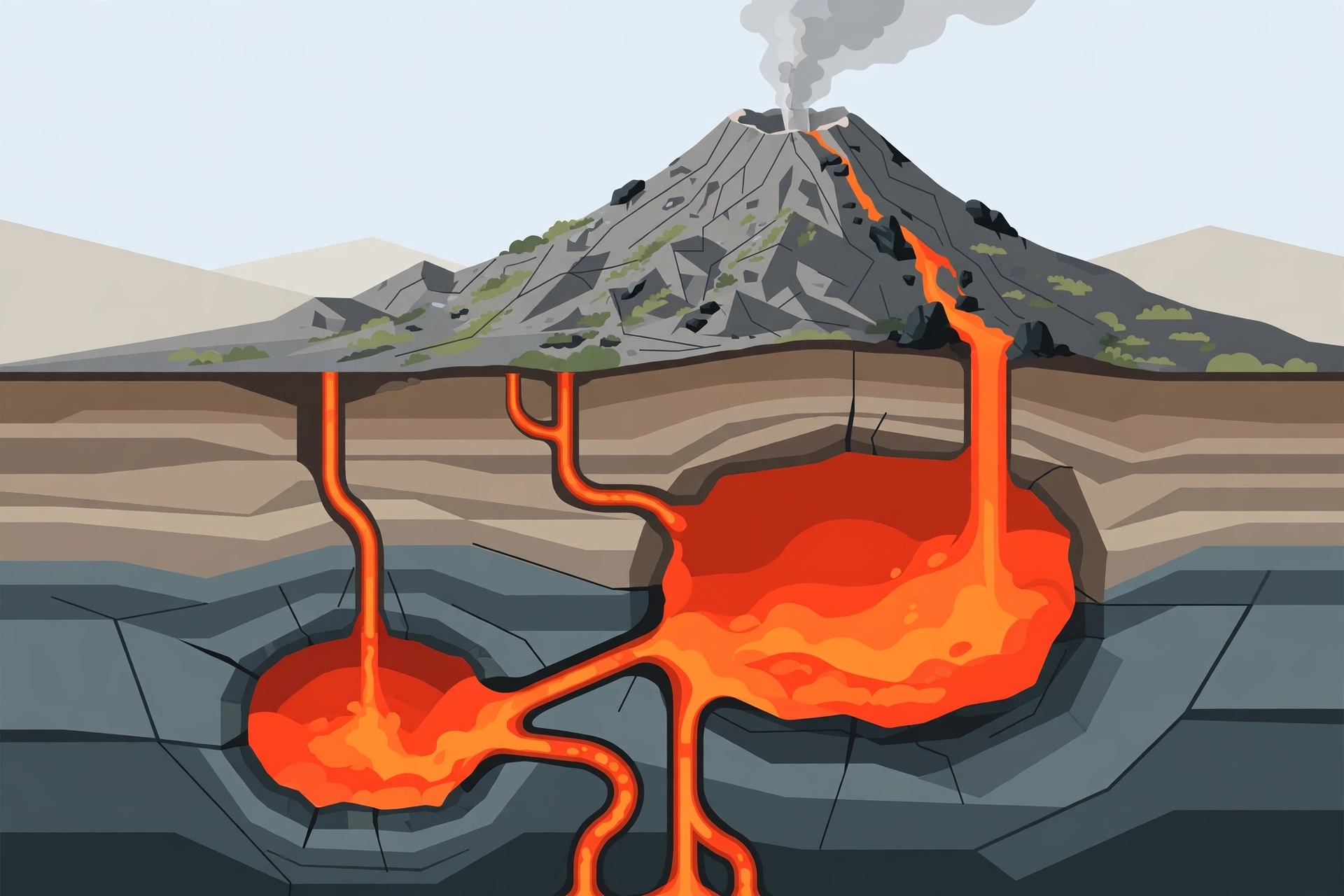
The process requires extreme conditions—humidity levels more than 100,000 times those typically found on Earth . The unique geometry of Arsia Mons makes this possible. As winds flow past the volcano, they trigger a powerful wave that lifts moist air several kilometers in just a few minutes. Temperatures plummet by as much as 30 degrees Celsius in ten minutes, causing water vapor to spontaneously freeze directly into cloud particles .
“Once we included this physics in our simulations, the AMEC emerged just as we hoped,” Hernández-Bernal said . The finding has implications beyond Mars. Scientists have theorized that homogeneous nucleation could occur in the upper atmospheres of Earth and Venus, but it has never been directly observed. The AMEC suggests that planetary atmospheres may be capable of processes previously considered too unlikely to matter .
The research, published in Nature Geoscience, offers a reminder that even within our own solar system, the rules can bend in unexpected ways. The cloud appears every morning, reliable as a clock, and yet its existence depends on conditions so extreme they exist nowhere else we have looked. Mars, it seems, still has the capacity to surprise us.
AI Image Disclaimer: The images accompanying this article are generated by artificial intelligence and are intended for illustrative purposes only.
Sources: European Space Agency, Nature Geoscience, The Independent, Yahoo News, Nautilus, bdnews24.com
Published by Banx Network. This article is part of the Banx decentralized media programme, powered by the BXE token on the XRP Ledger.