There is a strange and unintended collaboration unfolding on the Antarctic Peninsula—a partnership between birds, algae, and the slow arithmetic of a warming world. The penguins, waddling across the snow, are not trying to change the climate. They are simply living, tracking their guano behind them, unaware that their waste is feeding something that will, in turn, accelerate the melting of the ice beneath their feet.
A new study published in the Journal of Geophysical Research: Biogeosciences has revealed a direct link between penguin guano and the color of snow algae, a relationship that carries significant implications for how quickly Antarctica's coastal snowpack is disappearing . The research, led by Alia Khan of the University of Colorado Boulder and her team, focused on the West Antarctic Peninsula, where snow algae blooms are expanding as temperatures rise.
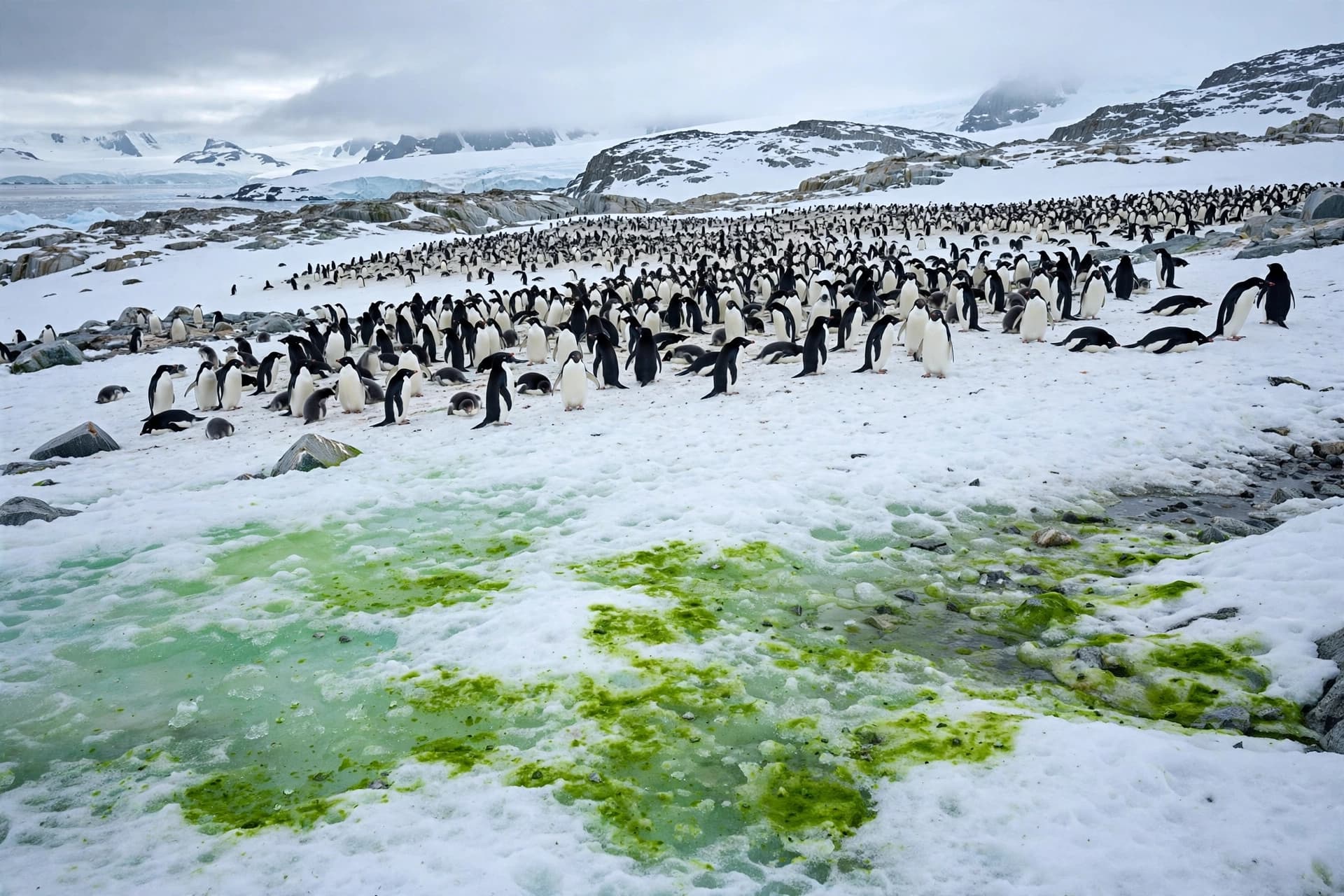
The science is elegant in its simplicity. Snow algae exists in two distinct phases. When nutrients are abundant, the algae produces green pigments like chlorophyll, racing to photosynthesize during the short Antarctic summer. When nutrients are scarce, it hunkers down, producing red, sunscreen-like pigments to protect itself while growth pauses . The researchers found that green algae blooms were concentrated near penguin colonies, where guano provides a rich supply of phosphate—a critical nutrient .
The consequences of this color shift are profound. Clean, white snow reflects most of the sun's energy. Red snow absorbs about 20 percent more energy than clean snow. But green snow—the kind fueled by penguin poop—absorbs 40 percent more, twice the increase of red snow . That extra energy heats the snow, causing it to melt faster, which in turn creates more habitat for algae, which darkens the surface further, which causes more melting. It is a feedback loop written in pigment and phosphate.
“The link between wildlife, nutrients, and snow algae is a critical missing component in projections of expansion of ice-free areas in Antarctica,” Khan said. “Without accounting for these biological darkening effects, we are likely underestimating how rapidly coastal snowpacks are melting” .
The fieldwork required to establish this link was not glamorous. Traveling by boat across the notoriously rough Drake Passage, the team collected over 100 snow samples, some near penguin colonies where the birds were “waddling around in their poop and tracking it all over the snow” . In the lab, microscopic analysis confirmed that samples with predominantly green algae had far more phosphate than those with red algae—phosphate that could only have come from guano.
As penguins move further south in response to changing conditions, the researchers warn, this guano-fertilized greening could spread, carrying its melt-enhancing effects to new areas . The projections of Antarctic melting that guide global climate policy do not yet account for this phenomenon. The penguins, in their quiet way, are writing themselves into the climate story—not as victims, but as participants in a process no one intended.
AI Image Disclaimer: The images accompanying this article are generated by artificial intelligence and are intended for illustrative purposes only.
Sources: AGU Newsroom, EurekAlert, Scimex, Phys.org, Journal of Geophysical Research: Biogeosciences
Published by Banx Network. This article is part of the Banx decentralized media programme, powered by the BXE token on the XRP Ledger.