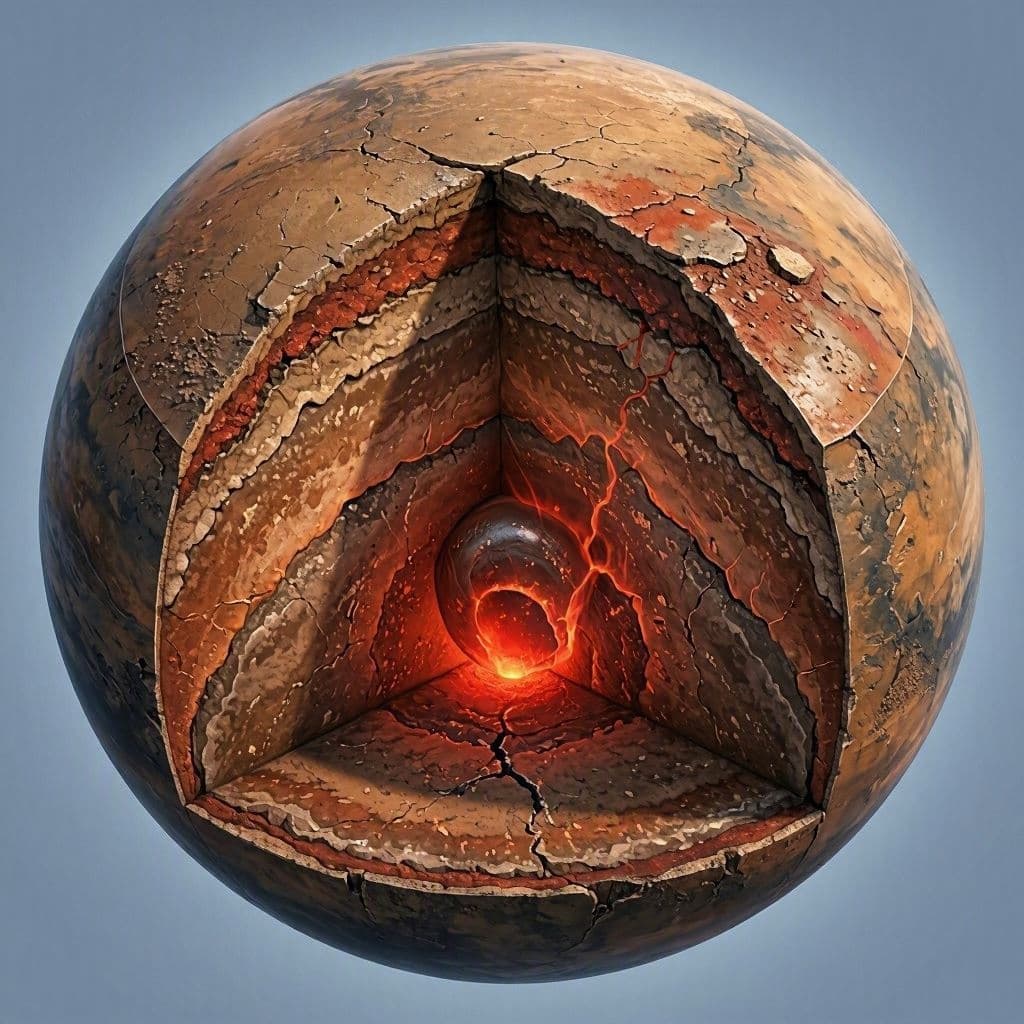
Beneath the rust-colored surface of Mars, a secret has long been kept hidden from view. For decades, we have looked at the Red Planet as a cold, dormant world, its history written in craters and dust. Yet, recent discoveries suggest that deep within its southern hemisphere, a warmth persists, hinting at a dynamic interior that defies our expectations of a dead planet. It is a reminder that even in silence, there is activity.
Using advanced gravitational data and seismic analysis, researchers have identified a significant thermal anomaly beneath the Martian crust. This region, located in the southern hemisphere, appears to be hundreds of degrees hotter than the surrounding mantle. The discovery challenges the conventional view that Mars cooled uniformly after its formation, suggesting instead a complex and uneven thermal history.
The temperature difference, estimated to be between 200 and 400 degrees Celsius, is substantial enough to influence the planet’s geological structure. This heat may be responsible for the distinct dichotomy between the northern lowlands and the southern highlands, a feature that has puzzled scientists for years. It suggests that internal forces continue to shape the planet, albeit slowly and subtly.
This finding adds a new layer to our understanding of planetary evolution. If Mars retains such heat, it implies that its core may still be active or that residual heat from its violent formation is trapped in specific regions. This could have implications for the potential of past or present subsurface water, as heat sources can maintain liquid reservoirs deep underground.
The methods used to detect this anomaly highlight the ingenuity of modern space science. Without direct access to the deep interior, scientists rely on indirect measurements, piecing together clues from gravity fields and seismic waves. It is a detective story played out on a planetary scale, requiring patience and precise interpretation of faint signals.
Such discoveries also inform our search for life. While the surface of Mars is harsh and irradiated, subsurface environments warmed by internal heat could offer more hospitable conditions. The presence of a thermal anomaly raises questions about whether niche environments exist where microbial life could have survived or even thrived.
As we prepare for future missions to Mars, this knowledge will be invaluable. Understanding the thermal structure of the planet helps in selecting landing sites and designing instruments capable of probing deeper. It shifts our focus from merely observing the surface to exploring the hidden depths that hold the key to Mars’s past.
The revelation of this heat anomaly invites us to reconsider Mars not as a static relic, but as a world with a lingering pulse. It is a gentle nudge from the cosmos, reminding us that there is always more to learn, and that even in the coldest places, warmth can be found if we look closely enough.
AI Image Disclaimer: The images associated with this piece are AI-generated artistic interpretations of Martian subsurface structures and do not represent actual photographic evidence from Mars rovers.
Sources: ScienceDaily, Space.com, Caltech, Phys.org
Published by Banx Network. This article is part of the Banx decentralized media programme, powered by the BXE token on the XRP Ledger.