In the quiet hum of subterranean laboratories, far removed from the chaotic noise of daily life, scientists have managed to capture a whisper from the beginning of time. It is a delicate endeavor, akin to trying to hear a single note in a symphony that ended billions of years ago, yet it represents one of humanity’s most profound attempts to understand its own cosmic ancestry. By recreating the conditions of the universe’s first moments, researchers are not just observing physics; they are touching the very fabric of existence.
At the heart of this exploration lies the Large Hadron Collider, a marvel of modern engineering that serves as a time machine of sorts. Here, particles are accelerated to speeds that defy common sense, colliding with such force that they briefly melt into a state of matter known as quark-gluon plasma. This primordial soup, which filled the universe microseconds after the Big Bang, has now been created in smaller and more precise quantities than ever before, offering a clearer window into the past.
The recent experiments have pushed the boundaries of what was thought possible, generating these tiny droplets of early-universe matter using surprisingly small atomic nuclei. It is a testament to the precision of contemporary science that such fleeting states can be captured and studied. The data gathered from these collisions suggests that the transition from pure energy to matter was more complex and nuanced than previous models had predicted.
These findings challenge our understanding of the threshold required to create such extreme conditions. For years, it was believed that only massive collisions could produce the necessary heat and density. However, the new results indicate that even smaller interactions can yield significant insights, suggesting that the early universe may have been more turbulent and varied in its formation than we once imagined.
The implications of this research extend beyond theoretical physics. Understanding how matter coalesced from the initial explosion helps explain why the universe looks the way it does today. It provides context for the formation of stars, galaxies, and eventually, the planets that harbor life. Each collision in the collider is a small step toward answering the ancient question of where we came from.
Moreover, this work highlights the collaborative nature of scientific discovery. Teams from around the world work in unison, analyzing terabytes of data to find patterns in the chaos. It is a slow, meticulous process that requires patience and humility, reminding us that knowledge is often gained in increments rather than sudden leaps.
As we look at these microscopic recreations of the Big Bang, we are reminded of the vastness of the unknown. Yet, there is comfort in the pursuit itself. The desire to understand our origins is a deeply human trait, one that connects us across cultures and generations. In studying the smallest pieces of the universe, we find reflections of our own curiosity and resilience.
While the answers remain partial, the journey continues with quiet determination. The creation of the "littlest big bang" is not just a technical achievement but a philosophical milestone, inviting us to reflect on our place in the cosmos with a sense of wonder and respect for the intricate dance of matter and energy that defines our reality.
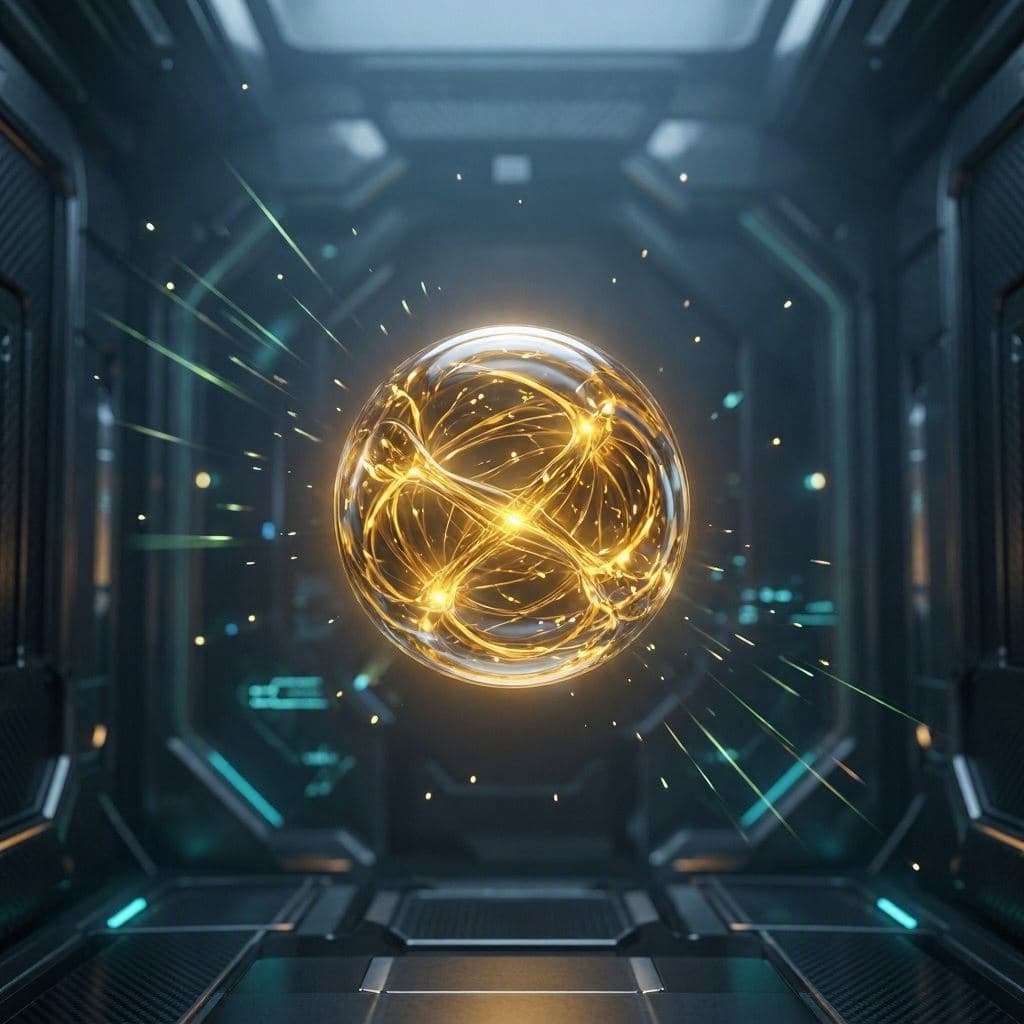
AI Image Disclaimer: Please note that any accompanying visuals for this article are AI-generated illustrations designed to represent abstract scientific concepts and are not actual photographs of the experimental data.
Sources: Wired, ScienceDaily, EurekAlert, CERN
Published by Banx Network. This article is part of the Banx decentralized media programme, powered by the BXE token on the XRP Ledger.