1. A Narrow Strait With Global Consequences
Some of the world's most important economic events do not begin on stock exchanges, in government offices or inside the headquarters of multinational corporations. Sometimes, they begin at sea.
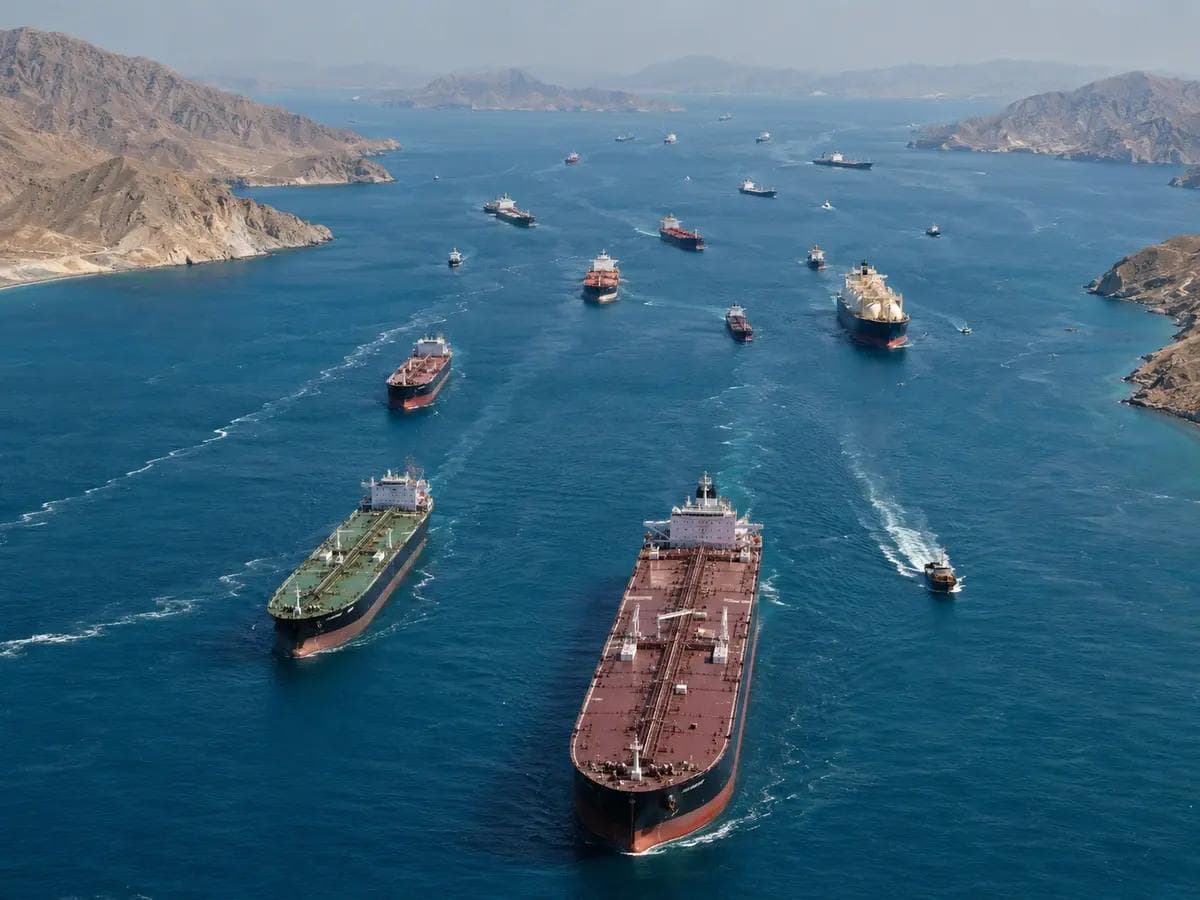
The Strait of Hormuz is a narrow maritime passage connecting the Persian Gulf to the Gulf of Oman and the Arabian Sea. It sits between Iran and the Musandam Peninsula, part of Oman, and serves as a major route for energy exports from the Middle East.
Its geographical importance is difficult to overstate. In 2025, approximately 20 million barrels of oil and petroleum products passed through the strait each day, representing around one-fifth of global oil consumption and roughly one-quarter of seaborne oil trade, according to the International Energy Agency (IEA) [1].
That makes the waterway more than a regional shipping route. It is a vital connection between major energy producers and the countries that depend on their exports.
In October 2026, the escalating war involving Iran, the United States and Israel has brought this vulnerability into sharp focus. Shipping movements have been severely disrupted, attacks on vessels have intensified, and concerns about energy availability have spread across international markets [2].
The crisis demonstrates how a conflict in one region can influence the cost of transportation, manufacturing, food production and everyday living around the world.
2. What Is the Strait of Hormuz?
The Strait of Hormuz is approximately 39 kilometres wide at its narrowest point. However, the navigable shipping channels used by large commercial vessels occupy only a fraction of that width [1].
This creates a strategic bottleneck. Oil tankers cannot simply travel wherever they choose through the surrounding waters. They must use designated routes capable of accommodating large vessels while navigating geographical and security constraints.
Several major energy exporters depend on this passage, including Saudi Arabia, Iraq, Kuwait, Qatar, the United Arab Emirates and Iran.
For many of these countries, the strait provides the principal maritime route connecting their Persian Gulf export terminals with international markets.
The consequences extend beyond crude oil. Large volumes of refined petroleum products and liquefied natural gas, or LNG, also travel through the waterway. Qatar is a particularly important LNG exporter, supplying customers that use natural gas for electricity generation, industrial production and heating.
Alternative pipelines can redirect some oil exports, but their capacity is insufficient to replace all the shipments normally carried through Hormuz [1].
Consequently, a serious disruption can affect multiple energy markets simultaneously.
3. How the Conflict Became a Global Economic Problem
The current crisis is part of a wider military confrontation involving Iran, the United States and Israel that began in February 2026, according to reporting by Reuters [2].
As the conflict developed, maritime security deteriorated. Attacks and threats involving commercial vessels increased, while military operations and restrictions on shipping complicated the movement of goods through the region.
On 11 October, Reuters reported that the US military had disabled a commercial cargo vessel in the Gulf of Oman after it allegedly ignored warnings while attempting to breach a naval blockade against Iran. The incident illustrated the growing risks facing commercial shipping in waters surrounding the strait [2].
For shipowners, the immediate question is no longer simply whether a voyage is profitable. It is whether the cargo, vessel and crew can complete the journey safely.
An oil tanker may be physically capable of crossing the strait, yet its operator may decide that the danger, insurance premiums and potential delays make the journey commercially unacceptable.
This is how a military confrontation can become an economic shock. Even without the complete physical destruction of energy infrastructure, the threat of disruption can reduce the volume of goods that companies are willing or able to transport.
4. Why Oil Prices Respond So Quickly
Oil is traded in an interconnected international market. Prices are influenced not only by how much oil is being produced, but also by how much is available for delivery, where it can be delivered and how much it costs to transport.
When a major shipping route becomes unreliable, traders must account for the possibility that fewer barrels will reach refineries and consumers.
That uncertainty can push prices higher before a physical shortage becomes visible at petrol stations.
The IEA has described the 2026 disruption to Middle Eastern energy supplies as an exceptionally severe shock to the global oil market. Its analysis highlights the consequences of sharply reduced traffic through Hormuz and the resulting pressure on crude oil and refined fuel prices [3].
The effect can spread rapidly. Higher crude oil prices influence the cost of producing petrol, diesel, jet fuel, plastics and numerous industrial chemicals.
However, crude oil prices do not translate into identical or immediate increases in every consumer price. Refinery capacity, existing inventories, government taxes, exchange rates, distribution costs and local competition all affect what households ultimately pay.
The central risk is that sustained disruption keeps energy costs elevated long enough to affect a much wider range of economic activity.
5. The Impact on Petrol and Diesel
For ordinary households, fuel is one of the most visible ways an international energy crisis can affect everyday life.
When wholesale fuel costs rise, retailers may eventually pass some of the increase on to motorists. The timing and size of that increase vary by country and supplier.
Diesel is particularly important because it powers much of the commercial transport sector, including heavy goods vehicles, agricultural machinery and numerous industrial operations.
If diesel becomes significantly more expensive, the cost of moving food, building materials, retail stock and manufactured products can rise.
Businesses may initially absorb some of these expenses. Over time, however, companies facing persistent pressure on their margins may raise prices, reduce investment or cut other costs.
For households already dealing with high living expenses, higher fuel prices can reduce the money available for other purchases.
The impact is uneven. People who depend on cars for work or live in areas with limited public transport may be more exposed than those who can travel by bus, train, bicycle or on foot.
A crisis thousands of miles away can therefore create very different financial pressures depending on where someone lives and how they earn and spend their money.
6. Why the United Kingdom Is Not Completely Insulated
The United Kingdom does not rely exclusively on oil shipped through the Strait of Hormuz. Its energy system draws on a mixture of domestic production, pipeline imports, international shipments and other sources.
Nevertheless, the UK operates within a global market. It cannot completely avoid international price movements simply because some of its energy supplies come from elsewhere.
If disruptions reduce the availability of oil in one part of the world, buyers may compete more aggressively for supplies from alternative producers. That competition can influence prices across multiple regions.
The same principle applies to refined fuels and other petroleum products, where supply chains and trading relationships cross national borders.
For British households, the effects could include more expensive petrol and diesel, higher transport costs and additional pressure on businesses that use energy-intensive equipment.
Inflation is another potential concern. If companies repeatedly face higher energy and distribution costs, they may pass those increases on to consumers.
The Bank of England's response to such a shock would depend on its duration, the strength of underlying inflation and the broader economic outlook. Higher energy prices do not automatically require a particular interest-rate decision, but they can complicate efforts to maintain price stability.
The ultimate impact on Britain would depend on how long the disruption lasts and how successfully alternative supplies and shipping arrangements compensate for lost flows.
7. Asia Could Face Especially Significant Exposure
Although the Strait of Hormuz matters to the entire world, its importance is particularly pronounced for Asian energy markets.
The IEA estimates that around 80% of the oil transported through the strait is destined for Asian markets, with China, India, Japan and South Korea among the major destinations [1].
These economies have different energy systems and levels of domestic production, but many rely heavily on imported fuels to support transport, electricity generation and manufacturing.
A prolonged disruption could force importers to seek supplies from alternative producers, compete with other buyers and draw more heavily on stored reserves.
The consequences could extend to industrial production and international trade. Higher energy prices can raise manufacturing costs, while shortages of particular fuels may force some businesses to adjust operations.
Countries with greater financial resources and diversified energy supplies may be better positioned to manage the disruption. Others may have less room to absorb higher import bills without putting pressure on their currencies, public finances or consumers.
The crisis therefore has the potential to widen economic differences between countries that can adapt relatively easily and those that are more dependent on uninterrupted energy imports.
8. Natural Gas: The Other Energy Vulnerability
Oil receives much of the attention during a crisis in the Strait of Hormuz, but natural gas is also important.
Liquefied natural gas is cooled into liquid form so it can be transported by specialised vessels. After arriving at its destination, it is converted back into gas for use by power stations, industrial facilities and other consumers.
Qatar is one of the world's major LNG exporters, and its shipments normally depend heavily on the Strait of Hormuz.
The IEA estimates that Qatar and the United Arab Emirates account for a substantial share of global LNG trade moving through the waterway [1].
Disruption can therefore affect countries that use imported LNG to support their electricity systems and industries.
If fewer cargoes become available, buyers may compete for shipments from other exporters. That can increase prices and redirect supplies away from other markets.
Natural gas is also an important input for the production of ammonia-based fertilisers. Higher gas prices can therefore influence agricultural costs, creating another possible link between the energy crisis and food prices.
The extent of the impact depends on the scale and duration of disruption, available inventories, alternative export capacity and the ability of consumers to reduce demand.
9. How an Energy Crisis Can Become a Food Crisis
Food production depends on energy at almost every stage.
Farmers use diesel to operate tractors and harvesting equipment. Food processors require electricity and fuel. Refrigerated warehouses consume energy, and lorries, ships and other vehicles transport goods from farms and factories to shops.
Fertilisers add another important connection. Natural gas is a major feedstock for producing ammonia, which is used in many nitrogen fertilisers.
If the cost or availability of natural gas deteriorates, fertiliser manufacturers may face higher production expenses. Some may reduce output if operating costs become too high.
Farmers who subsequently pay more for fertilisers, fuel and transport may face difficult choices: absorb the expenses, reduce the amount they apply, change crops or raise their prices where possible.
These effects do not happen uniformly or instantly. Agricultural inventories, planting seasons, government support and regional weather conditions all influence the outcome.
However, a prolonged energy shock can create pressure throughout the food supply chain.
For lower-income households, the consequences may be especially serious because food and essential transport often account for a larger proportion of their budgets.
10. Shipping Insurance and the Cost of Moving Goods
Even when ships continue operating, a dangerous maritime environment can make each voyage considerably more expensive.
Shipping companies must consider the possibility of vessel damage, cargo loss, crew injury, delays and changes to their planned routes.
Insurers assess these risks when pricing cover for vessels travelling through conflict-affected areas. When perceived danger increases, war-risk insurance can become more expensive or difficult to obtain.
Shipowners may also demand higher freight rates to compensate for additional risks and operating costs.
Some companies may reroute vessels, wait for improved security conditions or suspend services altogether.
These decisions can affect the delivery of much more than oil. Commercial shipping carries food, chemicals, manufactured goods, industrial equipment and other products needed by businesses and consumers.
When freight costs rise, importers may face higher expenses. If the disruption persists, those costs can spread through distribution networks and contribute to higher prices.
The crisis illustrates an important point about globalisation: efficient international trade depends on reliable transport links, and the loss of reliability can be costly even when the goods themselves remain available.
11. Can Oil Reach Global Markets Through Alternative Routes?
Countries and energy companies are not entirely without options.
Saudi Arabia and the United Arab Emirates have pipelines that can redirect some oil exports away from the Strait of Hormuz. These routes can reduce dependence on the waterway and help maintain a portion of regional supply during a disruption [1].
However, pipelines have finite capacity. Their usefulness also depends on the location of production facilities, available infrastructure, export terminals and the condition of alternative shipping routes.
Even if oil can reach a different port, tankers must still transport it to refineries and customers. That can introduce additional logistical costs and delays.
Building new pipelines or export terminals is not a rapid solution. Major energy infrastructure projects require investment, planning, construction and security arrangements.
Alternative routes should therefore be understood as a way to reduce vulnerability, not as a guarantee that the entire volume normally carried through Hormuz can be replaced.
The lesson for energy planners is that redundancy matters. Multiple routes and suppliers can make a system more resilient, but meaningful diversification takes time and money.
12. Can Strategic Oil Reserves Prevent a Crisis?
Governments maintain emergency petroleum reserves to help respond to severe supply disruptions.
These reserves can be released into the market when supplies become constrained, potentially easing shortages and reducing immediate pressure on prices.
International coordination can make such measures more effective, particularly when several countries face the same disruption.
However, reserves are a temporary buffer rather than a permanent replacement for normal production and transport.
Their usefulness depends on how much oil is available, how quickly it can be released, the type of fuel required and whether infrastructure can deliver it to the places that need it.
A prolonged crisis can also exhaust the most accessible supplies, leaving governments with fewer options if conditions deteriorate further.
Emergency releases cannot indefinitely replace millions of barrels of daily shipments if the underlying disruption continues.
For that reason, reserve management must be combined with other responses, including alternative supply arrangements, demand reduction and efforts to restore reliable maritime trade.
13. The Inflation Dilemma for Central Banks
An energy shock creates a difficult challenge for central banks.
When fuel and electricity prices rise, headline inflation can increase even if demand across the wider economy is weakening.
Central banks cannot directly produce more oil or reopen a shipping route by changing interest rates. Their decisions instead influence borrowing costs, spending, investment and broader financial conditions.
If higher energy prices spread into wages, transport contracts, manufacturing costs and consumer expectations, inflation may become more persistent.
On the other hand, if households spend more on essential energy and less on other goods and services, economic growth may weaken.
Central banks must assess whether the shock is likely to be temporary or whether it threatens to influence inflation over a longer period.
Responding too aggressively to a temporary increase could unnecessarily weaken economic activity. Allowing persistent inflation to become entrenched could create a different set of problems.
There is no automatic answer. The appropriate response depends on the evidence available at the time, including inflation expectations, employment, wages, demand and the duration of the energy disruption.
14. Could the Crisis Trigger a Global Recession?
A global recession is not an inevitable consequence of a disruption in the Strait of Hormuz.
The outcome would depend on several interacting factors: the duration of the conflict, the volume of energy supplies lost, the availability of substitutes, the effectiveness of government responses and the underlying strength of the world economy.
A short-lived disruption could produce a sharp but temporary increase in energy costs, followed by a recovery as shipping normalises.
A prolonged disruption would be more difficult to manage. Sustained high energy prices could reduce household purchasing power, weaken business investment, increase transport costs and place additional pressure on already indebted governments.
Energy-importing economies could be especially vulnerable if higher import bills coincide with weak currencies or expensive borrowing.
The IMF and World Bank have warned that the conflict, energy pressures, high public debt and inflation are complicating the global economic outlook. Their annual meetings in October 2026 are taking place against this backdrop of overlapping risks [4].
Nevertheless, it is important to distinguish between a serious economic threat and a confirmed outcome. A recession would depend on the scale and persistence of the shock, not simply on the existence of the conflict.
15. The Geopolitical Stakes
The Strait of Hormuz is not only an economic asset. It is also a strategic point where military security, national sovereignty and international commerce intersect.
Iran's geographical position gives it significant influence over the waterway. Other regional states depend on its continued accessibility, while major powers have interests in protecting maritime trade and maintaining the flow of energy.
Military activity around the strait can therefore create risks beyond the immediate parties to the conflict.
Countries that depend on imported energy may face pressure to participate in diplomatic initiatives, coordinate emergency measures or strengthen maritime security.
At the same time, military escalation can increase the danger to commercial vessels and make negotiations more difficult.
The situation also highlights the difference between possessing energy resources and being able to deliver them reliably. Oil in the ground has limited immediate value to international customers if it cannot reach the market.
For governments, energy security consequently involves more than securing production. It also requires dependable infrastructure, safe transport routes, diversified suppliers and diplomatic relationships that reduce the likelihood of prolonged disruption.
16. Who Benefits From Higher Oil Prices?
An energy crisis creates costs across much of the economy, but its effects are not identical for every producer, company or country.
Oil producers operating outside the disrupted region may receive higher revenues when international prices rise, particularly if their own production and export routes remain unaffected.
However, the gains are not guaranteed. Companies may face higher operating costs, financial-market volatility, transport expenses or restrictions on their ability to increase output.
Energy-importing countries generally face a different calculation. Higher prices can increase the cost of imports and put pressure on households, businesses and government budgets.
Some energy companies may benefit from elevated prices, while refiners, airlines, shipping operators and manufacturers can face greater expenses.
Even producers within the Middle East may lose revenue if they cannot export their output reliably.
This uneven distribution of costs and benefits helps explain why governments may respond differently to the same crisis.
It also reinforces the importance of looking beyond headline oil prices. The economic impact depends on who can produce, who can transport, who must import and who ultimately pays the additional costs.
17. The Long-Term Energy Security Question
The crisis raises a fundamental question: should countries place greater emphasis on reducing their dependence on imported fossil fuels?
Diversifying energy supplies can reduce exposure to a single supplier or transport route. Governments can also invest in domestic generation, electricity networks, storage and more efficient energy use.
Renewable energy sources such as wind and solar can reduce the amount of fossil fuel required for electricity generation. Nuclear power can also provide low-carbon electricity in countries that choose to invest in it.
However, the transition is not simple. Transport, aviation, shipping, heavy industry and chemical production still depend heavily on fuels and feedstocks that cannot be replaced overnight.
Electricity systems also require dependable networks, flexible generation and storage to manage fluctuations in supply and demand.
Energy security therefore does not have one universal solution. Different countries will need different combinations of domestic resources, international trade, infrastructure and technology.
The important principle is diversification. A system with multiple reliable sources and routes is generally better positioned to withstand the loss of any single component.
18. Could This Accelerate the Transition to Electric Vehicles?
Higher oil prices can strengthen the financial case for electric vehicles by increasing the cost of petrol and diesel.
For some motorists, a vehicle that uses electricity instead of liquid fuel may become more attractive if the total cost of ownership is competitive.
Governments may also reconsider transport policies, charging infrastructure and incentives for alternatives to conventional petrol and diesel vehicles.
Nevertheless, an energy crisis does not automatically accelerate adoption everywhere.
Electric vehicles require substantial upfront investment, access to charging and a reliable electricity supply. Electricity prices can also rise during a wider energy shock, depending on how power is generated and how energy markets operate.
Commercial transport presents additional challenges. Heavy goods vehicles, long-distance shipping and aviation have different operational requirements from private cars.
The most likely long-term effect is not that oil disappears from the economy overnight, but that recurring disruptions encourage governments and businesses to reassess their exposure to oil markets.
Investment decisions made in response to one crisis can influence energy infrastructure and consumer behaviour for many years.
19. Three Possible Futures
The trajectory of the Strait of Hormuz crisis remains uncertain. Three broad scenarios help illustrate the range of possible economic outcomes.
Scenario One: Shipping gradually recovers.
A reduction in hostilities, effective security arrangements or a negotiated settlement allows commercial traffic to recover. Energy prices and shipping costs begin to ease, although some supply chains may take time to return to normal.
This would limit the long-term damage, particularly if inventories and alternative supplies remain sufficient.
Scenario Two: Disruption continues for months.
Shipping remains possible but dangerous, with reduced traffic, elevated insurance costs and unpredictable delivery schedules.
Businesses continue to pay more for energy and transport. Governments draw on reserves, seek alternative supplies and consider measures to support vulnerable households and industries.
Inflationary pressure persists, and economic growth weakens in countries heavily exposed to imported energy.
Scenario Three: The conflict escalates further.
More attacks or restrictions cause a deeper and more prolonged interruption to energy shipments. Alternative routes and emergency reserves cannot fully compensate for the lost flows.
Oil and gas prices remain under severe pressure, while shipping, agriculture, aviation and manufacturing face mounting costs.
In this scenario, the risk of a broader global economic downturn would increase significantly.
These are analytical scenarios, not predictions. The actual outcome will depend on military developments, diplomatic decisions, the resilience of energy infrastructure and the response of international markets.
20. What Ordinary People Can Learn From the Crisis
International events can feel distant until they affect the cost of everyday necessities.
The Strait of Hormuz crisis demonstrates how household finances can be influenced by developments far beyond national borders.
It also highlights the value of understanding how energy prices affect the wider economy. Petrol is only one part of the picture; transport, food, manufacturing and heating can all be affected through direct and indirect costs.
For individuals, the crisis is not a reason to panic or make sudden financial decisions. It is a reminder that economic conditions can change and that essential expenses are connected to global supply chains.
For businesses, it underlines the importance of reviewing exposure to fuel costs, international freight, vulnerable suppliers and potential delivery delays.
For governments, it reinforces the need for credible emergency plans and long-term investment in resilient energy systems.
Preparation cannot eliminate the consequences of a major geopolitical shock, but it can reduce the damage and give households, businesses and public institutions more options when disruption occurs.
21. The Bigger Lesson: Globalisation Depends on Resilience
For decades, global trade has benefited from specialisation, large-scale production and relatively efficient transport networks.
Countries have been able to buy energy, materials and finished products from international suppliers rather than produce everything domestically.
This interconnected system can reduce costs and expand economic opportunities. However, it also creates vulnerabilities when critical routes or suppliers are disrupted.
The Strait of Hormuz is a powerful example because a narrow maritime passage supports an extraordinary volume of energy trade.
The lesson is not that globalisation has failed or that international trade should end. Rather, economic efficiency must be balanced with resilience.
Businesses may need alternative suppliers. Governments may need stronger strategic reserves. Energy producers may need more flexible export infrastructure, while importers may need a wider mix of energy sources.
Such measures can cost money, but so can dependence on a single point of failure.
The challenge is to build systems that remain functional when the conditions they were designed for no longer hold.
22. What Happens Next?
The immediate priority is to restore safe, reliable commercial shipping and prevent further escalation of the conflict.
Diplomatic progress, maritime security arrangements and the condition of regional energy infrastructure will all influence how quickly supply chains recover.
Markets will also respond to evidence about actual shipments, available inventories, alternative production and the willingness of shipping companies to resume normal operations.
A reduction in tensions could ease some of the pressure. However, the economic consequences may continue after shipping improves because inventories, contracts, transport schedules and production systems cannot always return to normal immediately.
If the disruption lasts longer, governments and businesses may accelerate plans to diversify supplies and reduce their exposure to vulnerable routes.
For now, the most useful indicators to watch are the volume of vessels passing through the strait, oil and refined-fuel prices, shipping and insurance costs, emergency reserve releases and changes in inflation expectations.
Together, these measures will help reveal whether the crisis is easing or becoming a more persistent threat to global economic stability.
23. Conclusion: Can One Waterway Shake the World Economy?
The Strait of Hormuz demonstrates how a geographically small location can have an outsized influence on the modern world.
Its importance comes from the concentration of energy exports passing through a narrow route that has limited alternatives. When that route becomes dangerous or inaccessible, the effects can travel through oil and gas markets into transport, agriculture, manufacturing and household budgets.
The conflict of 2026 has exposed the vulnerability created when essential global supply chains depend on infrastructure operating in an unstable geopolitical environment.
A prolonged disruption could contribute to persistent inflation, weaker economic growth and greater financial pressure on energy-importing countries. A recovery in shipping would reduce those risks, although some consequences could remain after normal traffic resumes.
A global recession is not inevitable, and the precise economic outcome cannot be known in advance. Much will depend on the duration of the disruption, the effectiveness of diplomatic efforts and the ability of markets and governments to adapt.
The broader lesson is clear: energy security is not simply about how much oil and gas the world produces. It is also about whether those resources can be transported safely, affordably and reliably.
In an interconnected global economy, a conflict at sea does not remain at sea. Its consequences can reach factories, supermarkets, businesses and households around the world.
References
[1] International Energy Agency (IEA). Strait of Hormuz. Factsheet, updated February 2026. https://www.iea.org/about/strait-of-hormuz
[2] Reuters. US military says it disabled cargo vessel trying to run Iran blockade. 11 October 2026. https://www.reuters.com/world/us-military-says-it-disabled-cargo-vessel-trying-run-iran-blockade-2026-10-11/
[3] International Energy Agency (IEA). Sheltering From Oil Shocks. 2026. https://www.iea.org/reports/sheltering-from-oil-shocks/summary
[4] Reuters. Middle East war, high debt levels to dominate IMF-World Bank meetings in Bangkok. 11 October 2026. https://www.reuters.com/world/china/middle-east-war-high-debt-levels-dominate-imf-world-bank-meetings-bangkok-2026-10-11/
[5] US Energy Information Administration (EIA). World Oil Transit Chokepoints. Updated 3 March 2026. https://www.eia.gov/international/content/analysis/special_topics/World_Oil_Transit_Chokepoints/
Published by Banx Network. This article is part of the Banx decentralized media programme, powered by the BXE token on the XRP Ledger.