For decades, space exploration was primarily a government enterprise.
The United States, Russia, Europe, China and other nations invested billions into rockets, satellites, spacecraft and scientific missions, with governments acting as the primary customers and operators.
That model is changing.
A commercial space economy is emerging in which private companies are developing launch vehicles, satellites, lunar landers, spacecraft, communications networks and eventually infrastructure beyond Earth.
The shift is more significant than simply seeing private companies launch rockets.
It represents the beginning of a potentially new economic frontier — one where space infrastructure becomes commercial infrastructure and, eventually, the Moon itself could become part of a wider space economy.
Space Is Becoming a Commercial Industry
The commercialisation of space has already moved beyond theory.
NASA increasingly describes its role as enabling private companies to build, own and operate space systems, while the agency purchases services to support its scientific and exploration objectives. The approach is being applied to human spaceflight, low-Earth orbit infrastructure and lunar exploration.
This changes the traditional economic model.
Rather than a government paying for an entire mission from beginning to end, it can become one customer within a larger commercial ecosystem.
A company can develop a spacecraft.
The government can purchase transportation services.
Another company can purchase satellite capacity.
A research institution can purchase access to a laboratory.
And eventually, multiple customers could support the same underlying infrastructure.
This is an important distinction because sustainable commercial markets require more than government spending. They require multiple customers, repeat demand and infrastructure that can serve different purposes.
The Space Economy Is Already Large
Space is no longer an industry measured only by rocket launches.
Satellites support communications, navigation, Earth observation, weather services and numerous digital applications used on Earth.
The European Space Agency's 2026 Space Economy Report estimated the global downstream space market at approximately €490 billion in 2025. The downstream market includes satellite communications, Earth observation and global navigation satellite system-related services.
ESA also reported that private investment in space increased by approximately 60% globally, while European space ventures attracted €1.4 billion of private investment in 2025.
That provides important context.
The commercial space economy already exists.
The question is how far it can expand.
The Next Frontier: Lunar Infrastructure
The Moon represents a potentially important next stage.
NASA's Commercial Lunar Payload Services programme allows private companies to provide lunar delivery services, carrying scientific and technological payloads to the Moon.
NASA currently lists 17 planned lunar deliveries through 2028, involving more than 60 NASA instruments. The programme's CLPS contracts have a combined maximum value of $2.6 billion through November 2028.
This is significant because the companies involved are not simply developing technology for theoretical future missions.
They are providing actual transportation services.
NASA has also announced additional commercial lunar missions under its Moon Base programme. In June 2026, the agency selected Astrobotic, Firefly Aerospace and Intuitive Machines for four additional lunar missions planned for late 2028, with awards totalling nearly $600 million.
The emerging model is therefore becoming increasingly clear:
Develop infrastructure → sell services → attract customers → expand the market.
Why Infrastructure Matters
The first profitable businesses in the lunar economy may not involve tourism or luxury hotels.
They could be much less glamorous.
Communications.
Navigation.
Power.
Robotics.
Transportation.
Data.
Construction.
Scientific research.
These are the basic infrastructure layers that other businesses can eventually build upon.
The European Space Agency is developing its Moonlight programme around lunar communications and navigation infrastructure, with the goal of supporting future lunar missions and commercial activity.
That is an important concept.
On Earth, businesses can rely on roads, electricity grids, telecommunications networks, ports and financial infrastructure.
A lunar economy would need its own equivalent.
The first companies may therefore make money by building the infrastructure that allows later companies to make money.
The Moon's Potential Resources
One of the most frequently discussed opportunities involves lunar resources.
Water ice is of particular interest because water could potentially serve multiple purposes.
It could support human life.
It could be processed into oxygen.
And its constituent hydrogen and oxygen could potentially be used as rocket propellant.
If future missions can extract and process lunar resources economically, the Moon could become more than a destination.
It could become a supply point.
That would potentially change the economics of deep-space transportation.
Instead of every spacecraft carrying all of its supplies from Earth, some future missions could potentially obtain resources from the lunar environment.
However, this remains a technological and economic possibility rather than an established commercial industry.
Extracting resources in space is considerably more difficult than extracting resources on Earth.
From Moon Base to Moon Economy
The first permanent lunar infrastructure is unlikely to resemble the futuristic cities often depicted in science fiction.
Early settlements would probably be compact, highly engineered environments.
Habitats would need protection from radiation and extreme temperatures.
Power systems would have to operate reliably.
Robotic equipment would likely perform much of the heavy construction and transportation work.
Communications and navigation systems would connect different operations.
NASA's current Moon Base initiative is explicitly focused on establishing infrastructure that can support sustained human presence and expanded scientific and commercial activity around the lunar South Pole.
This suggests that the first stage of lunar commercialisation could look more like an industrial outpost than a city.
The objective would not necessarily be to create a large population immediately.
It would be to create infrastructure capable of supporting increasingly complex operations.
What Could a Future Lunar Economy Look Like?
Imagine a scenario several decades into the future.
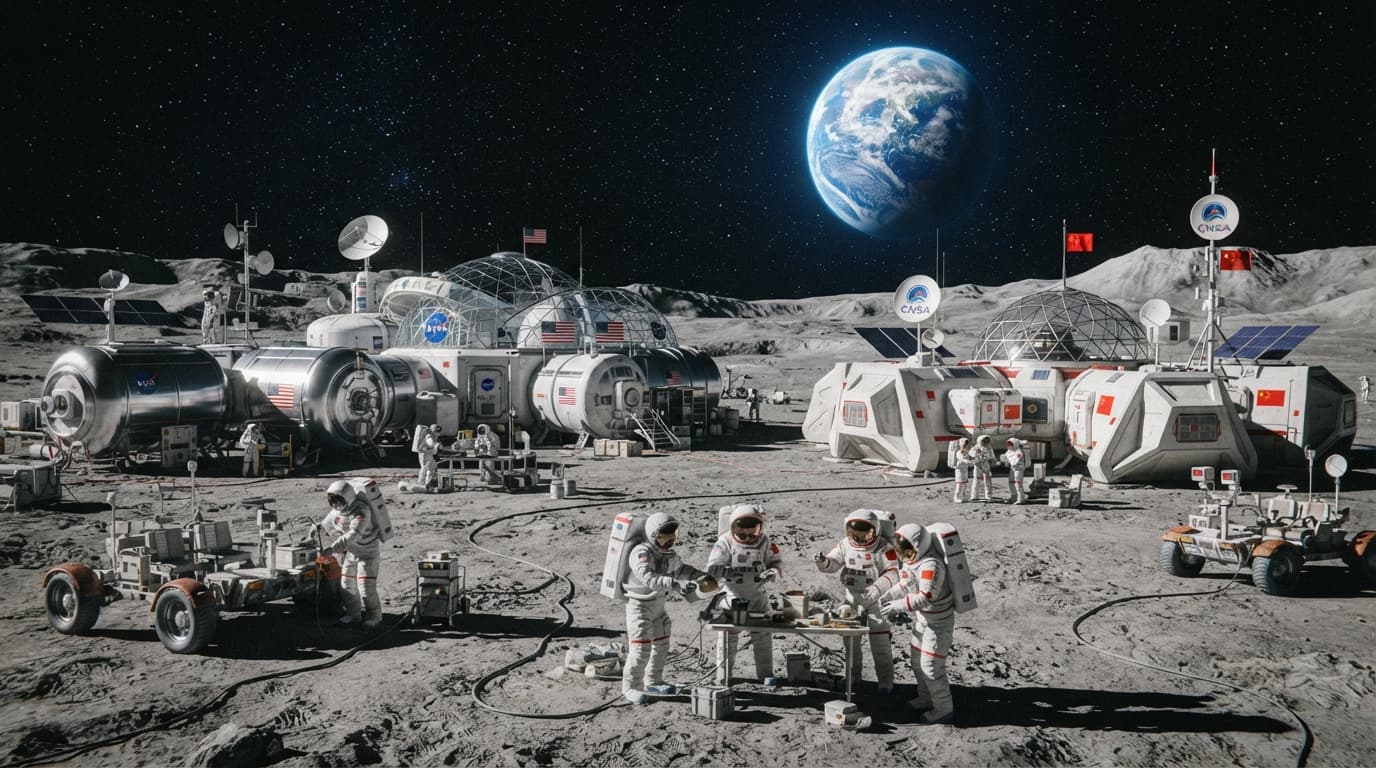
A lunar settlement contains multiple habitats, solar power systems, communications infrastructure, robotic construction equipment and landing facilities.
Different companies operate different parts of the ecosystem.
One company provides transportation.
Another operates communications satellites.
Another extracts and processes lunar resources.
Another provides construction services.
Scientific organisations rent laboratory facilities.
Manufacturers experiment with production in low gravity.
Tourism companies eventually offer visits to lunar facilities.
Financial institutions could potentially provide capital and risk-management services for companies operating in the lunar economy.
The important point is that the Moon would not need to become self-sufficient immediately.
It would need to become commercially useful.
Economic activity could grow incrementally as infrastructure becomes more capable and transportation costs fall.
The Financial Opportunity — and the Risk
For investors, the commercialisation of space presents an unusual proposition.
The potential market is enormous, but the risks are equally significant.
Space companies face enormous development costs, long timelines, technical failures, regulatory uncertainty and limited early customers.
NASA's Office of Inspector General has highlighted challenges associated with commercial lunar landers, including technical development, schedule and programme-management risks.
That means investors cannot simply assume that growing space activity will automatically translate into profitable companies.
There is an important distinction between:
A growing space industry
and
a profitable individual space company.
The industry can expand while individual businesses struggle.
That is already a familiar pattern in emerging technologies.
The Long-Term Vision: A Lunar Industrial Base
The most ambitious possibility is that lunar infrastructure eventually becomes an industrial ecosystem.
Rather than simply supporting scientific missions, the Moon could eventually host commercial facilities.
Construction materials could potentially be produced locally.
Water could potentially be processed into life-support resources and propellant.
Robotic systems could maintain infrastructure.
Communications networks could connect lunar operations.
And spacecraft travelling deeper into the Solar System could potentially use the Moon as a logistical waypoint.
These possibilities remain speculative.
But they are no longer entirely detached from present-day planning.
NASA has already identified companies and technologies intended to support transportation, planetary surface operations and lunar infrastructure. In June 2026, the agency selected 41 proposals from 37 companies to advance technologies supporting long-term lunar presence and future Mars exploration.
Could There Be Moon Colonies?
This is where the distinction between evidence and prediction becomes particularly important.
There is currently no established timetable for a large, self-sustaining lunar colony.
A permanent human outpost is itself an enormous engineering challenge.
A genuine colony would require much more.
It would need reliable transportation, food production, power, radiation protection, medical systems, manufacturing, communications and a sufficiently strong economic reason for people and companies to remain there.
A plausible long-term progression could therefore look something like:
Exploration → Outpost → Infrastructure → Commercial Activity → Industrial Base → Settlement
The timeline for each stage is uncertain.
It could take decades longer than optimistic projections suggest.
Technological breakthroughs could accelerate development, while economic, political or engineering difficulties could slow it considerably.
The important point is that a lunar colony should be viewed as a long-range scenario, not a guaranteed outcome.
The 2050s and Beyond
If commercial space continues developing successfully, the second half of the 21st century could look very different from today.
By the 2050s, it is conceivable that humans could have permanent facilities on the Moon supported by a mixture of government programmes and private companies.
Further into the future, those facilities could potentially expand into larger settlements.
By then, the distinction between space exploration and space industry could become increasingly blurred.
The Moon could have customers, suppliers, infrastructure providers, research organisations and competing commercial interests.
And if lunar resources can be economically utilised, the Moon could potentially become a logistical platform for missions travelling deeper into the Solar System.
Mars would remain vastly more challenging.
But a mature lunar economy could provide an intermediate environment for testing technologies required for long-duration human exploration.
The New Space Economy
The most important development in commercial space may not be any individual rocket.
It may be the creation of an entirely new economic layer.
Governments are increasingly becoming customers rather than the only operators.
Private companies are developing transportation and infrastructure.
Investors are providing capital to commercial space ventures.
Satellite services are already embedded throughout the wider digital economy.
And lunar missions are beginning to move from government-only projects toward public-private ecosystems.
The Moon is still a distant frontier.
But the economic foundations of reaching it are being built today.
The next stage of the space race may therefore not be about which country plants a flag first.
It may be about which companies build the infrastructure that everyone else uses.
And if those companies succeed, today's commercial space industry could eventually become the foundation of something far larger: a permanent human economy extending beyond Earth.
References
1. NASA — Commercial Space NASA's overview of its commercial-space strategy, including commercial human spaceflight, low-Earth orbit and lunar activities. NASA — Commercial Space
2. NASA — Commercial Lunar Payload Services Information on NASA's commercial lunar delivery programme, providers, planned missions and contract structure.
3. NASA — Growing the Lunar Economy NASA's strategy for encouraging commercial activity and developing a lunar marketplace.
4. European Space Agency — 2026 Space Economy Report Current data on global space investment, upstream and downstream markets and private investment.
5. NASA — Moon Base Programme Information on commercial lunar missions and infrastructure supporting sustained activity around the lunar South Pole.
6. NASA Office of Inspector General — Commercial Lander Services Independent assessment of the challenges and risks associated with NASA's commercial lunar lander approach.
7. NASA — Space Technology Collaboration Details on NASA's 2026 selection of 41 proposals from 37 companies to advance technologies supporting long-term lunar and Mars exploration.
8. European Space Agency — Commercial Opportunities for Space Exploration ESA's overview of commercial opportunities and the development of a low-Earth-orbit and lunar economy.
Published by Banx Network. This article is part of the Banx decentralized media programme, powered by the BXE token on the XRP Ledger.