Key Highlights
- Pulsar Fusion's Sunbird aims to revolutionize interplanetary travel.
- The spacecraft utilizes nuclear fusion propulsion for enhanced efficiency.
- Targeted for an orbital test in 2027, promising significant speed improvements.
[Why Space Travel Needs a New Generation of Propulsion]
Getting into space is challenging, but traveling efficiently once a spacecraft has left Earth presents another significant hurdle. Most launch vehicles rely on chemical propulsion, which burns fuel and an oxidizer to produce thrust. While this technology is mature and capable of lifting satellites and crew into orbit, it has inherent limitations. The propellant must be carried onboard, and achieving greater spacecraft velocity generally requires additional fuel, leading to a difficult engineering trade-off: more fuel means more mass, necessitating a larger rocket and even more propellant.
This issue becomes increasingly critical for missions traveling to Mars, Jupiter, Saturn, and beyond. A spacecraft traveling to Mars using conventional propulsion may take approximately six to nine months, depending on various factors such as the launch window and mission design. Missions to the outer planets can take considerably longer. As a result, the industry has spent decades investigating propulsion systems that could deliver higher exhaust velocities and improve the efficiency of deep-space missions.
Electric propulsion, nuclear fission propulsion, and advanced plasma engines are among the technologies being explored. However, nuclear fusion represents a particularly ambitious possibility. If engineers can develop a compact, controllable fusion propulsion system, spacecraft could potentially achieve much higher performance than conventional chemical rockets. The challenge lies in turning the physics of fusion into a reliable machine that can operate in the harsh environment of space.
[What Is Nuclear Fusion Propulsion?]
Nuclear fusion is the process through which light atomic nuclei combine to form heavier nuclei, releasing energy in the process. This is the same fundamental reaction that powers the Sun and other stars. On Earth, scientists are attempting to reproduce fusion under controlled conditions to develop a potential source of low-carbon electricity. Fusion propulsion applies this underlying physics to spacecraft engines, harnessing the energy and charged particles produced by nuclear reactions to create an exhaust stream. Magnetic fields could guide and accelerate this extremely hot plasma, generating thrust.
One of the key attractions of fusion propulsion is the potential combination of high exhaust velocity and useful thrust. Exhaust velocity is crucial as it determines how efficiently an engine uses propellant. A higher exhaust velocity allows a spacecraft to achieve substantial changes in speed while carrying less reaction mass. This concept differs from conventional nuclear fission propulsion, which involves splitting heavy atomic nuclei. Both approaches could improve space propulsion, but they involve different fuels, reactor designs, engineering challenges, and levels of technological maturity. Currently, fusion propulsion remains experimental, with no operational fusion-powered spacecraft yet developed.
[Meet Sunbird: Britain's Ambitious Fusion Spacecraft]
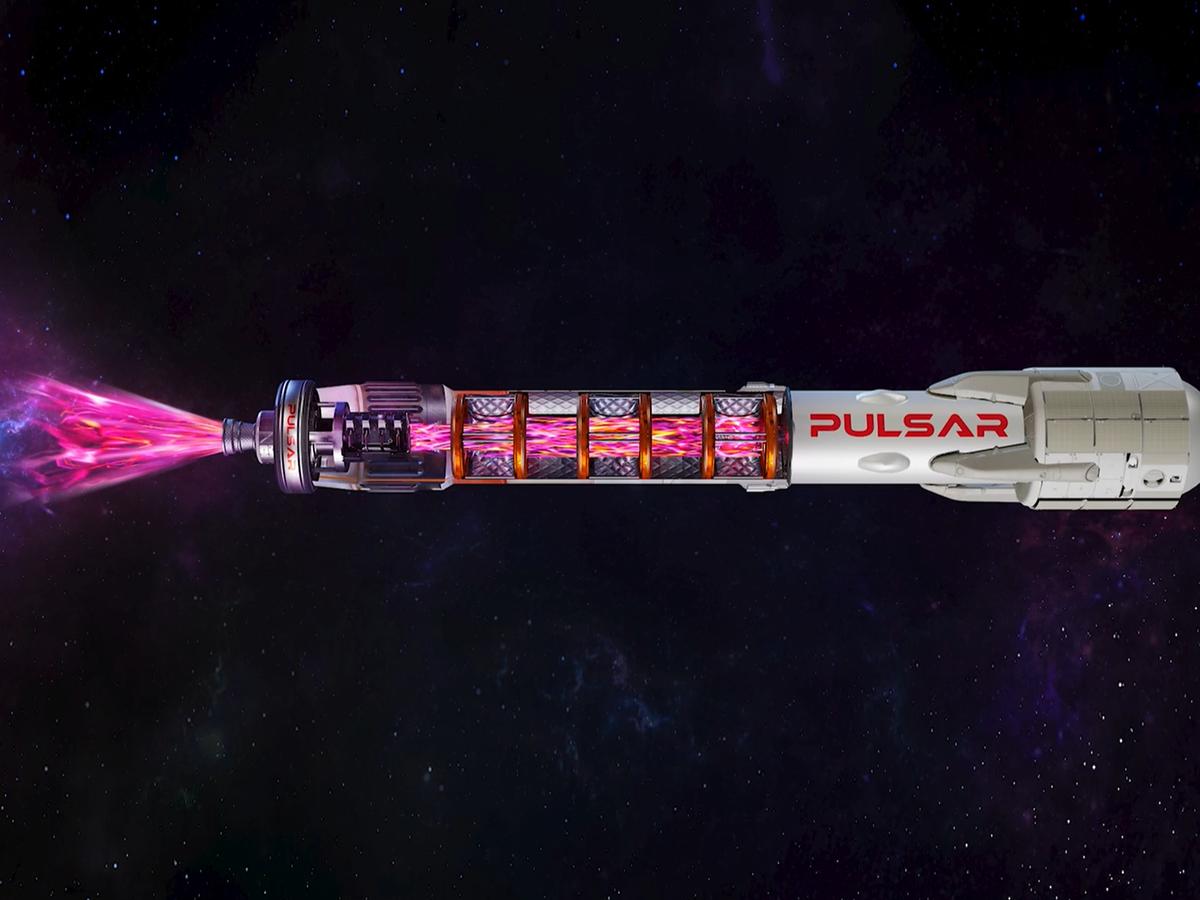
Among the companies advancing this technology is Pulsar Fusion, a British space propulsion business based in Bletchley, England. Its proposed spacecraft, known as the Sunbird Migratory Transfer Vehicle, is designed to operate as an orbital transportation system. Instead of launching directly from Earth's surface, Sunbird is intended to be stationed in orbit. Other spacecraft would launch using conventional rockets, reach a suitable orbital location, and dock with the fusion-powered vehicle. Sunbird would then provide propulsion for the onward journey, effectively separating the challenging task of escaping Earth's gravity from the longer journey through space.
Pulsar describes its proposed propulsion architecture as a Dual Direct Fusion Drive (DDFD). This concept aims to combine propulsion with electrical power generation, potentially providing energy to spacecraft and scientific equipment at their destinations. According to the company's published design specifications, the proposed system targets approximately 2 megawatts of power and a specific impulse of 10,000–15,000 seconds, which could significantly enhance the efficiency and speed of interplanetary travel.
As Pulsar Fusion prepares for an orbital test of the Sunbird in 2027, the implications of successful fusion propulsion technology could reshape our approach to space exploration, making distant planets more accessible than ever before.
Published by Banx Network. This article is part of the Banx decentralized media programme, powered by the BXE token on the XRP Ledger.