Key Highlights
- Solar energy is rapidly growing but faces limitations on Earth.
- Space-based solar power could provide consistent energy regardless of weather.
- Recent advancements in technology renew interest in orbital solar power.
[Why Scientists Want to Move Solar Power Generation Into Space]
Solar energy has become one of the world's most rapidly expanding electricity sources. Falling panel costs and improvements in manufacturing have made solar farms increasingly competitive with conventional power generation. However, solar power has a fundamental limitation: it depends on sunlight reaching the panels. On Earth, clouds, weather conditions, seasonal changes, and nighttime darkness all influence electricity production. Solar farms generate their strongest output during daylight, which does not always coincide with periods of peak electricity demand.
Energy storage can help address this problem, but batteries add costs, require materials, and have limitations around how much electricity they can store and for how long. Space-based solar power (SBSP) offers a different approach. By positioning large solar arrays in orbit, operators could collect sunlight above the atmosphere and potentially maintain electricity generation for much longer periods than conventional ground-based solar installations.
The UK Department for Energy Security and Net Zero describes SBSP as a system that collects solar energy in high Earth orbit and beams it to a fixed location on the ground. Its potential advantage is the ability to provide predictable electricity throughout the year, in different weather conditions, and during the night. The concept is not entirely new; scientists have investigated orbital solar power stations for decades. However, launch costs, limited manufacturing capabilities, and the difficulty of constructing enormous structures in space have prevented the idea from progressing towards commercial deployment.
Recent advances in reusable launch vehicles, lightweight materials, solar cells, and wireless power transmission have renewed interest in this technology. The question now is whether these technologies can be combined into a system capable of delivering electricity at a competitive price.
[How Would a Solar Power Station in Space Work?]
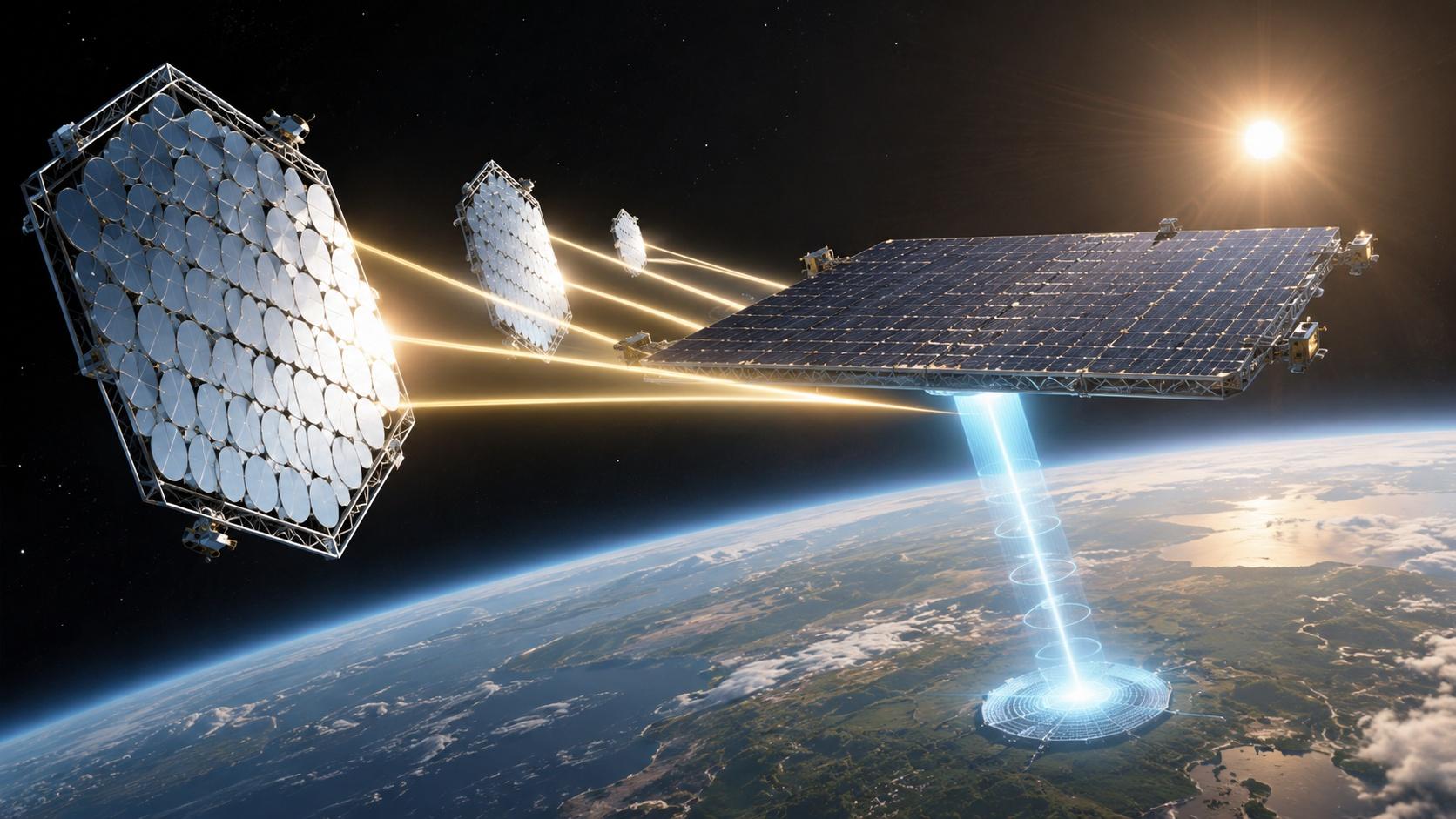
A space-based solar power station would essentially function as an enormous orbital electricity generator. Its solar panels would capture sunlight and convert it into electrical energy. Instead of transmitting that electricity through conventional cables, the satellite would convert it into electromagnetic energy and direct it towards a receiving station on Earth. The process involves three principal stages: collection, transmission, and reception.
In the collection phase, solar panels mounted on an orbital structure capture sunlight and generate electricity. During transmission, the electricity is converted into a directed microwave or laser beam. Finally, in the reception phase, a ground-based receiving system captures the transmitted energy and converts it back into electricity. One proposed method uses microwave transmission, where the satellite contains an array of microwave transmitters capable of directing energy towards a receiving installation known as a rectenna. A rectenna combines an antenna with rectifying circuitry, capturing incoming microwave energy and converting it into direct-current electricity, which can then be converted into alternating current for use by the electricity grid.
The advantage of microwave transmission is that microwaves can travel through the atmosphere with relatively low attenuation when suitable frequencies are selected. The UK government's 2025 technical feasibility study examined frequencies including 2.45 GHz and 5.8 GHz, both of which are established industrial, scientific, and medical frequency bands. The alternative is laser transmission, which uses concentrated optical energy rather than microwaves. Lasers can potentially deliver energy to smaller receiving areas, but atmospheric conditions, cloud cover, accurate targeting, and optical safety create additional challenges. For large-scale electricity delivery to Earth, microwave transmission is currently one of the most extensively studied approaches.
[Caltech Has Already Demonstrated Wireless Power Transmission in Space]
One of the most important developments in the field came from the California Institute of Technology (Caltech). In January 2023, the university launched its Space Solar Power Demonstrator, known as SSPD-1, to test technologies needed for future orbital solar power systems. The experiment contained three main components: DOLCE, a lightweight deployable structure designed to demonstrate how large solar arrays could be assembled and supported in space; ALBA, a collection of different solar cell technologies tested in orbit; and the transmission system to evaluate the efficiency of energy transfer from space to Earth.
As interest in renewable energy sources continues to grow, the potential for space-based solar power to revolutionize energy generation is becoming increasingly viable. With ongoing research and technological advancements, the dream of harnessing solar energy from space may soon become a reality, paving the way for a more sustainable energy future.
Published by Banx Network. This article is part of the Banx decentralized media programme, powered by the BXE token on the XRP Ledger.