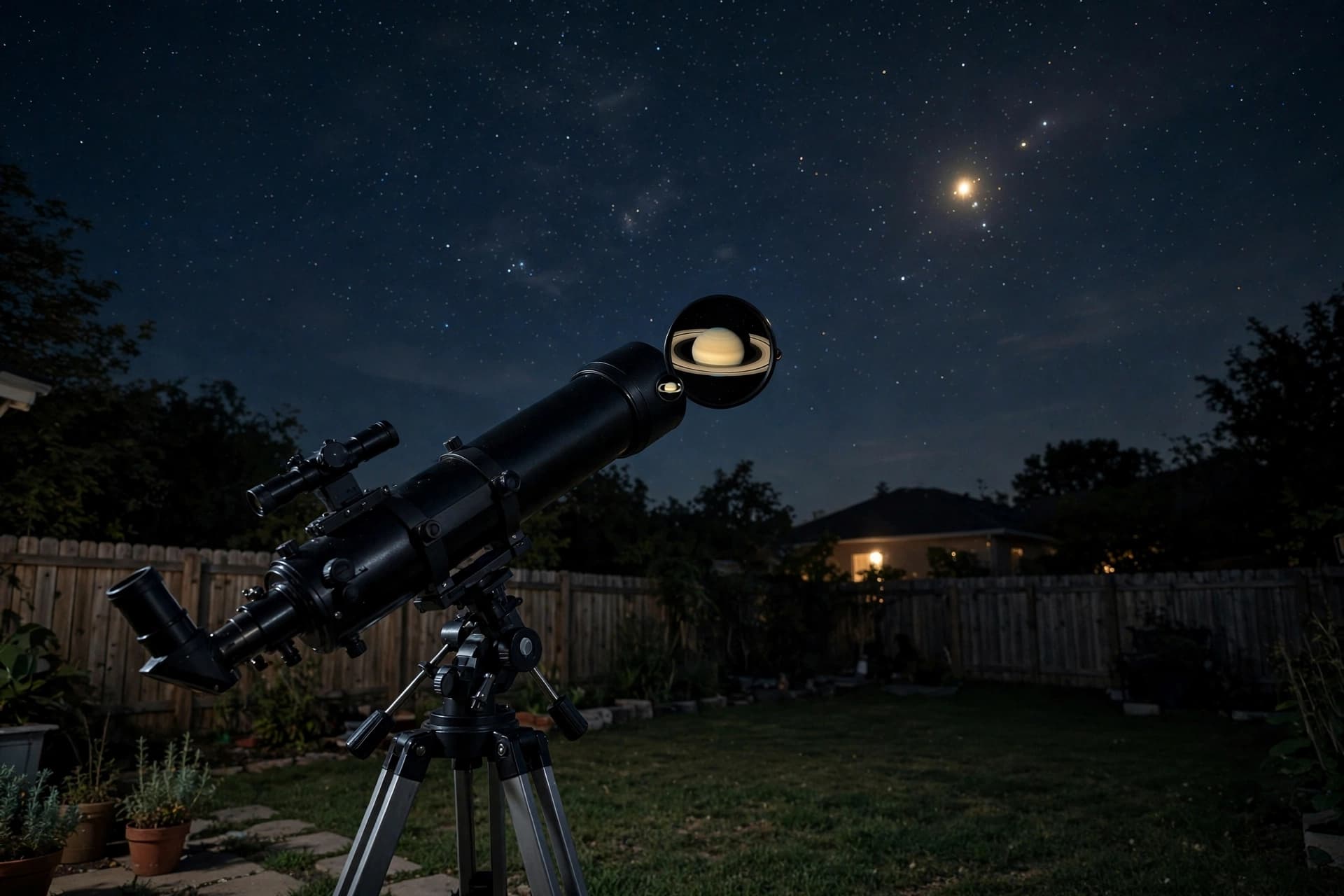
There is a quiet invitation written in the night sky this week, one that requires no ticket and no equipment—only a clear evening and a willingness to look up. Saturn, the ringed giant that has captivated observers for centuries, is reaching opposition on Sunday, October 4. This is the moment when Earth passes directly between Saturn and the sun, placing the two planets on the same side of the solar system and bringing Saturn to its brightest and largest appearance of the year .
Opposition is a gift of orbital geometry. Saturn rises in the east around sunset, reaches its highest point near midnight, and remains visible until sunrise—making it the only planet visible all night . At a distance of roughly 784 million miles (1.26 billion kilometers), Saturn is relatively close, causing its disk to appear about as large as it gets through a telescope and making its pale-yellow light shine more brightly than at any other time .
For those without equipment, Saturn is still an easy target. Under a clear sky, it appears as a bright, steady point of light, distinguishable from stars by its lack of twinkling. It can be found between the constellations Pisces and Cetus . A phone-based sky map or astronomy app can help locate it, but the naked eye alone is sufficient to see the planet itself.
The real reward comes with a telescope. Even a modest backyard instrument transforms that point of light into a recognizable world—a pale-yellow disk encircled by rings. Larger apertures and higher magnifications may reveal the Cassini Division, the dark gap between the A and B rings, and some of Saturn's moons, including Titan, its largest .
This year offers an additional reason for interest. Saturn's axial tilt means our viewing angle of its rings changes over its roughly 29-year orbit. After the rings appeared nearly edge-on in 2025, they are gradually opening up again, giving observers an increasingly clear view of their structure . The rings themselves are not changing form; only our perspective is shifting.
The best nights for observation are from September 30 through October 4, though Saturn will remain a prominent evening target throughout October . If clouds interfere this week, the planet will still be there tomorrow, and the next night, and the next. But opposition is a once-a-year alignment. The next time Saturn will be at opposition is October 18, 2027 . For anyone who has been waiting for an excuse to point a telescope at the sky, this is the moment.
AI Image Disclaimer: The visual materials in this article were produced by artificial intelligence and are used solely for illustrative purposes.
Sources: Yahoo, The Economic Times, Universe Space Tech, Star Walk
Published by Banx Network. This article is part of the Banx decentralized media programme, powered by the BXE token on the XRP Ledger.