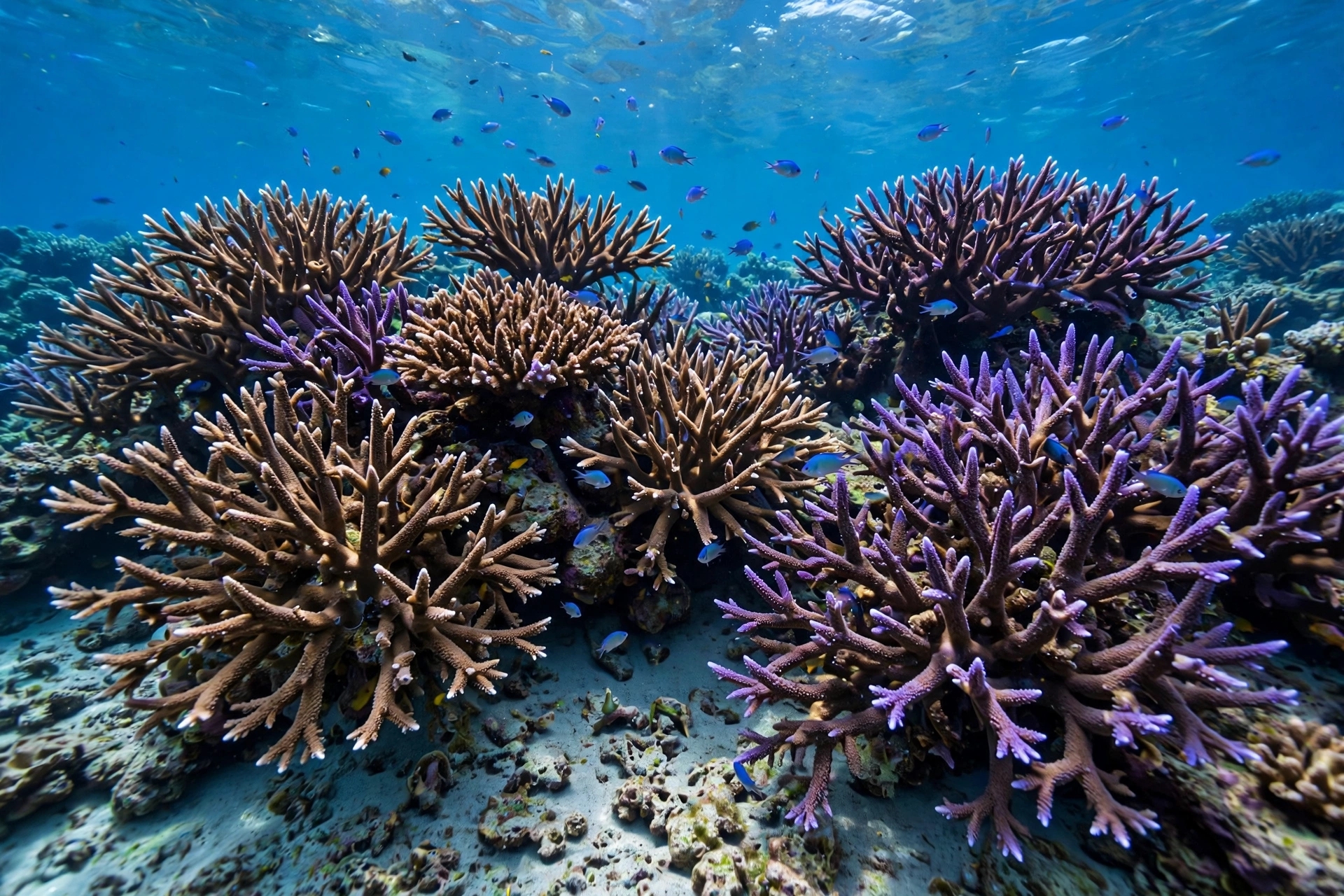
There is a particular kind of vanishing that happens without anyone noticing, when something that appears abundant turns out to be not one thing but many, and each of those many is rarer than anyone knew. On the Great Barrier Reef, the corals of the genus Acropora—the branching staghorns, the table-forming plates, the structures that build the architecture of the reef itself—have long been classified by their shapes. A branching coral was one species, a plating coral another. But shape, it turns out, can deceive. New genomic research has revealed that twelve corals previously treated as mere variants of other species are, in fact, distinct species of their own, and that distinction matters for how we understand and protect the reef.
The study, led by Dr. Augustine Crosbie of James Cook University and the Queensland Museum, combined genomic sequencing with historical museum specimens to reassess fifty-three named Acropora species, forty of which were first described from Australia's east coast . The team found that forty-seven of the fifty-three were genuinely distinct, restoring species status to twelve that had been lumped in as synonyms of others and confirming four previously unresolved species as valid . The work, published in Invertebrate Systematics, is a reminder that even in one of the most studied ecosystems on Earth, the basic question of what lives there has not been fully answered.
The challenge of coral taxonomy is not new. For decades, scientists have struggled to determine whether differences in a coral's form reflect separate species or simply different shapes taken by a single species in response to its surroundings . A coral growing in calm water may look different from one in a high-energy environment, and without genetic tools, the line between variation and speciation was difficult to draw. The Queensland Museum's CoralBank project addressed this by examining historical type specimens—the original samples used to describe each species—and then collecting living corals from the exact locations where those species were first found. Because many of the historical specimens are preserved skeletons that cannot be sequenced, the researchers used the modern samples as stand-ins, connecting the old collections to new genomic data .
"A coral that appears to be common and widespread may actually represent several species, each with a much smaller geographic range," said Peter Cowman, principal scientist of marine biodiversity at the Queensland Museum. "That matters when we assess extinction risk, monitor reef communities and decide where conservation resources should be directed" . The implications are significant. A species that was thought to be secure because it seemed widespread may, once split, turn out to be a collection of narrow-range endemics, each more vulnerable than the whole. Conservation planning that treated them as one unit would have missed the fragility of the parts.
The Great Barrier Reef is under pressure from warming oceans, coral bleaching, and the accumulated stresses of human activity. Knowing precisely what is there—not just the genus, not just the growth form, but the species—is fundamental to understanding what is being lost and what might be saved . The research does not suggest that the reef is healthier than previously thought, or that the newly recognized species are thriving. It suggests that the accounting has been incomplete, and that completeness matters. "The Great Barrier Reef is one of the best studied ecosystems on Earth, yet we are still discovering that we have underestimated the number of coral species living there," said Andrew Baird, a co-author and adjunct professor at James Cook University .
What the work reveals, beyond the taxonomic revision, is a quieter truth about scientific knowledge. The reef has been studied for generations, its corals catalogued and photographed and described in papers that fill shelves in museums and libraries. And yet, within that accumulated knowledge, there were gaps—species hiding in plain sight, mistaken for each other, their distinctness invisible until the tools existed to see it. The genomic revolution has made those tools available, and the result is a more accurate picture of a complex and fragile world.
For the corals themselves, the recognition changes nothing. They have been what they are all along, regardless of what they were called. But for the people who study them and the institutions that manage them, the new taxonomy offers a better map of what is at stake. The reef is not a single thing, and neither are its corals. It is a multitude, each part with its own story, its own range, its own vulnerability. Knowing that is the first step toward caring for it.
The images in this article are AI-generated and do not depict the actual corals or researchers.
Published by Banx Network. This article is part of the Banx decentralized media programme, powered by the BXE token on the XRP Ledger.