Key Highlights
- Discovery:Teghaza 001, a Martian meteorite, was found in the Sahara Desert.
- Age:The meteorite is over 4.1 billion years old, revealing early Mars' crust.
- Significance:The specimen connects scientific research with public interest at a Maine museum.
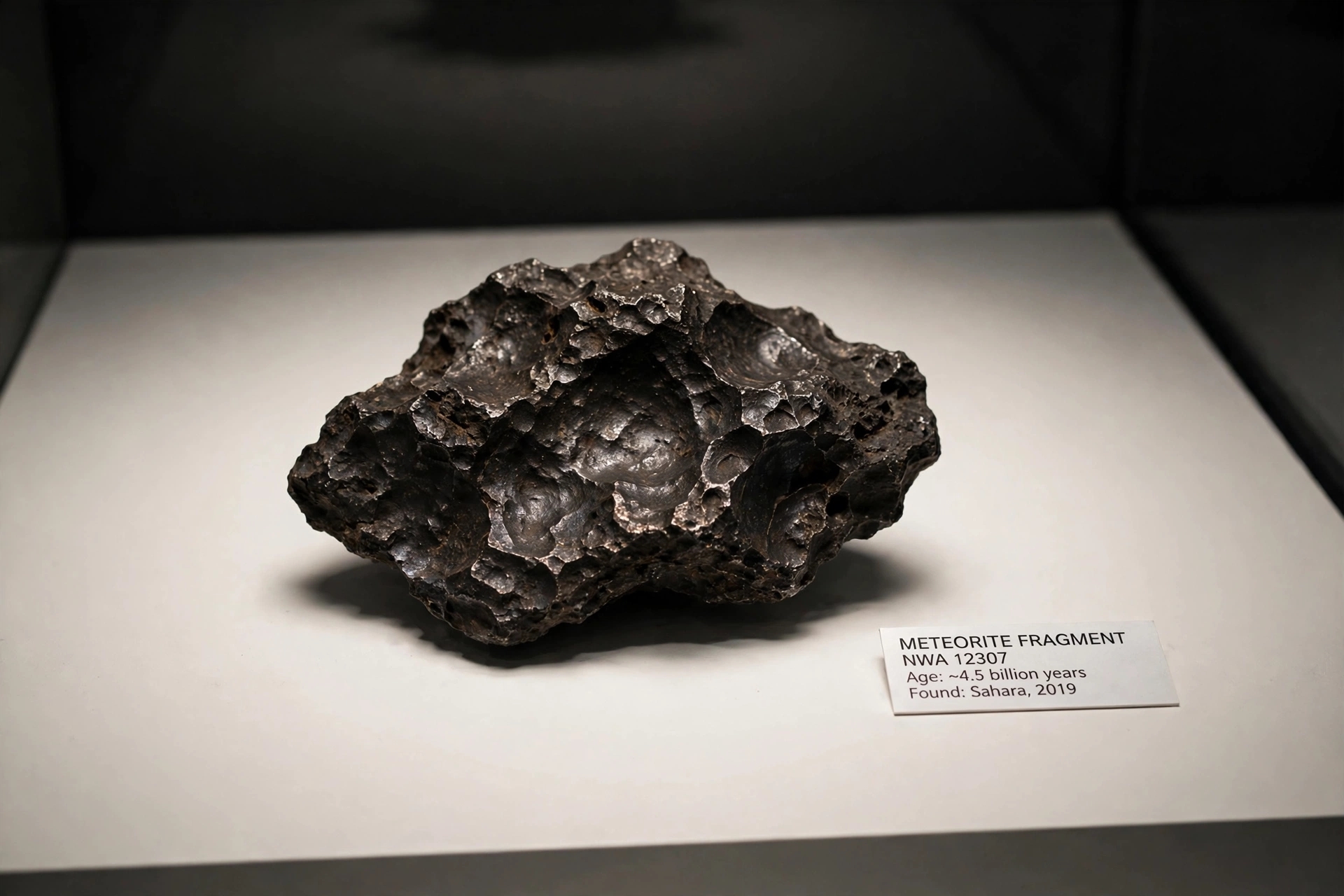
Teghaza 001, a remarkable meteorite that fell from Mars, has found its home at the Maine Mineral & Gem Museum in Bethel. Discovered by Sahrawi prospectors in the Sahara Desert, this ancient rock is not just a curiosity; it is a piece of Mars that offers insights into the planet's early geological history. The meteorite is one of the oldest identified, with research published in the journal Science this October confirming its formation over 4.1 billion years ago. This makes it only the second known Martian meteorite to preserve a record of the planet's earliest crust.
What distinguishes Teghaza 001 from other Martian meteorites is its unique composition. While most Martian meteorites are dark volcanic rocks known as basalts, Teghaza 001 is rich in silicon, indicating that ancient Mars may have had a more chemically diverse crust than previously thought. This suggests the presence of rocks resembling granite, which could reshape our understanding of Mars' geological evolution. The texture and mineralogy of Teghaza 001 point to a source in Mars' mantle that has yet to be sampled by any other meteorite, providing a rare glimpse into a part of the planet's interior that remains largely unexplored.
In addition to its geological significance, Teghaza 001 carries vital evidence of water on Mars. Researchers have analyzed the ratios of hydrogen and deuterium within the meteorite, uncovering signs that Mars was losing water more than 4.1 billion years ago. This finding contributes to the growing narrative of early Mars as a planet with active fluids and a complex geology, contrasting sharply with its current cold and arid surface.
For the Maine Mineral & Gem Museum, Teghaza 001 serves as both a scientific resource and a public attraction. The museum boasts an internationally significant collection of meteorites, including samples from the Moon and Mars, and actively promotes research on these specimens. Displaying Teghaza 001 connects the discovery made in the Sahara to ongoing scientific endeavors and engages visitors who may never have the chance to encounter a piece of another planet.
Holding a rock from Mars evokes a unique sense of intimacy. Unlike photographs or simulations, Teghaza 001 is a tangible fragment of another world, formed long before Earth's earliest known rocks. It carries traces of water that once flowed on a planet now silent, waiting behind glass in Bethel—not merely as a curiosity, but as a testament to a history that scientists continue to unravel.
The presence of Teghaza 001 in a Maine museum highlights the importance of connecting scientific discoveries with public interest, fostering a deeper understanding of our solar system and the mysteries that lie beyond our planet.
AI Image Disclaimer: The imagery in this article is AI-generated and is not a photograph of the actual meteorite specimen.
Published by Banx Network. This article is part of the Banx decentralized media programme, powered by the BXE token on the XRP Ledger.