Key Highlights
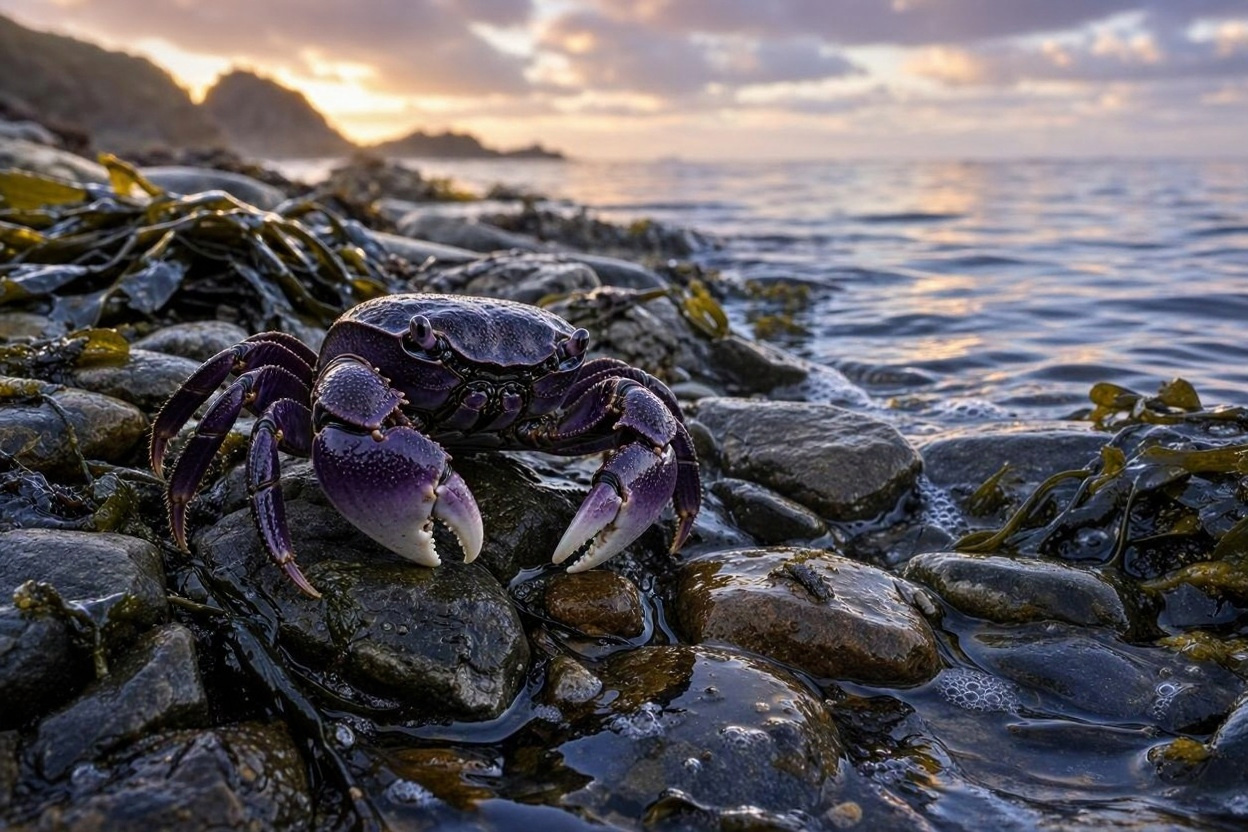
- Unique Species:Vancouver's shores host vibrant purple and orange crabs.
- Habitat Range:These crabs thrive in intertidal zones from Alaska to Baja California.
- Ecological Importance:Understanding these species reveals the richness of marine life.
Along the shorelines of British Columbia, where cold water meets gray stone and the tide rehearses its ancient rhythm twice a day, there are creatures that seem almost too vivid for their surroundings. A flash of violet beneath a rock, a spark of orange against dark kelp—these are not the muted tones one might expect from the Pacific Northwest's restrained palette. The vibrant colors of these crabs draw attention, yet they are often overlooked by beachgoers and casual observers.
The most likely candidate for a purple crab near Vancouver is the Hemigrapsus nudus, commonly known as the Purple Shore Crab. This small crab typically sports a deep, dark purple carapace, though it can shift toward olive green or red. Its legs match its body color, and its claws are tipped in lighter shades, often marked with purple or red spots. This species reaches a size of approximately four to five and a half centimeters and is commonly found sheltering under rocks in intertidal areas, particularly at locations like Spanish Banks and Pacific Spirit Regional Park.
In contrast, the orange companion mentioned could belong to the Puget Sound King Crab, scientifically known as Lopholithodes mandtii. Juvenile specimens are bright orange, developing red and purple patches as they mature, creating a striking, almost patchwork appearance. This species is one of the largest crabs on the West Coast, with a carapace that can reach up to thirty centimeters. Unlike the Purple Shore Crab, the Puget Sound King Crab is typically found in deeper waters, ranging from thirty to one hundred forty meters, although it migrates to shallower depths during winter to molt and mate.
Another intriguing possibility is the Purple Hermit Crab (Elassochirus cavimanus), which showcases its own vibrant palette. This crab features an orange or scarlet carapace, a right claw that is violet with orange margins, and walking legs that are deep red or orange, often dotted with white. Its range extends to Departure Bay in British Columbia, although records of sightings are scattered and primarily concentrated in northern regions.
The confusion surrounding the headline is understandable. "Purple and orange" could describe a single animal exhibiting both colors or two distinct species photographed in proximity. The intertidal zone serves as a unique habitat where small and large, common and rare species coexist, sharing the same cold water and rocky shelters. A photographer kneeling at low tide might capture any of these colorful crabs, revealing the hidden beauty of the marine ecosystem.
Ultimately, the visual content accompanying this article highlights the ordinary richness of Vancouver's coastline. These creatures are not unusual visitors or anomalies; they are residents, quietly going about their business beneath the surface, waiting for the tide to return. Understanding their presence enriches our appreciation of the biodiversity that thrives in these coastal waters.
The visual content accompanying this article was produced using AI image generation.
Published by Banx Network. This article is part of the Banx decentralized media programme, powered by the BXE token on the XRP Ledger.