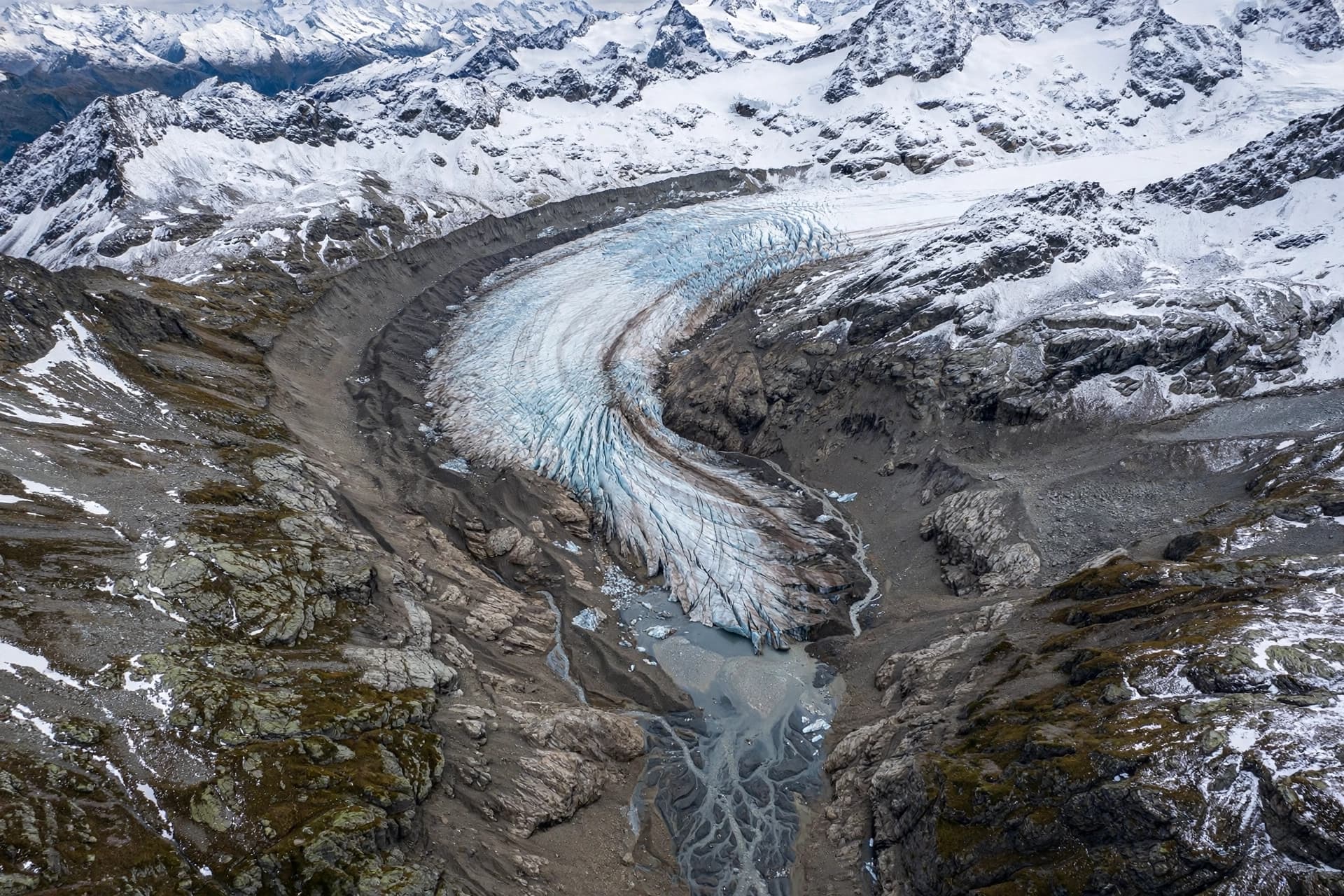
High in the Swiss Alps, glaciers can seem almost timeless. Their white surfaces have shaped mountain landscapes, fed rivers, and become symbols of the Alpine environment. But measurements released at the end of September show how quickly that impression is changing: Switzerland's glaciers have lost nearly one-fifth of their ice volume in only five years.
According to the Swiss Glacier Monitoring Network, known as GLAMOS, and the Swiss Academy of Sciences, Swiss glaciers lost 5.5 percent of their ice volume during the first eight months of 2026. That was the second-largest annual percentage loss recorded, behind the exceptional melt of 2022. Since 2021, total ice loss has reached about 19.4 percent.
The immediate causes were unusually intense heat and limited snowfall. Winter snow is particularly important because it acts as a protective layer over glacier ice and contributes to the accumulation of new mass. When snow arrives in insufficient quantities, more exposed ice remains vulnerable as temperatures rise during the warmer months.
The scale of this year's melting was visible across several major glaciers. The Aletsch Glacier and Rhone Glacier experienced substantial retreat, while the Glacier de Tsanfleuron lost several meters of thickness. Smaller glaciers have been especially vulnerable, with some disappearing entirely as their remaining ice becomes too thin to sustain the glacier structure.
Scientists monitoring the Alps have also observed changes beneath the surface. In some locations, melting water has entered and enlarged internal channels and cavities, contributing to structural instability. These changes mean that glacier loss is not simply a matter of a white landscape gradually becoming smaller; the physical structure of the ice itself can change as warming continues.
The implications extend beyond scenery. Alpine glaciers function as important water stores, releasing meltwater into river systems during warmer months. The 2026 melt released an estimated 2.2 trillion liters of water between July and September, more than four times Switzerland's annual household drinking-water consumption. That additional water can temporarily support supplies, but scientists note that the benefit diminishes as the underlying ice reserve becomes smaller.
The changing glaciers also matter for hydropower and major European river systems. Water originating in the Alps contributes to rivers including the Rhine and Danube, while Switzerland relies heavily on hydropower for electricity generation. Glacier retreat therefore connects a distant-looking environmental change with questions about water availability, energy, ecosystems, and mountain communities.
Scientists say the broader trend is closely connected to human-caused climate warming. Europe has been warming particularly rapidly, and repeated periods of extreme heat combined with reduced snow accumulation are accelerating glacier loss. While individual years can vary because of weather conditions, the measurements from recent years show a sustained decline rather than a single isolated season.
For Switzerland, the numbers represent more than a statistic about disappearing ice. A loss of nearly one-fifth of the country's glacier volume in five years illustrates how quickly a landscape associated with permanence can change. The remaining question is how much ice can still be preserved as temperatures rise, and how societies downstream will adapt to a mountain environment whose water reserves are steadily being transformed.
AI Image Disclaimer: This image is AI-generated to illustrate glacier retreat and does not depict an actual 2026 measurement site.
Sources: Reuters; Associated Press; GLAMOS; Swiss Academy of Sciences; Swissinfo; The Guardian
Published by Banx Network. This article is part of the Banx decentralized media programme, powered by the BXE token on the XRP Ledger.