Key Highlights
- New Study:A recent study in Communications Physics offers insights into the magnetic fields of Uranus and Neptune.
- Superionic Ice:The research highlights the role of superionic ice in generating the planets' unusual magnetism.
- Future Exploration:Understanding these magnetic fields is crucial for interpreting future missions to the ice giants.
When Voyager 2 flew past Uranus and Neptune in the 1980s, it sent back data that did not fit the tidy picture scientists had constructed from Earth's own magnetic field. Our planet's field is roughly dipolar, resembling a bar magnet, with poles that align closely with the geographic poles. In contrast, the ice giants' magnetic fields were found to be tilted sharply, offset from the planets' centers, and lopsided, exhibiting complex multipolar structures that seemed to defy easy explanation. For four decades, planetary scientists have been striving to understand what kind of interior could produce such strange magnetism.
A new study published in Communications Physics offers a mechanism that may resolve this long-standing puzzle, suggesting that the explanation does not require exotic ingredients or finely tuned conditions. The key, the researchers argue, lies in the way electrical conductivity varies with depth inside these planets. Within the interiors of Uranus and Neptune, water exists in a state known as superionic ice—a phase where oxygen atoms form a crystalline lattice while hydrogen nuclei flow through it like a liquid. As pressure increases with depth, the conductivity of this material also increases. The new dynamo models indicate that this radial variation in conductivity can generate magnetic fields that are non-dipolar and non-axisymmetric, aligning with the observations made by Voyager.
The models successfully reproduce a specific feature of the ice giants' magnetic spectra: a peak at the M1 term, the same signature that Voyager measured. Additionally, they produce magnetic fields that vary over time, with intervals of slow secular variation that could last for centuries. The researchers found that this mechanism works across a range of shell geometries and dynamical regimes, suggesting it does not depend on knowing every detail of the planets' interior structure. This robustness is crucial because Uranus and Neptune, despite their similarities, differ in heat flux, composition, and thermal evolution.
This work builds on decades of theoretical and experimental effort. A 2024 study in PNAS proposed that phase separation of planetary ices—a water-rich layer overlying a carbon-nitrogen-hydrogen layer—could create a stably stratified region where the dynamo operates only in the upper shell. The new conductivity-based model offers a complementary pathway, relying on a property of the material itself rather than a specific layered structure. Laboratory experiments at facilities like SLAC have also probed the behavior of superionic water under ice-giant conditions, revealing that its crystalline structure may be messier and more variable than early models assumed.
The implications of this explanation for future exploration are significant. NASA has prioritized a mission to Uranus for the coming decades, and understanding the dynamo is essential for interpreting any magnetic measurements that such an orbiter might make. If the magnetic fields are indeed time-varying, as suggested by the models, then a single snapshot—which is all Voyager provided—may have been misleading. The fields that Voyager measured in 1986 and 1989 could look different today. An orbiter that lingers, measuring the magnetic field over months or years, would reveal the temporal dimension that the flybys could not capture.
For now, the ice giants remain unvisited since Voyager's brief passes. While the models are not definitive proof, they are plausible, physically grounded, and consistent with the data, which is the most that theory can offer in the absence of new observations. Uranus and Neptune have kept their magnetic secrets for four decades. If the new work is correct, the explanation was never about something exotic; it was about the ordinary behavior of water under extraordinary pressure and how that behavior shapes the invisible fields surrounding two of the solar system's least understood worlds.
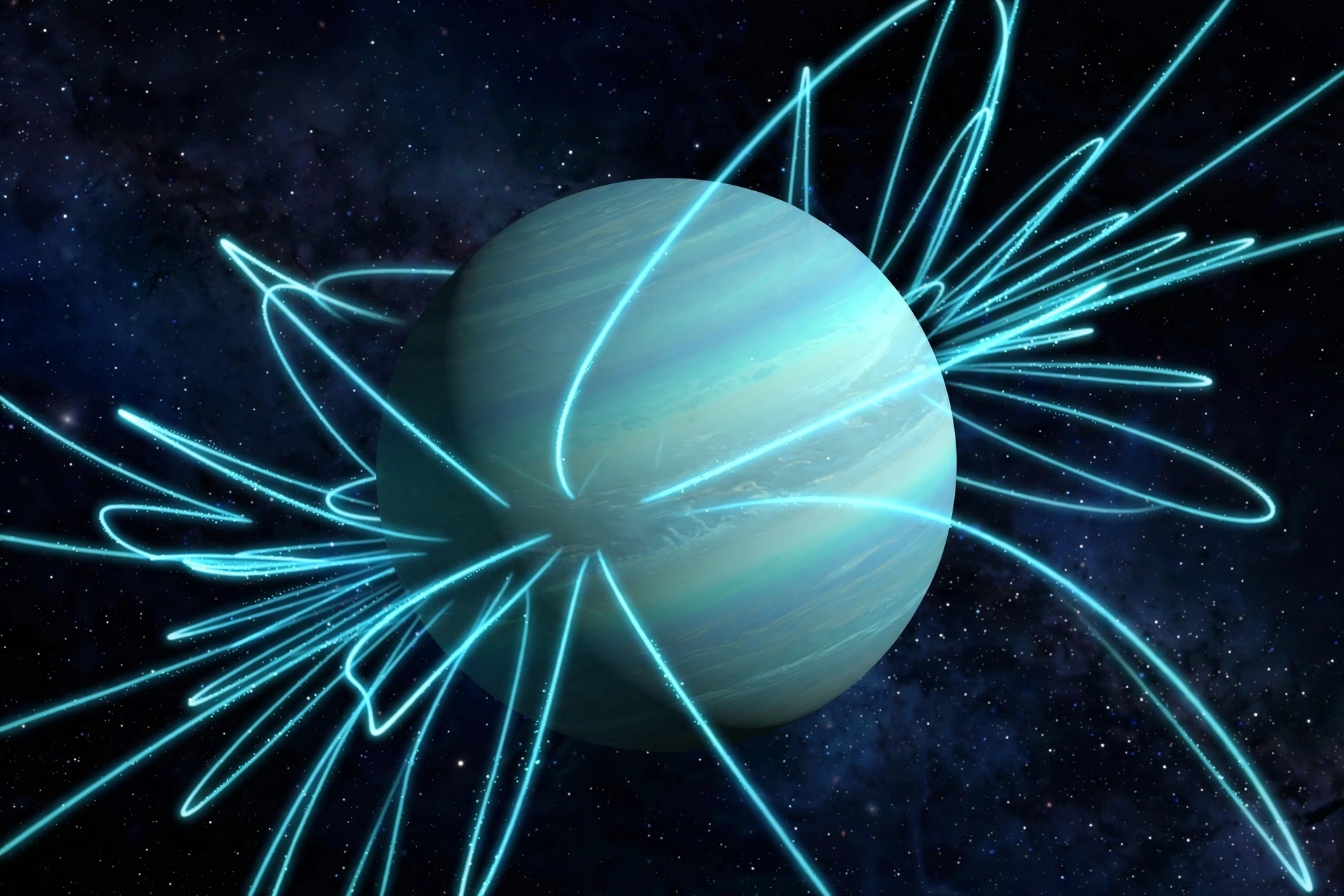
The images in this article are AI-generated and do not depict the planets or the researchers' simulations.
Published by Banx Network. This article is part of the Banx decentralized media programme, powered by the BXE token on the XRP Ledger.