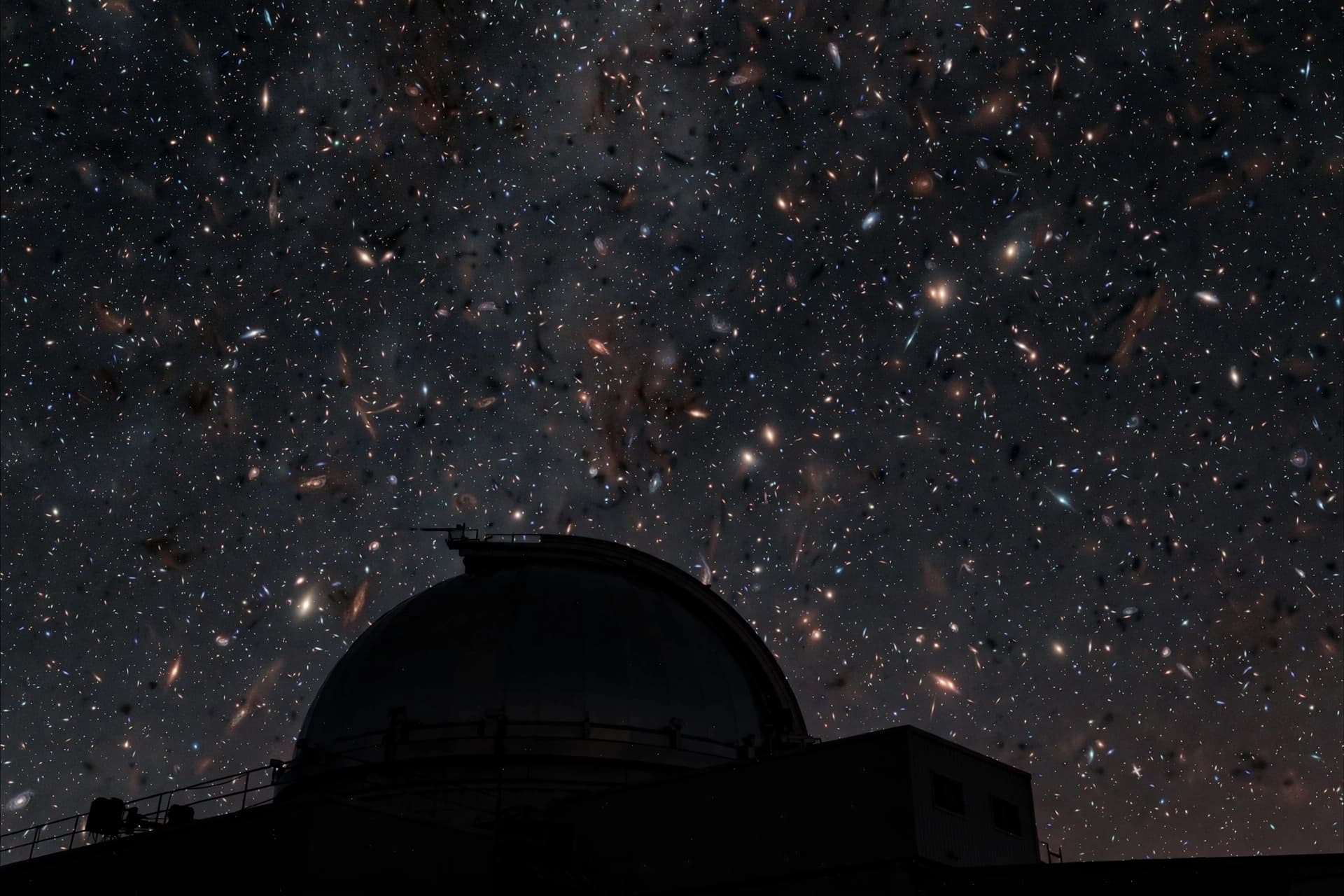
There is a kind of listening that astronomy asks of us, a patience that stretches beyond the span of a human life. When we look up, we are not merely seeing light; we are receiving messages that began their journey long before anyone was here to read them. In the first moments after the universe began, everything that would later become matter was forged in a furnace too hot and too brief to imagine. Yet the echoes of those moments remain, faint and patient, waiting in the oldest galaxies for someone to measure them carefully.
An international team of astronomers has now done precisely that, achieving a measurement of primordial helium with a precision never before reached. Their work, published across five papers in The Astrophysical Journal, reduces the uncertainty in this fundamental cosmic value to just 0.5 percent—three times better than previous standards . The research, involving institutions from the University of Minnesota to Ohio State and beyond, relied on 130 hours of observation with the Large Binocular Telescope in Arizona .
The significance of this lies in what helium can tell us about the universe's first five minutes. According to the Big Bang theory, the cosmos expanded from an extremely hot, dense state approximately 13.8 billion years ago. Three pillars support this framework: the expansion of the universe, the cosmic microwave background, and the abundance of light elements like helium and deuterium . While the first two have been studied extensively, the third has remained less precisely measured—until now.
To achieve this, the team took an approach that was both innovative and elegant. Rather than estimating primordial helium by extrapolating from many galaxies, they focused on fifteen of the most "pristine" small, remote galaxies ever discovered. These chemically unevolved objects serve as cosmic time capsules, preserved almost exactly as they were shortly after the Big Bang . They are, in a sense, living fossils of the early universe, holding within their light the conditions of creation itself.
Using spectrographs built at Ohio State University over twelve years, the researchers analyzed more than ten helium lines and fifteen hydrogen lines simultaneously. This allowed them to account for small systematic effects that had previously been deemed negligible but became critical when aiming for sub-percent accuracy . The instruments, it seems, were designed for exactly this kind of patient, precise work.
The implications reach beyond confirmation of what we already suspected. By determining the exact amount of helium, the team was able to calculate the number of neutrino families present in the early universe . This is not merely an exercise in cosmic bookkeeping. It is a test of the Standard Model of physics itself, a way of asking whether the rules we have written for reality hold true at the very edge of time.
Evan Skillman, a Distinguished Professor at the University of Minnesota, described the finding as one of the biggest of his forty-year career. "It's a fundamental number that tells us specifically about the conditions of our universe in its first five minutes," he said . There is a quiet wonder in such a statement, a recognition that after decades of looking, the universe still has secrets worth measuring.
AI Image Disclaimer: The imagery accompanying this article is generated by artificial intelligence and serves only as illustrative interpretation.
Sources: EurekAlert, The Astrophysical Journal, University of Minnesota, Universe Space Tech, Cadena 3 Argentina
Published by Banx Network. This article is part of the Banx decentralized media programme, powered by the BXE token on the XRP Ledger.