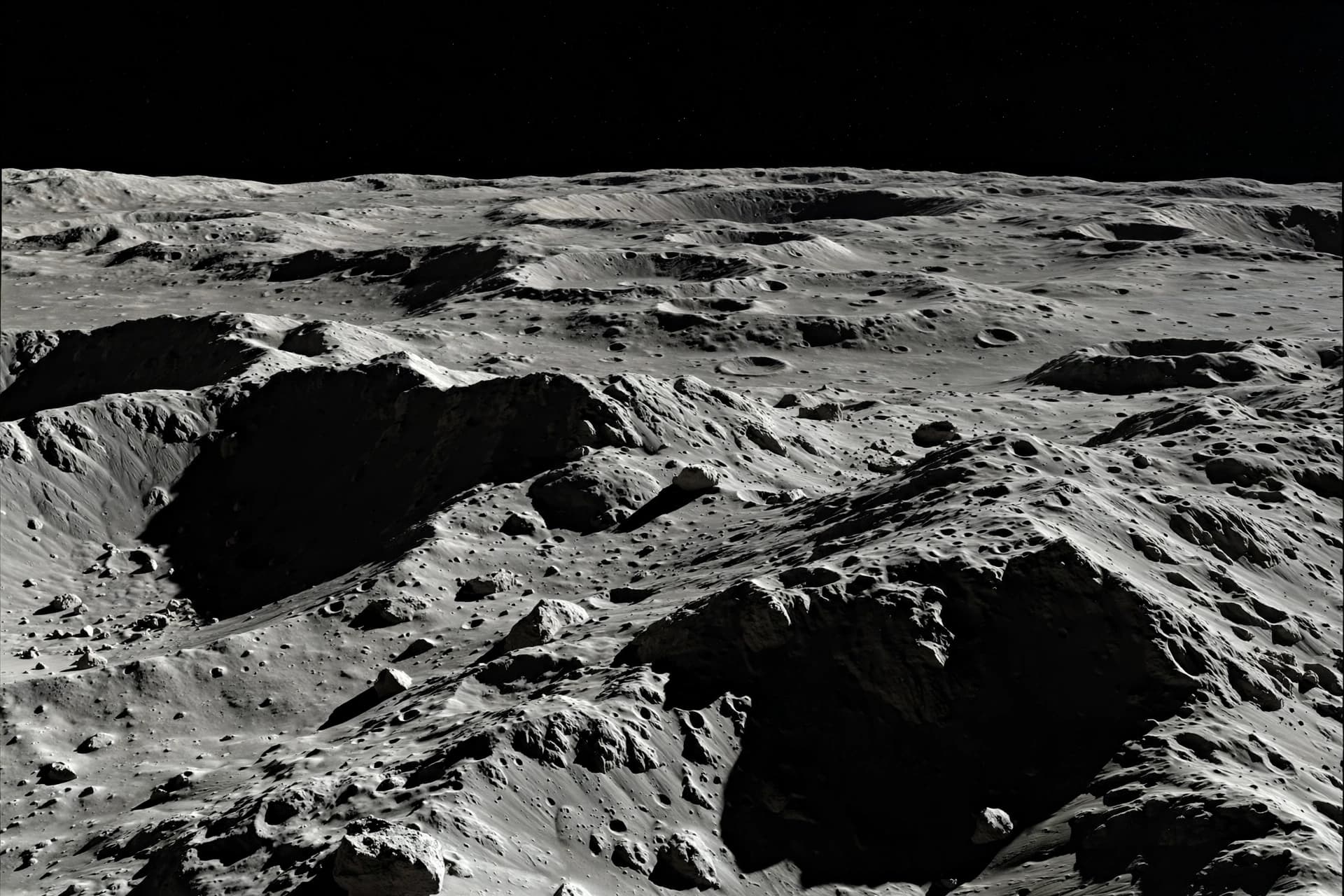
Mercury has always been the quiet one, the smallest planet huddled closest to the sun, scorched and cratered, easy to overlook in the grand parade of worlds. Yet there is a particular kind of mystery that clings to the unassuming. Beneath its cracked and gray exterior, Mercury holds secrets about how planets are built and how they change, secrets that scientists have been piecing together with the patience of archaeologists brushing away centuries of dust. The planet's interior, it turns out, is stranger than anyone expected.
Data from NASA's MESSENGER spacecraft, which orbited Mercury from 2011 to 2015, revealed a world of superlatives. Mercury is the second densest planet after Earth, but when gravitational compression is accounted for, it is the densest of all, with an uncompressed density far exceeding Earth's . Its iron core takes up an estimated 83 percent of the planet's diameter, compared to Earth's comparatively modest 54 percent . This is a world that is, in essence, a enormous metallic heart wrapped in a thin shell of stone.
The MESSENGER mission's gravity measurements pushed this estimate even higher, suggesting that as much as 85 percent of Mercury's radius is occupied by its dense core . Such a structure leaves precious little room for a mantle, the silicate layer that on other rocky planets drives volcanism and tectonics. And yet Mercury's surface shows signs of geological activity that persisted well past its first several hundred million years. Basin floors are tilted, uplifted, disturbed—evidence of an active middle age that a thin mantle should not, by conventional thinking, be able to produce .
Scientists have proposed a solution to this paradox. The liquid iron core may be encased in a relatively thin shell of iron sulfide, a layer that would satisfy the gravitational data and explain why Mercury's crust is enriched in sulfur and depleted in iron . But this too creates problems. If most of the planet is core topped by sulfide, there is relatively little mantle available to drive the tectonic and volcanic features observed at the surface .
Adding to the complexity, MESSENGER surprisingly revealed Mercury to be a volatile-rich planet despite its proximity to the sun. Elements like sulfur, sodium, potassium, and chlorine are abundant and widespread, and their distribution does not appear to correlate simply with surface temperature . This was not the picture anyone had expected of a scorched, airless world. Mercury, it seems, has been holding onto more than its fair share of surprises.
The question now is how to peer deeper. A dedicated lander or a more advanced orbiter with instruments capable of probing beneath the crust would help resolve the uncertainty. Seismic measurements, similar to those that revealed Earth's internal structure, would be transformative, but placing seismometers on Mercury's harsh surface presents formidable engineering challenges. For now, scientists must rely on gravity, topography, and the slow accumulation of orbital data.
What makes Mercury worth this attention is not merely curiosity about a distant oddity. The planet's extreme density and unusual internal structure offer a test of theories about planetary formation and differentiation. How does a world end up with a core that dominates its volume? What does that say about the building blocks of the solar system? The answers may lie beneath that scarred, sun-baked surface, waiting for the right question and the right instrument.
AI Image Disclaimer: This article features AI-generated visuals created for illustrative purposes only.
Sources: Nature, Journal of Geophysical Research: Planets, NASA MESSENGER Mission, HAL Theses
Published by Banx Network. This article is part of the Banx decentralized media programme, powered by the BXE token on the XRP Ledger.