In the damp stillness of a West Virginia woodland, where oak and beech leaves gather in soft layers and moss holds moisture like a quiet promise, a man knelt on the ground for forty-five minutes, taking photographs of something he had never seen before. Drew Palmer is not a professional scientist. He is an amateur mycologist, a board member of the West Virginia Mushroom Club, and the person poison control calls when someone may have eaten the wrong fungus. But in June, on a walk near his home in Cross Lanes, he found two mushrooms of a color combination so striking, so far removed from the expected palette of the region, that he knew immediately they were something apart .
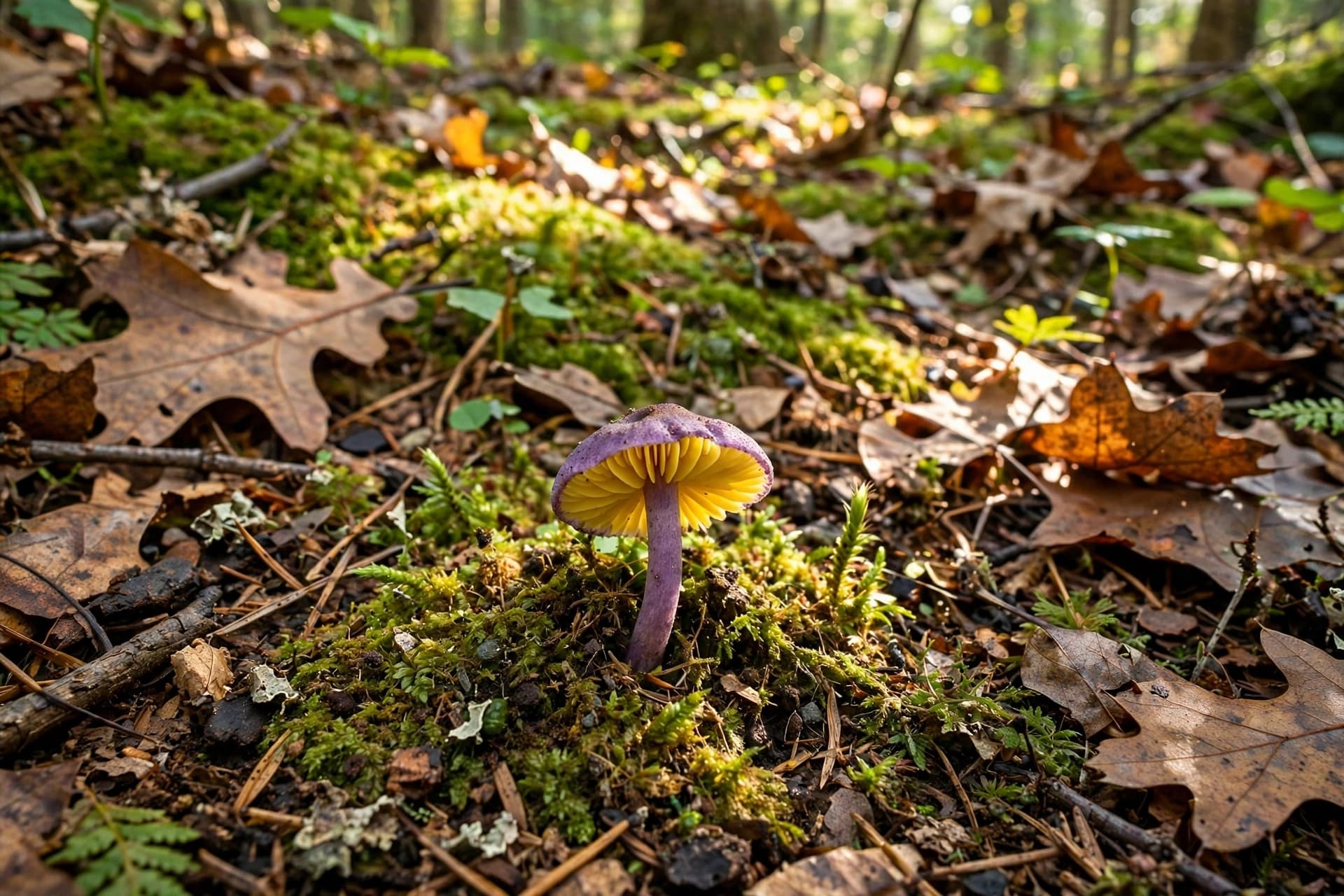
The mushrooms were bright purple with chrome yellow gills. Under ultraviolet light, the colors shifted entirely, becoming blue, orange, and a translucent white. Palmer photographed them, consulted books and papers, posted images on iNaturalist and international mycophile forums. No identification emerged. He sent dehydrated tissue samples to the Mycota Lab in Michigan for DNA sequencing. The result, when it came, was a sequence that had never been recorded in any database .
It is tempting to hear such news as the opening of a science fiction story. Palmer himself said as much, with a kind of delighted humility: the truth, he suggested, is sometimes cooler than fiction. But the reality is more grounded and, in its own way, more remarkable. Fungi are among the least catalogued major groups of living things. A widely cited estimate holds that between two and four million fungal species exist, of which only a fraction have been formally named. Most of the world's fungi have never been described at all .
An unmatched DNA sequence, however, is not the same as a confirmed new species. Reference databases remain incomplete, and a formal description requires detailed morphological comparison, careful documentation, and publication in a peer-reviewed venue. Palmer's mushroom, temporarily designated Hygrocybe sp. 'WV02', is for now a very promising question rather than a settled answer. Its closest known relative, he noted, is a conifer-loving species from California and the Pacific Northwest, a significant genetic and geographic distance away .
What gives the story its quiet weight is not the possibility of a new species alone. It is the reminder that the living world remains, in many corners, uncharted. Palmer was not searching for novelty when he found it. He was walking in woods he knows, looking at the ground, paying attention. The discovery arrived not as a conquest but as a gift to someone who had cultivated the habit of noticing .
There is also a practical dimension to Palmer's work that deserves mention. His role with poison control means he sees the consequences when curiosity outruns caution. His advice to foragers is plain and worth repeating: do not eat a mushroom on a whim or a hunch. Know what you have before you eat it. The same woods that harbor the unfamiliar also harbor the dangerous, and the line between them is not always visible to the untrained eye .
For now, researchers continue their analysis. The mushroom may prove to be a new species. It may belong to an entirely new genus, a larger taxonomic category that would make the find more significant still. Or it may turn out to be something already known but never sequenced, a quieter outcome that would still add a page to the catalogue. Palmer, for his part, seems at peace with the uncertainty. Finding something brand new, he said, is just a step above .
AI Image Disclaimer: The visual content associated with this article was created using artificial intelligence and does not depict the actual specimen.
Sources: Futura-Sciences, WCHS / WKRC Local 12, WV News, Yahoo News
Published by Banx Network. This article is part of the Banx decentralized media programme, powered by the BXE token on the XRP Ledger.