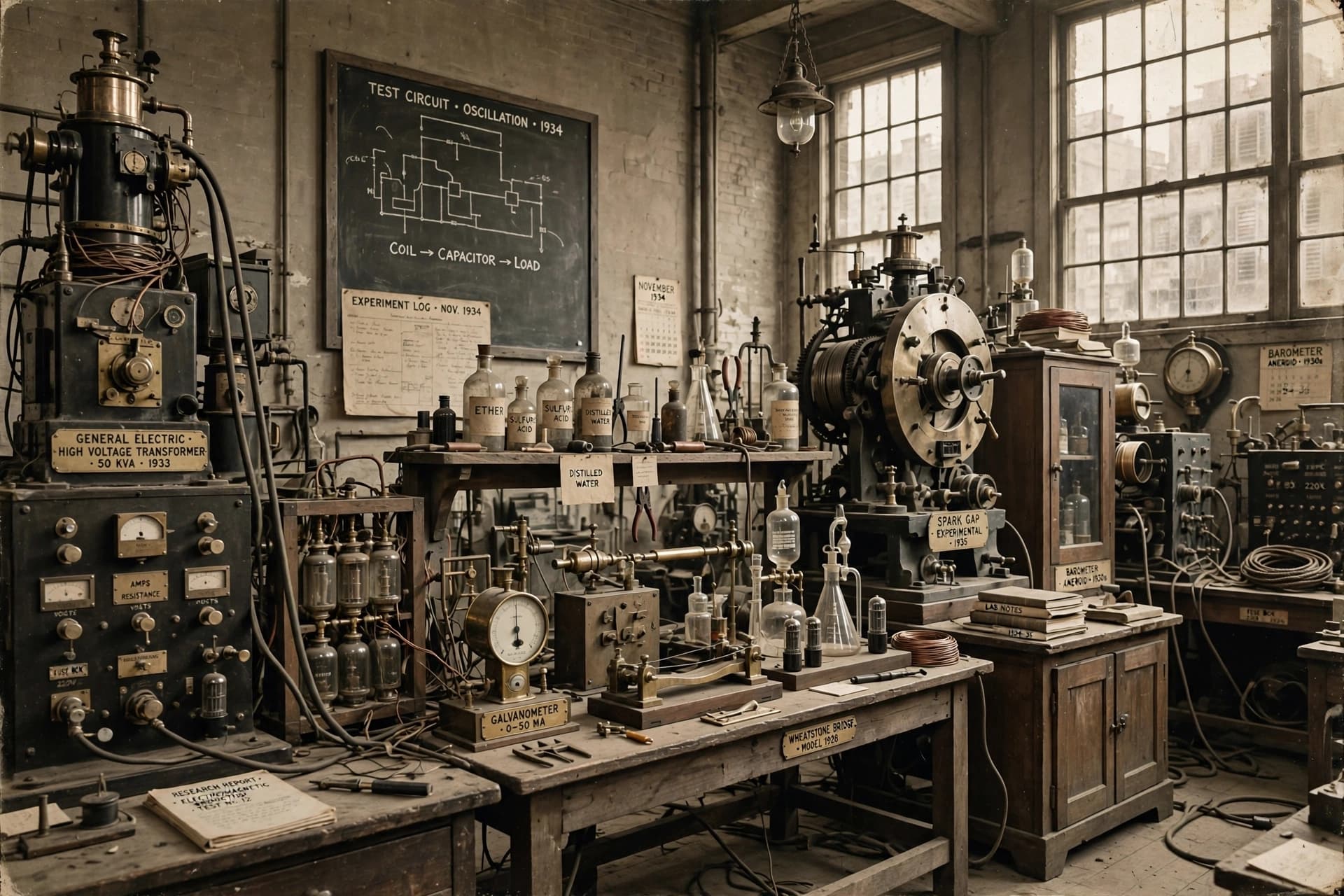
There is a particular kind of courage that belongs to the laboratory—the willingness to crawl on the floor to avoid electrocution, to work with voltages that could kill, in pursuit of a question no one has yet answered. In the early 1930s, at the Cavendish Laboratory in Cambridge, two physicists did exactly that. Their names were John Cockcroft and Ernest Walton, and seventy-five years ago this year, their perseverance was honored with the Nobel Prize in Physics.
Before Cockcroft and Walton, the study of atomic nuclei relied on naturally radioactive materials, which emitted particles spontaneously . Ernest Rutherford had already shown that these particles could transform one element into another. But Cockcroft and Walton wondered if they could do it deliberately—using a machine to accelerate particles and hurl them at a target .
Working under Rutherford's direction, they built the first particle accelerator capable of accelerating hydrogen atoms, each consisting of a single proton, to high energies. Their high-voltage system could produce up to 800,000 volts—the equivalent of over 500,000 AA batteries . The apparatus was modest by modern standards, fitting comfortably in a room. Today's accelerators, like those at CERN, stretch for 17 miles .
In 1932, they directed their accelerated protons at a lithium target and witnessed something remarkable. The lithium nuclei split, producing two alpha particles . This was the first artificial nuclear reaction, a demonstration that humans could build machines to probe and transform the nucleus itself.
The legacy of that experiment is difficult to overstate. Particle accelerators became essential tools not only for nuclear physics but for medicine, materials science, and even art research. They are used to diagnose and treat disease, to study the structure of ancient artifacts, and to explore the fundamental constituents of matter .
The Nobel Prize came in 1951, nearly two decades after the breakthrough. By then, the field they had launched was already transforming the world. The apparatus they built has been superseded by machines of unimaginable scale and power, but the principle remains the same: if you want to understand the smallest things in the universe, sometimes you have to build something large enough to reach them.
Seventy-five years after the prize, their work continues to echo through laboratories around the world. The physicist who crawls on the floor to avoid a lethal current, the engineer who designs a magnet that can bend a beam of particles, the doctor who uses that beam to treat a tumor—all of them are heirs to the room-sized machine Cockcroft and Walton built in Cambridge.
AI Image Disclaimer: Visuals in this article are AI-generated and do not depict actual historical events.
Sources: The Conversation, Yahoo Science, Nobel Prize, Cavendish Laboratory
Published by Banx Network. This article is part of the Banx decentralized media programme, powered by the BXE token on the XRP Ledger.