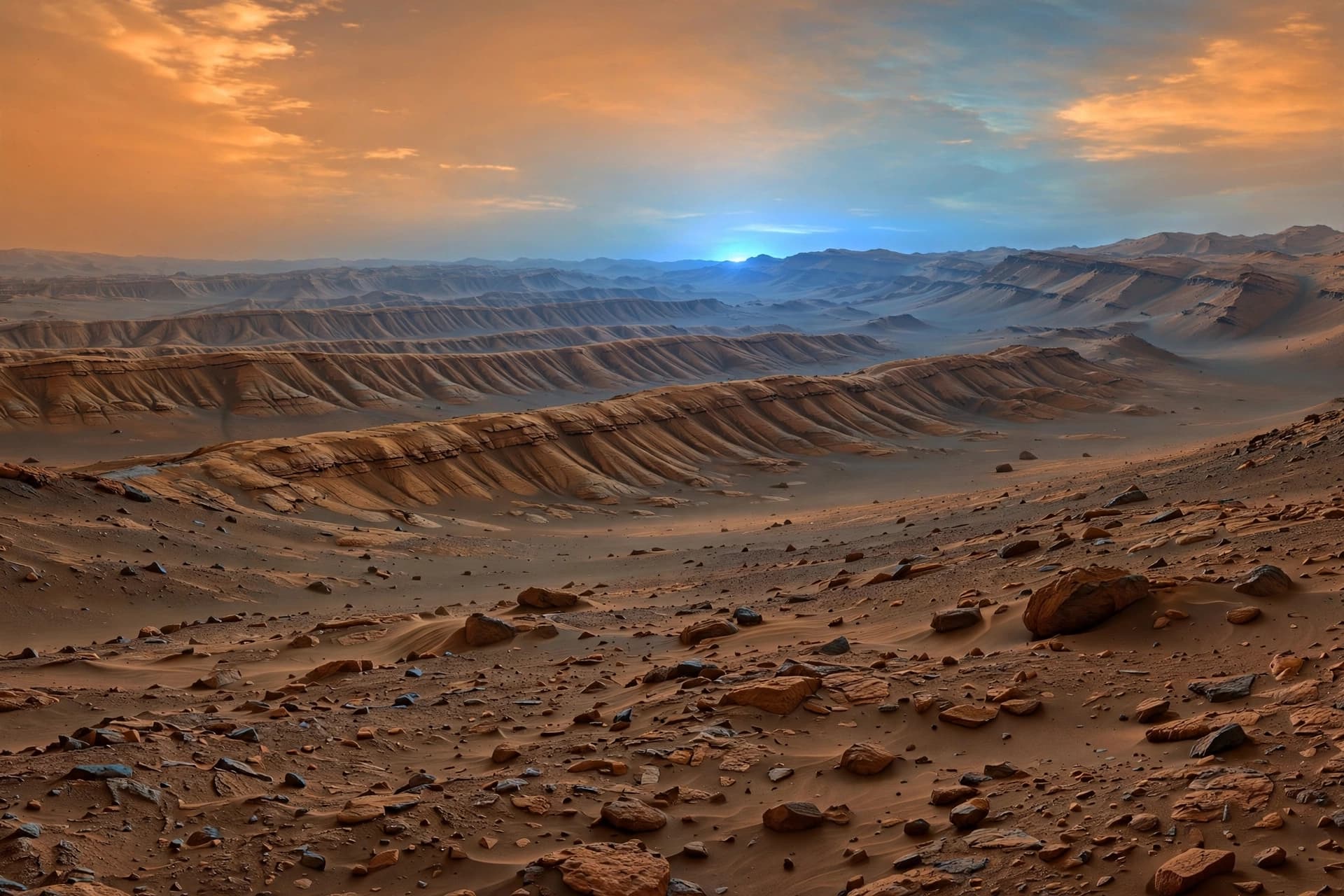
There is a particular silence that attends the first light of day on another world—a stillness that no human ear has heard, but that the camera of a solitary rover has learned to capture. This week, NASA released an image from the Curiosity rover that shows that silence made visible: sunlight spilling across wind-carved cliffs on the shoulder of a mountain that rises from the floor of an ancient crater.
The image was taken by Curiosity's Mastcam camera about an hour after sunrise on August 11, 2026—the 4,982nd Martian day of the mission. It captures a landscape of jagged crags in the distance, features that scientists call "yardangs," carved by eons of wind into ridges and peaks. "The bright craggy peaks in the distance are a rock layer that is quite different in appearance from all the layers the rover has driven through so far," said Ashwin Vasavada, Curiosity's project scientist at NASA's Jet Propulsion Laboratory .
Curiosity landed in Gale Crater near the Martian equator in 2012. Since 2014, it has been climbing Mount Sharp, a five-kilometer-tall mountain built from layers of sedimentary rock, each recording a chapter in the planet's geological history. The rover has now gained more than a kilometer in elevation—the most ever climbed on Mars—and is approaching a layer that may hold clues about a time when the planet was warmer and wetter .
The yardang layer likely formed about three billion years ago. Scientists believe it began as wind-blown sediment—perhaps sand or volcanic ash—that hardened into rock and was then sculpted by wind over unimaginable spans of time. The layer spans roughly 16 kilometers across the northwestern slopes of Mount Sharp . But it does not appear to be part of the continuous stack of layers that make up the mountain. It sits above what geologists call an unconformity—a gap in time where earlier layers eroded away before new material was deposited on top .
The image was processed without the usual white balancing that Curiosity's cameras typically apply, an artistic choice that preserves the early morning appearance of the scene. The result is a sky that glows orange, a sunrise with shades of blue, and a landscape that feels both alien and eerily familiar. "This scene has a wildness that reminds me of a road trip through Monument Valley, Arizona," Vasavada said. "You can almost feel the silence and the endless open space under the sky. But as familiar as that sounds, the sky is orange and the sunrise has shades of blue. It's like Earth, but it's definitely Mars" .
Curiosity is expected to reach the yardang layer in 2027 or 2028, when it will use its instruments to study the geology up close and perhaps answer lingering questions about how the layer formed . For now, the rover continues its slow ascent, one Martian day at a time, carrying with it the curiosity that gave it its name.
AI Image Disclaimer: The images accompanying this article are generated by artificial intelligence and are intended for illustrative purposes only.
Sources: NASA Science, CBC News, South China Morning Post, Telegraph India, GMA Network
Published by Banx Network. This article is part of the Banx decentralized media programme, powered by the BXE token on the XRP Ledger.