Key Highlights
- New Research:A UCLA study reveals stellar collisions may explain early black hole formation.
- Cosmic Mystery:Observations show supermassive black holes existed less than a billion years after the Big Bang.
- Simulation Insights:Researchers suggest dense star clusters led to the rapid creation of massive stars and black holes.
A new study from researchers at UCLA sheds light on a cosmic mystery that has puzzled astronomers: the rapid formation of supermassive black holes shortly after the Big Bang. Utilizing data from the James Webb Space Telescope, the team has identified a phenomenon they refer to as 'Little Red Dots'—small, luminous objects that are too bright and compact to fit existing theories of galaxy formation. These objects may harbor black holes that are unexpectedly massive for their host galaxies.
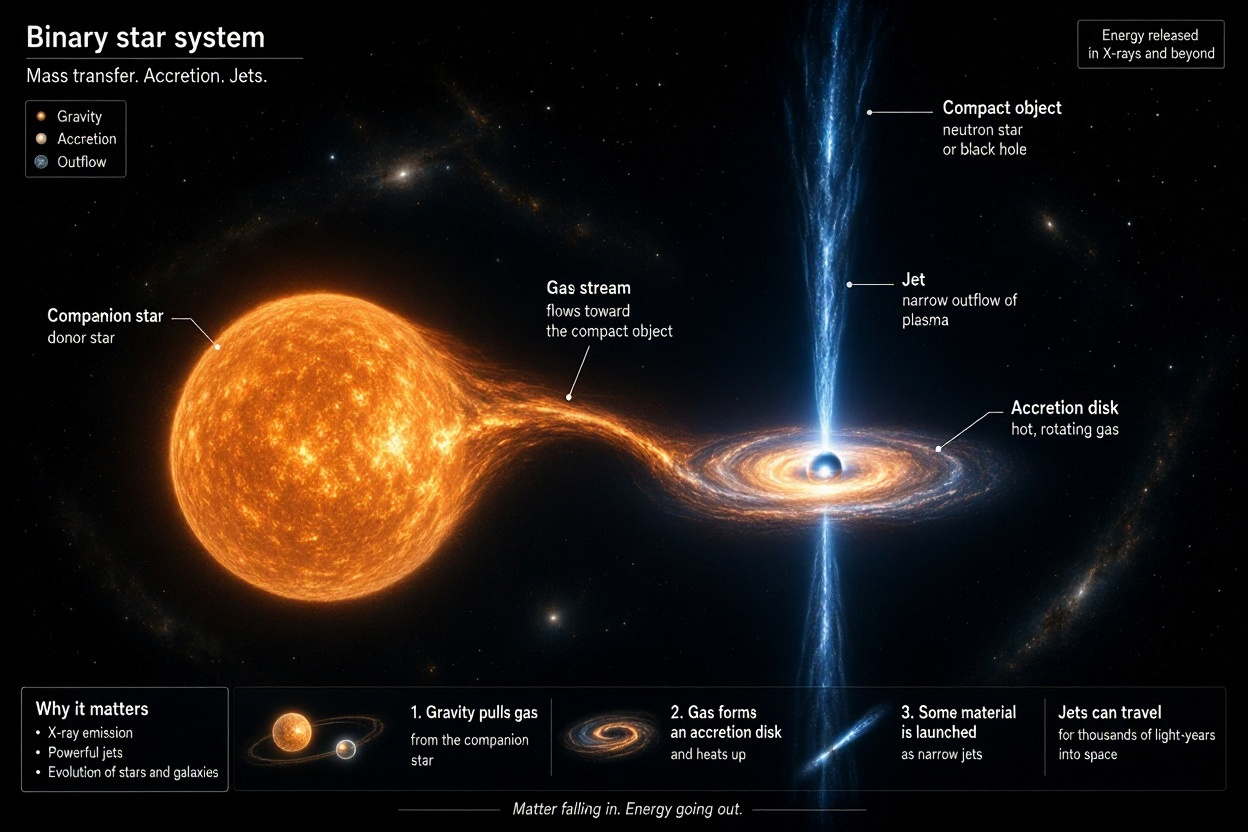
The research proposes that these black holes could have formed from stellar collisions rather than the traditional models of gradual growth through mergers and accretion. In the dense stellar environments of the early universe, stars would have collided and merged repeatedly, creating extraordinarily massive stars. When these massive stars reached the end of their life cycles, they could collapse directly into intermediate-mass black holes, which could then evolve into the supermassive black holes observed today.
The timing of these events is critical. Observations have shown that supermassive black holes, some with masses millions or billions of times that of the sun, existed less than a billion years after the Big Bang. This timeline poses a challenge to conventional models, which suggest that such massive entities could not have formed so quickly from smaller black holes. The UCLA simulations provide a potential solution: dense star clusters where repeated collisions produce a single massive star capable of collapsing directly into a black hole, bypassing the usual growth stages.
The Little Red Dots may serve as indicators of these dense stellar environments. Instead of being mere galaxies powered by a central black hole or star formation, they could represent clusters of stars in constant collision, with a massive star forming at their core. Claire Williams, a researcher involved in the study, remarked, "Perhaps the strangest outcome of our simulations is that stars can merge repeatedly within the cluster until they form one gigantic star with a mass equal to that of an entire cluster."
While the research does not claim to have solved the entire puzzle of black hole formation, it offers a framework that connects various observations: the abundance and compactness of the Little Red Dots, their fleeting existence in cosmic history, and the presence of black holes that seem to defy conventional understanding. Team member Smadar Naoz likened the study to the parable of blind people describing an elephant, where each perspective reveals a part of the truth.
The implications of this research are significant, as they could reshape our understanding of the early universe and the formation of black holes. Further observations and refinements will be necessary to validate these findings, but for now, the study provides a comprehensive view of a complex cosmic phenomenon.
Image Disclaimer: The visual accompanying this article was generated by artificial intelligence and does not depict actual astronomical observations.
Published by Banx Network. This article is part of the Banx decentralized media programme, powered by the BXE token on the XRP Ledger.