
Key Highlights
- Discovery:Astronomers have identified a cool molecular gas trail in the Large Magellanic Cloud.
- Source:The trail is linked to LMC P3, a luminous gamma-ray binary system.
- Implications:This finding may enhance methods for identifying microquasars and understanding cosmic ray contributions.
In a groundbreaking discovery, astronomers have detected a remarkable trail of cool molecular gas in the Large Magellanic Cloud (LMC), a dwarf galaxy located near our Milky Way. This trail is associated with LMC P3, the most luminous gamma-ray binary known outside our galaxy. Observations made with the Atacama Large Millimeter/submillimeter Array (ALMA) in Chile reveal that this jet-like feature extends approximately eight parsecs in length and one parsec in width, indicating that LMC P3 is actively driving this outflow.
The significance of this discovery lies in the temperature of the carbon monoxide gas within the jet, which registers between thirty-three and sixty Kelvin. This is notably warmer than the surrounding non-jet cloud, which is around fifteen Kelvin. The absence of any nearby stars or visible shocks to account for this warmth suggests that shock heating is at play. The high-speed jet from the compact object is likely colliding with the ambient interstellar gas, compressing and heating it as it moves outward.
LMC P3 consists of a compact object—believed to be either a black hole or a neutron star—and a massive O-type star that exceeds thirty solar masses. The two stars orbit each other every 10.3 days. For years, scientists have debated the source of LMC P3's intense gamma-ray emissions, with theories ranging from colliding stellar winds to a microquasar jet powered by accretion onto the compact object. The new data from ALMA strongly supports the latter hypothesis, providing crucial insights into the nature of this binary system.
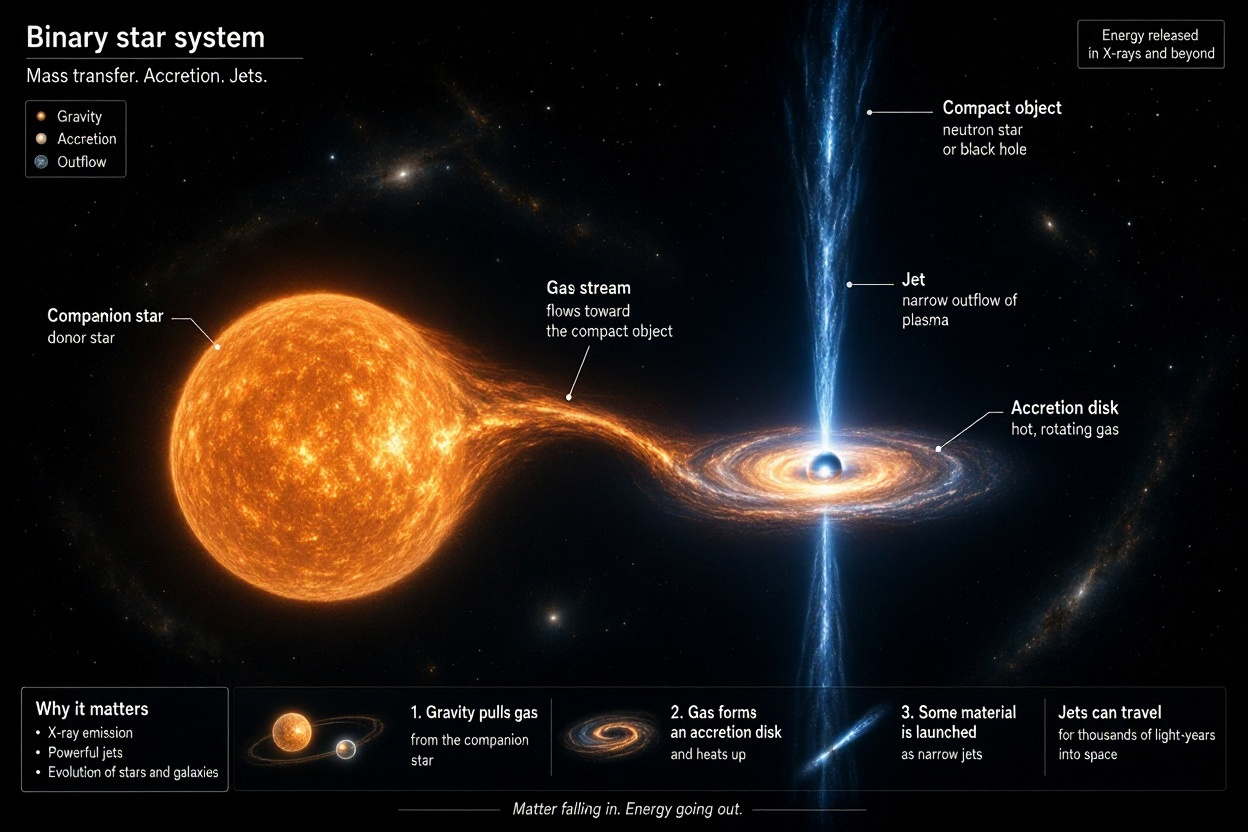
Microquasars are essentially smaller versions of the supermassive black holes that power distant quasars. In these systems, material from the companion star spirals toward the compact object, forming an accretion disk. Some of this material is then ejected in jets that travel at nearly the speed of light. When these jets interact with surrounding gas, they create shocks that heat the gas, which is precisely what ALMA has detected in the case of LMC P3.
This discovery also opens up new avenues for identifying microquasars. By utilizing submillimeter observations of molecular gas, astronomers may be able to detect jets that are otherwise invisible to X-ray or radio telescopes. This could lead to the identification of a class of objects that has remained elusive to researchers. Notably, LMC P3 may represent only the second known instance of cool molecular jets driven by a microquasar, following the discovery of HESS J1023-575 in our own galaxy.
The broader implications of this finding are still being explored. If microquasar jets can indeed accelerate particles and influence their environments over millions of years, they may play a significant role in the cosmic ray population in ways that have not yet been fully understood. The cool, warm gas associated with LMC P3's jet is not merely an interesting phenomenon; it serves as a visible trace of an invisible engine operating quietly in a neighboring galaxy, contributing to the ongoing process of cosmic transformation.
The images in this article were generated using artificial intelligence.
Published by Banx Network. This article is part of the Banx decentralized media programme, powered by the BXE token on the XRP Ledger.