Key Highlights
- New Study:Researchers estimate Earth's carbon likely arrived from outer solar system meteorites.
- Methodology:Analysis of ancient magma droplets from Hawaiian volcanoes provides insights.
- Implications:Findings reshape understanding of how essential elements formed on Earth.
A recent study led by researchers from Columbia University and Yale University has provided new insights into the origins of Earth's carbon, suggesting that much of it may have come from carbon-rich meteorites in the outer solar system. This groundbreaking research offers the first observational estimate of the carbon locked in Earth's core, revealing that the element crucial for life on Earth likely traveled vast distances before becoming part of our planet.
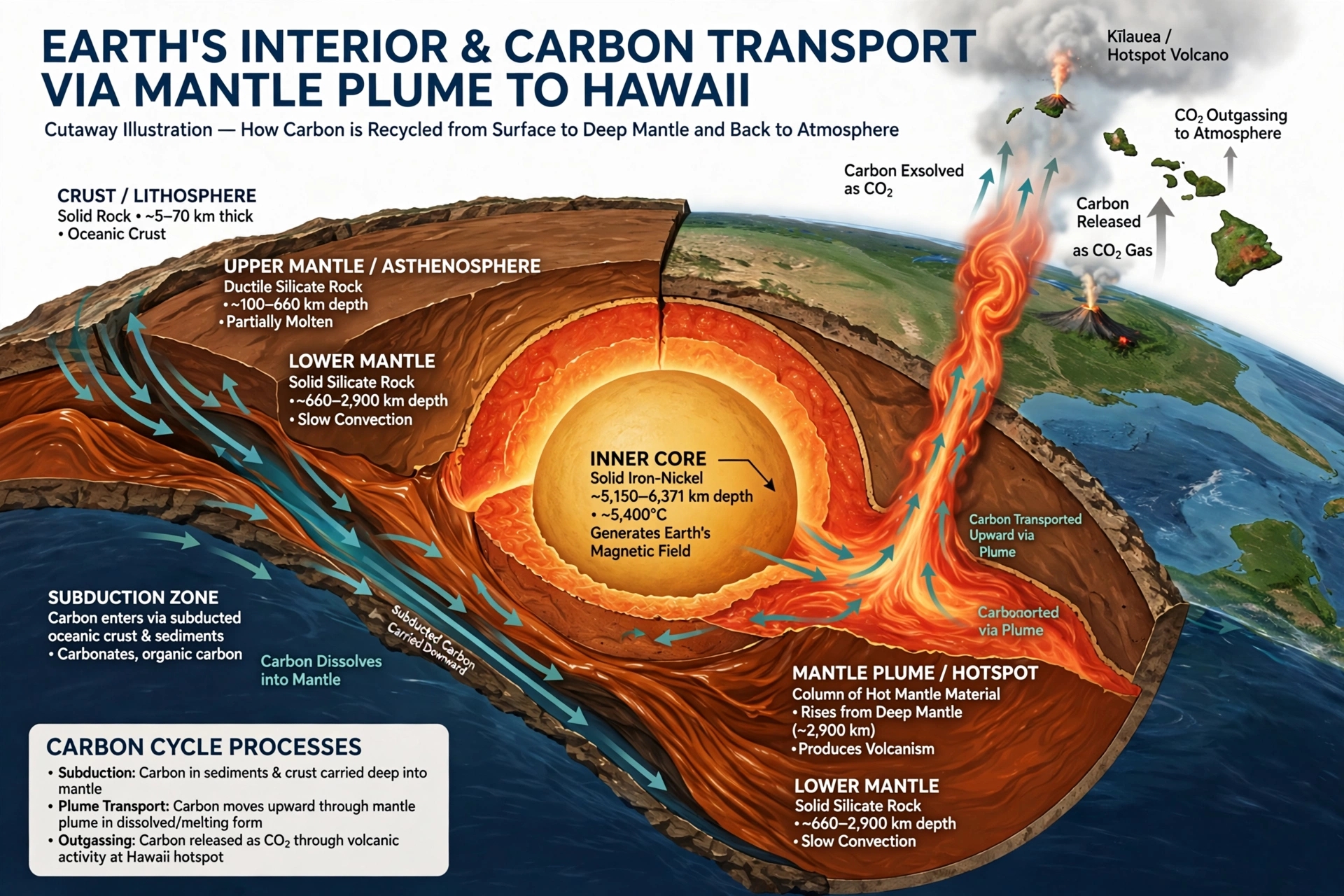
For decades, scientists have debated the sources of Earth's carbon, pondering whether it originated from the rocky material that formed the planet or from more distant celestial bodies. The challenge has always been the inaccessibility of Earth's core, where approximately 80 percent of its carbon is stored, nearly 2,900 kilometers beneath the surface. Direct measurement of this carbon has been deemed impossible, leading researchers to seek alternative methods to uncover its origins.
In their innovative approach, the research team analyzed tiny droplets of ancient magma, known as melt inclusions, trapped within crystals from Hawaiian volcanoes. These inclusions serve as valuable geological records, providing a glimpse into the conditions deep within the Earth. The lava from Kīlauea, during its shield-building phase, samples a mantle plume that originates at the core-mantle boundary. The researchers discovered a distinctive carbon isotope signature in these inclusions, characterized by a heavier ratio of carbon-13 to carbon-12 than typically found in ordinary mantle material.
This unique isotopic fingerprint suggests that the carbon is leaking from the core, preserved through the extensive layers of rock above it. When compared to known materials, the isotopic signature matched that of carbonaceous chondrites—meteorites rich in carbon and organic compounds that originate from the outer solar system. This finding indicates that the carbon that now constitutes our atmosphere, cells, and fossil fuels may share a common ancestry with these icy bodies.
The timing of this carbon's arrival is also critical. If it had come earlier during Earth's formation, subsequent collisions with other celestial bodies could have expelled much of it back into space. Conversely, if it had arrived too late, the core would have already sealed, preventing any further exchange. The researchers concluded that only during the final stages of planetary growth did a window of opportunity exist for this carbon to be incorporated into Earth's structure.
While the study provides a coherent narrative regarding the origins of Earth's carbon, it does not answer every question. The core's carbon remains an estimate rather than a direct sample, and the interpretation relies on the assumption that mantle plumes accurately preserve the isotopic signature of their source. Nevertheless, the findings significantly enhance our understanding of how essential elements for life became part of our planet.
The uncertainty surrounding the core's composition serves as a reminder of the complexities of Earth's history. The deepest parts of our planet hold records that can only be deciphered indirectly, through volcanic activity that brings fragments of the core to the surface. This study represents not just a conclusion but a new framework for exploring the origins of Earth's carbon and the broader implications for planetary formation.
Published by Banx Network. This article is part of the Banx decentralized media programme, powered by the BXE token on the XRP Ledger.