Key Highlights
- Lumina Simulation:A new simulation called Lumina tracks the universe's first two billion years.
- Reionization Processes:It captures hydrogen and helium reionization, pivotal for cosmic transparency.
- Astronomical Insights:The simulation aids in interpreting observations from the James Webb Space Telescope.
Researchers from MIT, Harvard, and the Harvard-Smithsonian Center for Astrophysics have developed a groundbreaking simulation named Lumina, which offers unprecedented insights into the early universe. This simulation is the largest of its kind, tracking the first two billion years of cosmic history across a volume of space that is approximately 1.5 billion light-years on each side. This scale is more than 100 times larger than previous simulations, allowing scientists to observe the intricate interplay of dark matter, gas, stars, and radiation.
Lumina focuses on two critical transformations that marked the universe's transition from a dark age dominated by neutral hydrogen to a luminous cosmos. The first transformation is hydrogen reionization, a process initiated by ultraviolet light emitted from the first stars and galaxies. This light stripped electrons from neutral hydrogen atoms, enabling light to travel freely through space. The second transformation, helium reionization, is driven by the intense radiation from supermassive black holes. Lumina is unique in that it is the first simulation to model both processes together in a self-consistent manner, allowing researchers to observe how these reionization events influence the evolving universe.
The technical achievement of Lumina is significant, as it utilized over 15,000 graphics processing units on the Frontier supercomputer, one of the fastest in the world. The simulation encompasses half a trillion individual elements, achieving about 30 times the resolution of its predecessor, IllustrisTNG. This high resolution allows for the detailed modeling of individual galaxies while simultaneously capturing the large-scale radiation fields that shaped the entire cosmic volume.
The implications of Lumina are profound, particularly in light of the capabilities of the James Webb Space Telescope (JWST). As JWST observes the early universe with unprecedented clarity, astronomers require theoretical predictions to make sense of their findings. When Lumina's predictions align with JWST observations, it bolsters confidence in existing cosmological models. Conversely, discrepancies may highlight gaps in current understanding or assumptions that require revision. For example, Lumina has suggested that there may be fewer massive galaxies in the early universe than some observations indicate, presenting a challenge for future research.
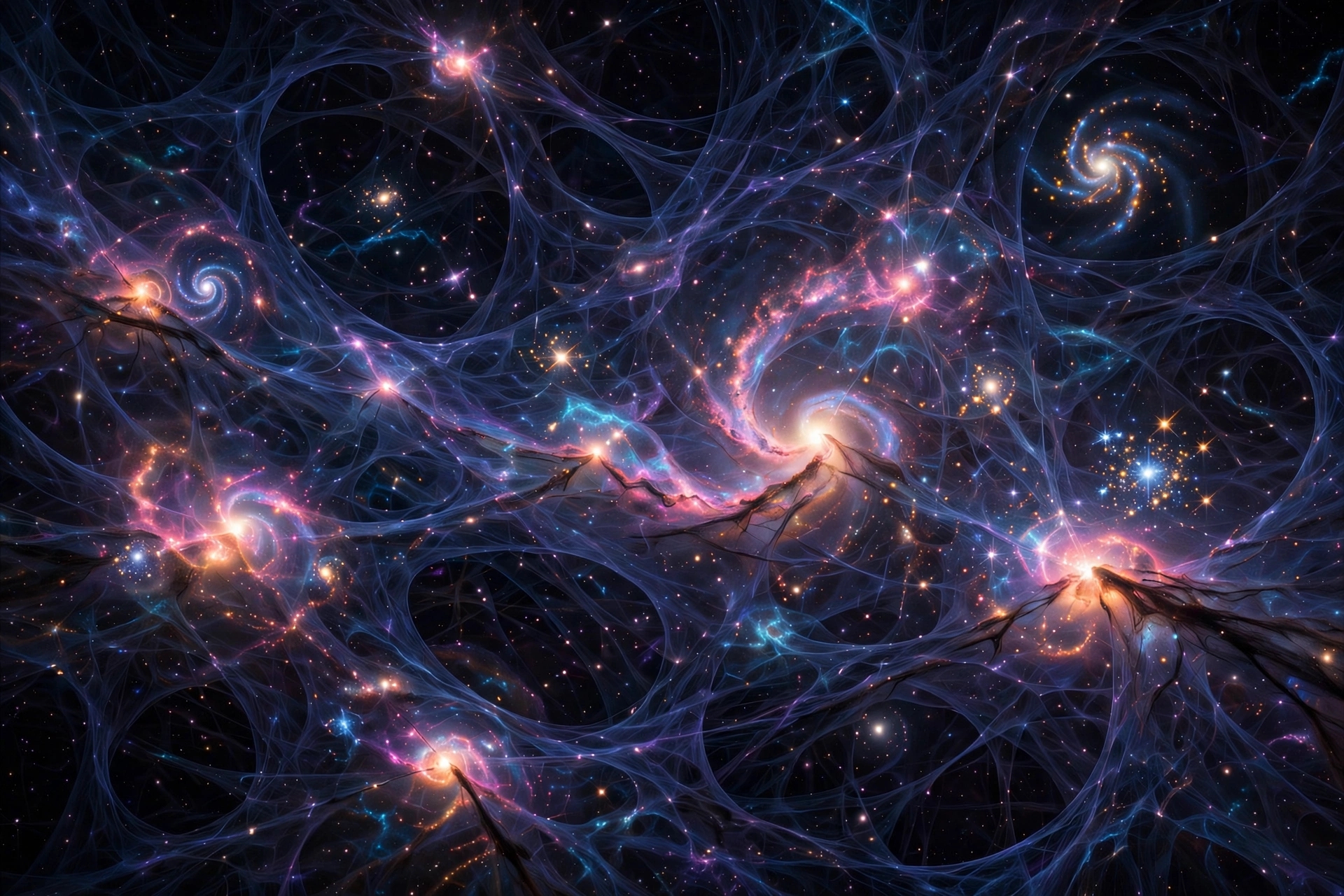
The collaborative effort behind Lumina has made the simulation accessible to the broader scientific community. Its visualizations, which depict the cosmic web, dark matter filaments, and glowing gas between galaxies, serve not only as scientific tools but also as artistic representations of a universe in the process of becoming. Watching the simulation unfold is a poignant reminder that every structure we observe today, from the Milky Way to Earth, has its origins in these early cosmic transformations.
Despite the advancements made through Lumina, the universe's first two billion years remain largely elusive, understood primarily through indirect evidence and theoretical models. Lumina does not directly observe these epochs; instead, it reconstructs them, testing our understanding against the principles of physics. The simulation acts as a hypothesis made visible, prompting scientists to evaluate whether the narratives constructed about the early cosmos hold true. Currently, the findings suggest a qualified affirmation, with enough uncertainty to keep the scientific inquiry vibrant and ongoing.
Published by Banx Network. This article is part of the Banx decentralized media programme, powered by the BXE token on the XRP Ledger.