Key Highlights
- New Analysis:A recent study confirms the existence of the black hole ring image captured in 2019.
- Scientific Validation:The findings support Einstein's predictions about light bending around massive objects.
- Ongoing Debate:Researchers continue to discuss the implications of different image reconstruction methods.
In April 2019, the scientific community celebrated a groundbreaking achievement: the first image of a black hole, showcasing a blurry ring of orange and red that represented the shadow of a supermassive black hole at the center of the galaxy M87. This image, produced by the Event Horizon Telescope (EHT) collaboration, was not only a technical marvel but also a cultural milestone, capturing the public's imagination. However, the image's authenticity sparked debate among researchers, with some questioning whether the ring was a genuine feature or merely an artifact of the complex image-processing techniques used to create it.
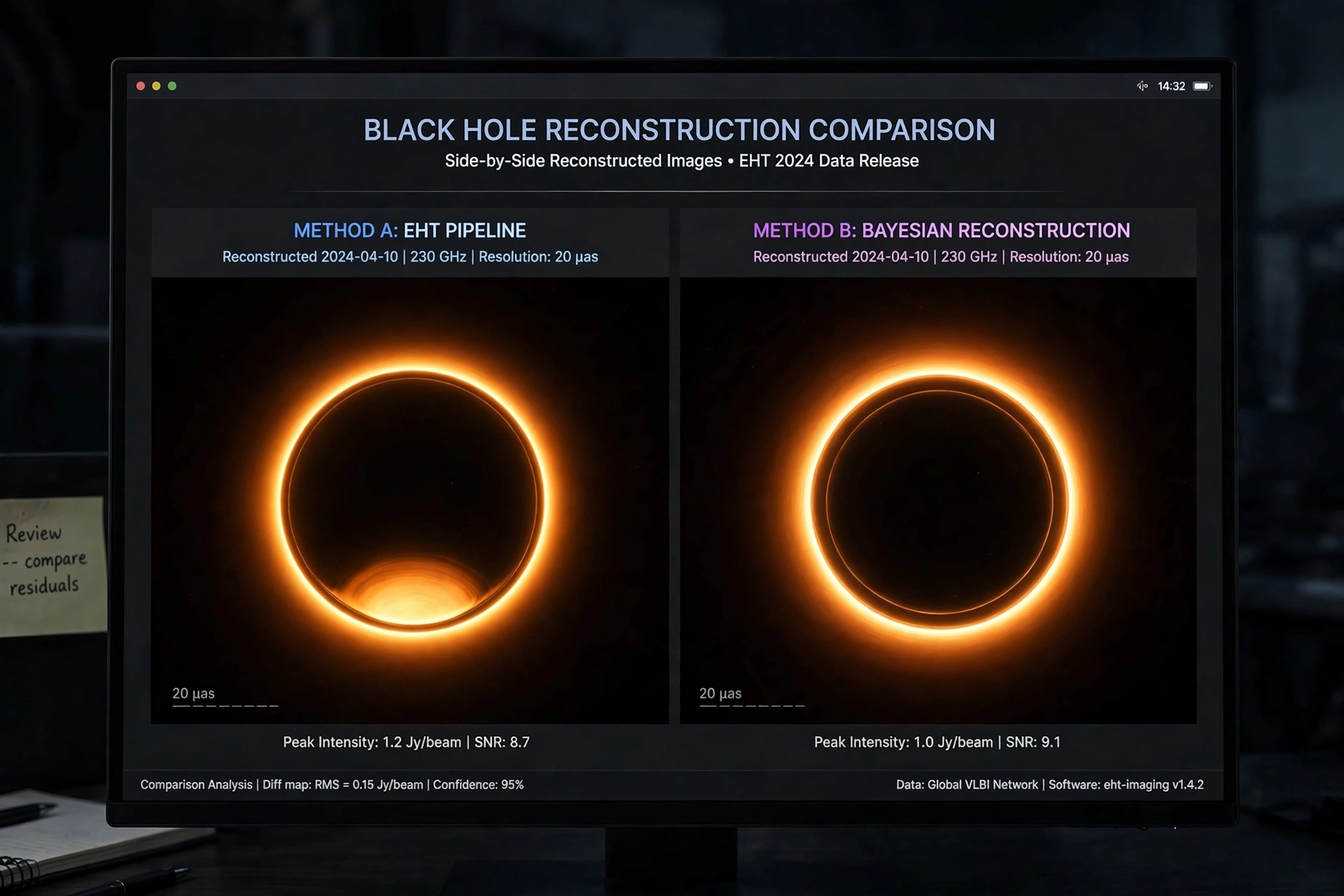
Recently, an independent team of scientists has reanalyzed the original data, and their findings, published in the journal Nature, affirm that the ring is indeed a real feature of the black hole. Led by Samuel Lai and Nithyanandan Thyagarajan from Australia's Commonwealth Scientific and Industrial Research Organisation (CSIRO), the new analysis employed a novel approach by grouping data from triplets of telescopes rather than pairs, which is the standard practice. This method allowed the researchers to preserve the integrity of the object's shape while minimizing errors caused by atmospheric distortions and telescope inaccuracies.
The results of this new analysis closely resemble the original EHT image, confirming the ring's characteristics, including its radius and the dark center surrounded by a bright arc. This independent verification not only reinforces the validity of the EHT's findings but also aligns with the predictions made by Einstein's general theory of relativity, which posits that light bends around massive objects like black holes. Such a clear validation of scientific predictions is a rare occurrence, underscoring the significance of this study.
Despite the positive findings, the debate surrounding the black hole image continues. Junichiro Makino, a researcher who previously produced a different interpretation of the data, remains skeptical. He points out that the new image contains brighter spots around the ring that shift depending on the reconstruction method used. This discrepancy raises questions about the reliability of the different approaches. Lai and Thyagarajan acknowledge these concerns but emphasize that their findings still demonstrate a consistent ring structure, regardless of the variations in prior models.
This ongoing dialogue among scientists exemplifies the nature of scientific inquiry. The EHT image was always a reconstruction based on data that required careful interpretation. The central question was whether the ring was a genuine feature of the data or simply a byproduct of the reconstruction methods employed. The new analysis suggests that the ring is indeed a real phenomenon, reinforcing the idea that scientific understanding is often built on inferences drawn from complex data.
The black hole at the center of M87 is located approximately fifty-five million light-years away from Earth. Its image, while blurry and imperfect, represents a remarkable achievement in human ingenuity and scientific exploration. The confirmation of the ring structure not only validates the EHT's groundbreaking work but also highlights the enduring relevance of Einstein's theories, which continue to provide profound insights into the nature of the universe.
As scientists continue to explore the mysteries of black holes and the fundamental laws of physics, the image of the black hole ring serves as a testament to the power of collaboration and innovation in the pursuit of knowledge.
The images in this article are AI-generated and do not depict the actual black hole image or the researchers involved.
Published by Banx Network. This article is part of the Banx decentralized media programme, powered by the BXE token on the XRP Ledger.