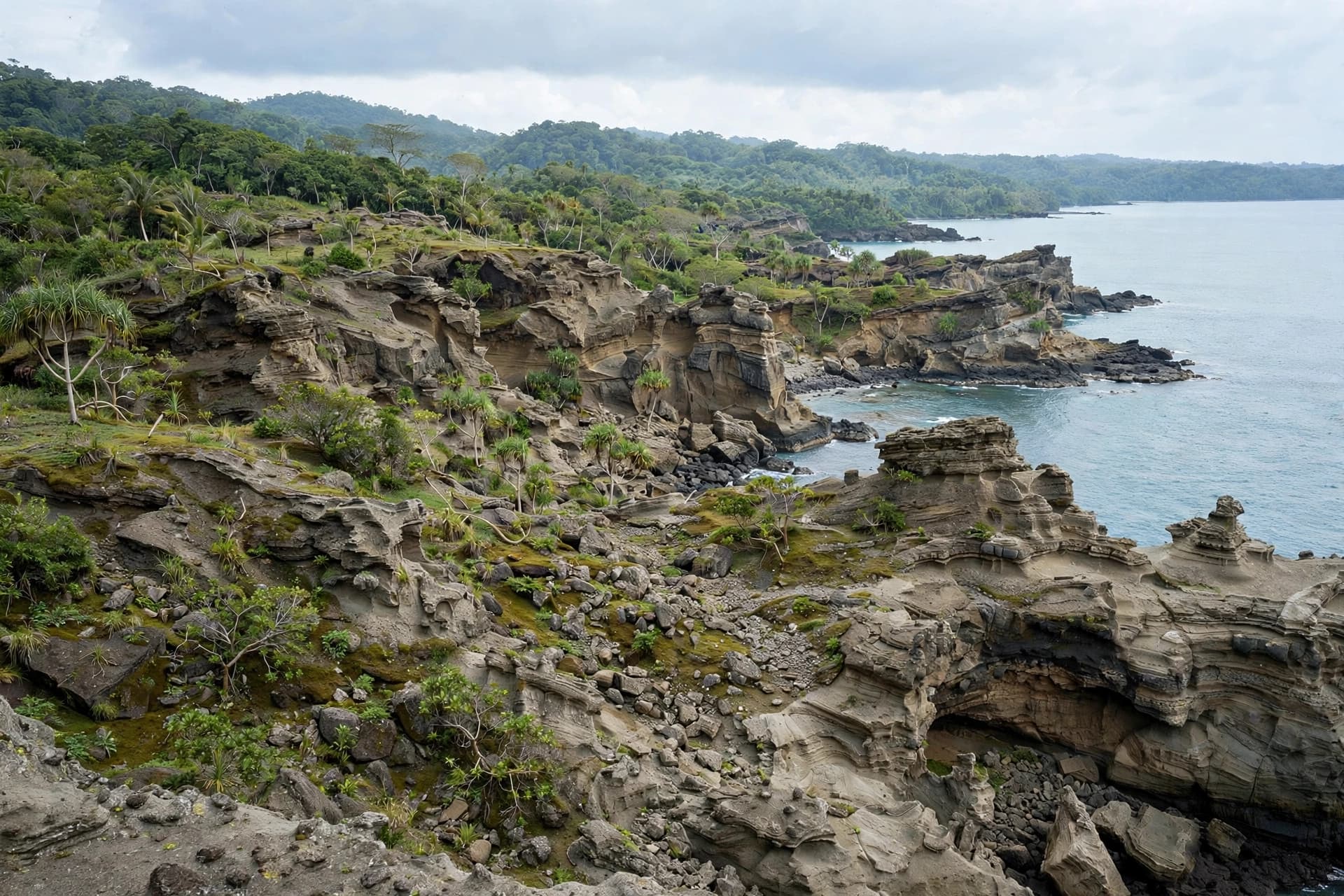
There is a counterintuitive truth buried in the rocks of Papua New Guinea—a story that defies the simple logic of depth and heat. In most places on Earth, the deeper you go, the hotter it gets. But in the gneiss domes of the D'Entrecasteaux Islands, something stranger happened: rocks that descended deeper underground also cooled, and they did so at remarkable speed.
The rocks in question are among the youngest ultrahigh-pressure (UHP) rocks ever found, formed just 5 to 8 million years ago. They were exhumed from depths of over 100 kilometers to the mid-crust at rates measured in centimeters per year—a pace that geologists describe as dramatic, almost violent . How they returned to the surface so quickly, and what happened to them along the way, has been a subject of debate for years.
A study published in Geochemistry, Geophysics, Geosystems used a technique called Ti-in-quartz thermometry to reconstruct the thermal history of these rocks. The method relies on the fact that quartz grains incorporate titanium as they crystallize, and the amount of titanium depends on temperature. By measuring titanium concentrations across 89 samples from four gneiss domes, researchers from Victoria University of Wellington and their colleagues inferred how quickly different parts of the domes cooled during exhumation .
What they found was unexpected. Titanium concentrations increased from the margins of the domes toward their centers, from 2.5 to 20 parts per million at the edges to 20 to over 100 ppm at the core. Higher titanium means higher temperatures were preserved—which suggests that the rocks near the center of each dome cooled most rapidly. The most rapidly cooled rocks were the ones that had been exhumed near the center of the domes .
That pattern reinforces a specific model of how these domes formed. Rather than being dragged sideways along large detachment faults, the researchers argue, the domes were pushed vertically upward as diapirs—buoyant blobs of hot rock that rose through the crust like bubbles in a thick liquid. The rapid cooling at the center fits this model: as the dome rose and decompressed, the core cooled quickly while the margins, which had been in contact with cooler surrounding rock for longer, retained lower temperatures .
The D'Entrecasteaux Islands are a natural laboratory for studying how UHP rocks return to the surface. The rocks are so young, and the exhumation so rapid, that the processes involved are still relatively fresh in geological terms—not yet erased by later events. The Ti-in-quartz data adds a new line of evidence to a debate that has been ongoing for decades, supporting the diapir model over the detachment-fault alternative.
For geologists, the finding is a reminder that the Earth's crust does not always behave according to simple expectations. Sometimes, the deepest rocks are the ones that cool the fastest—a paradox written in the chemistry of quartz, waiting millions of years to be read.
AI Image Disclaimer: Visuals in this article are AI-generated and do not depict actual geological specimens.
Sources: Geochemistry, Geophysics, Geosystems, Victoria University of Wellington, American Geophysical Union
Published by Banx Network. This article is part of the Banx decentralized media programme, powered by the BXE token on the XRP Ledger.