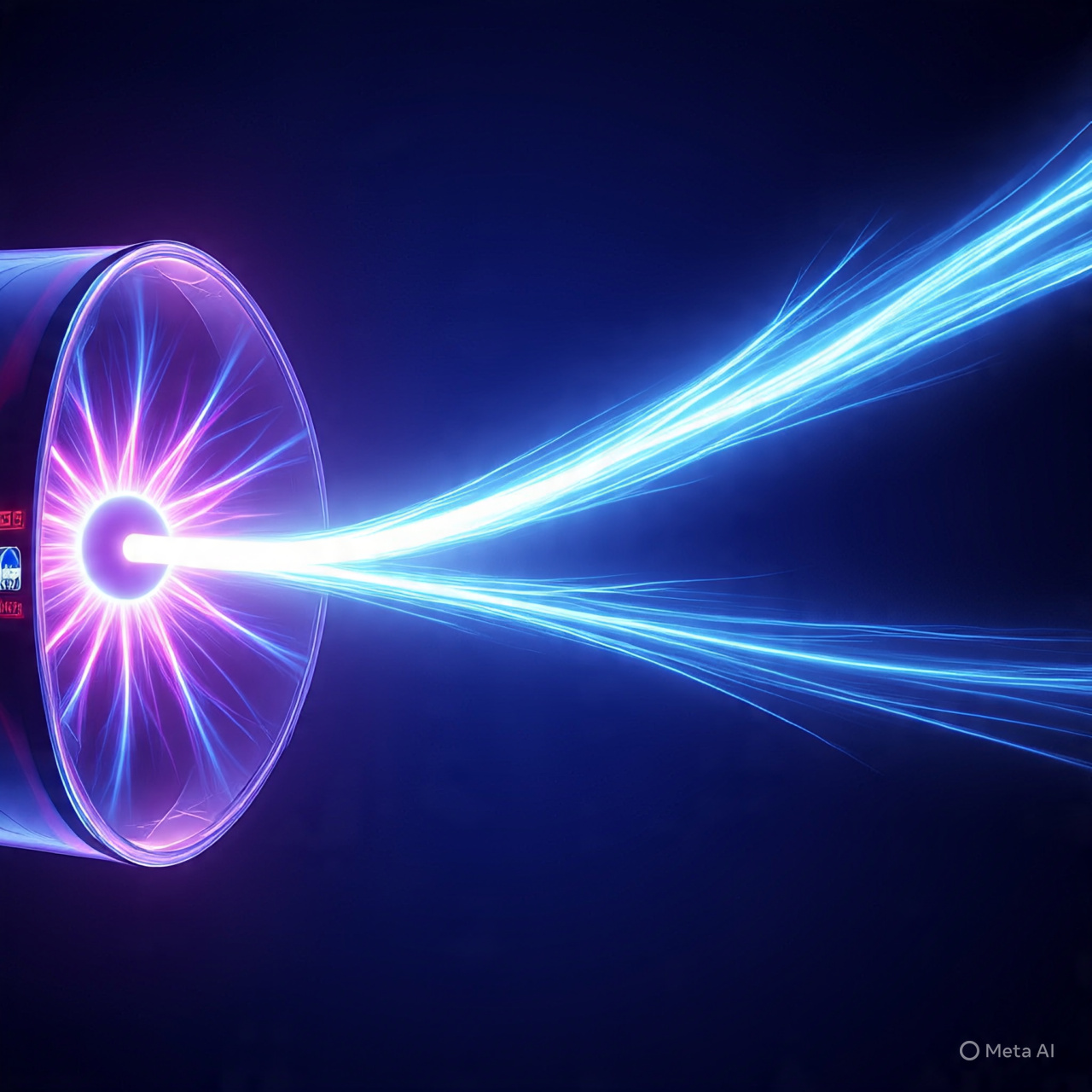
Traditionally, particle accelerators have been gargantuan structures: kilometers of magnets, cavities, and tunnels, like the Large Hadron Collider. But now, scientists are exploring accelerators that could fit on a table — or even on a microchip. According to recent simulations, it’s possible to build a microscopic synchrotron using “twisted light” and carbon nanotubes. The concept is elegant: a circularly polarized laser pulses through a hollow nanotube, creating a spiral electromagnetic field that traps electrons, forcing them to move in a corkscrew motion. As they spiral, they emit coherent, high-energy X-rays — and the fields inside the nanotube could reach teravolts (trillions of volts) per meter, far beyond conventional accelerators.
On a larger but still revolutionary scale, the AWAKE experiment at CERN is pushing forward a different paradigm: plasma wakefield acceleration. In this scheme, a high-energy proton beam drives waves in a plasma, like a speedboat cutting through a lake. Electrons then “surf” these wakefields, gaining massive amounts of energy over a much shorter distance than in traditional accelerators. The latest upgrades at AWAKE include a new rubidium-vapor plasma source that is segmented to control density, enabling stronger wakefields and paving the way for multi-stage acceleration.
Meanwhile, scientists are finding ways to merge different accelerator types. A team at Ludwig-Maximilians-Universität in Munich recently demonstrated that combining a laser-driven wakefield accelerator (LWFA) with a beam-driven wakefield accelerator (PWFA) gives better control and a denser beam of electrons. This kind of hybrid system could help tame the notoriously difficult plasma environment, making next-gen accelerators more stable and efficient.
Why does all this matter? Because these compact accelerators have real-world potential. A tabletop accelerator could be brought out of national facilities and into hospitals, universities, or industrial labs. In medicine, they could improve imaging — for example, enabling high-resolution X-ray scans without contrast agents. In drug development, labs could use these accelerators to analyze protein structures quickly and in-house. And in materials science or semiconductor research, they could nondestructively probe delicate components.
There are also advances in laser-plasma acceleration. Researchers at Berkeley Lab used dual lasers and a novel gas injection system to accelerate an electron beam to 10 GeV in just 30 centimeters. That’s a powerful beam in a tiny space — a clear sign that the future of acceleration may not lie in ever-larger machines, but in smarter, more intense fields.
Of course, much of this is still in the research or simulation phase. The microchip-style accelerator remains theoretical, and experiments to validate it have yet to fully materialize. AWAKE’s plasma sources are being upgraded, but scaling up and maintaining beam quality will remain technical challenges. And combining different wakefield methods demands precise control over plasma dynamics, which is notoriously fickle. But researchers are optimistic: the building blocks already exist, and the momentum is growing.
AI Image Disclaimer “Visuals are created with AI tools and are not real photographs — they serve as conceptual illustrations.”
Published by Banx Network. This article is part of the Banx decentralized media programme, powered by the BXE token on the XRP Ledger.