Key Highlights
- Researchers at the University of Arkansas have developed a method to 3D-print lunar regolith into building blocks.
- The technique uses laser powder bed fusion, allowing for self-binding without additional materials.
- This innovation could significantly reduce the cost and complexity of lunar construction.
[Innovative Research on Lunar Construction]
There is a quiet poetry in the idea that the moon, which has watched humanity look upward for all of recorded history, might one day supply the materials for our arrival. For decades, engineers have dreamed of building structures on the lunar surface, only to confront a stubborn arithmetic: every kilogram of building material launched from Earth carries a cost measured not just in dollars but in fuel, complexity, and risk. The dust beneath astronauts' boots, it turns out, may offer a way out of that equation.
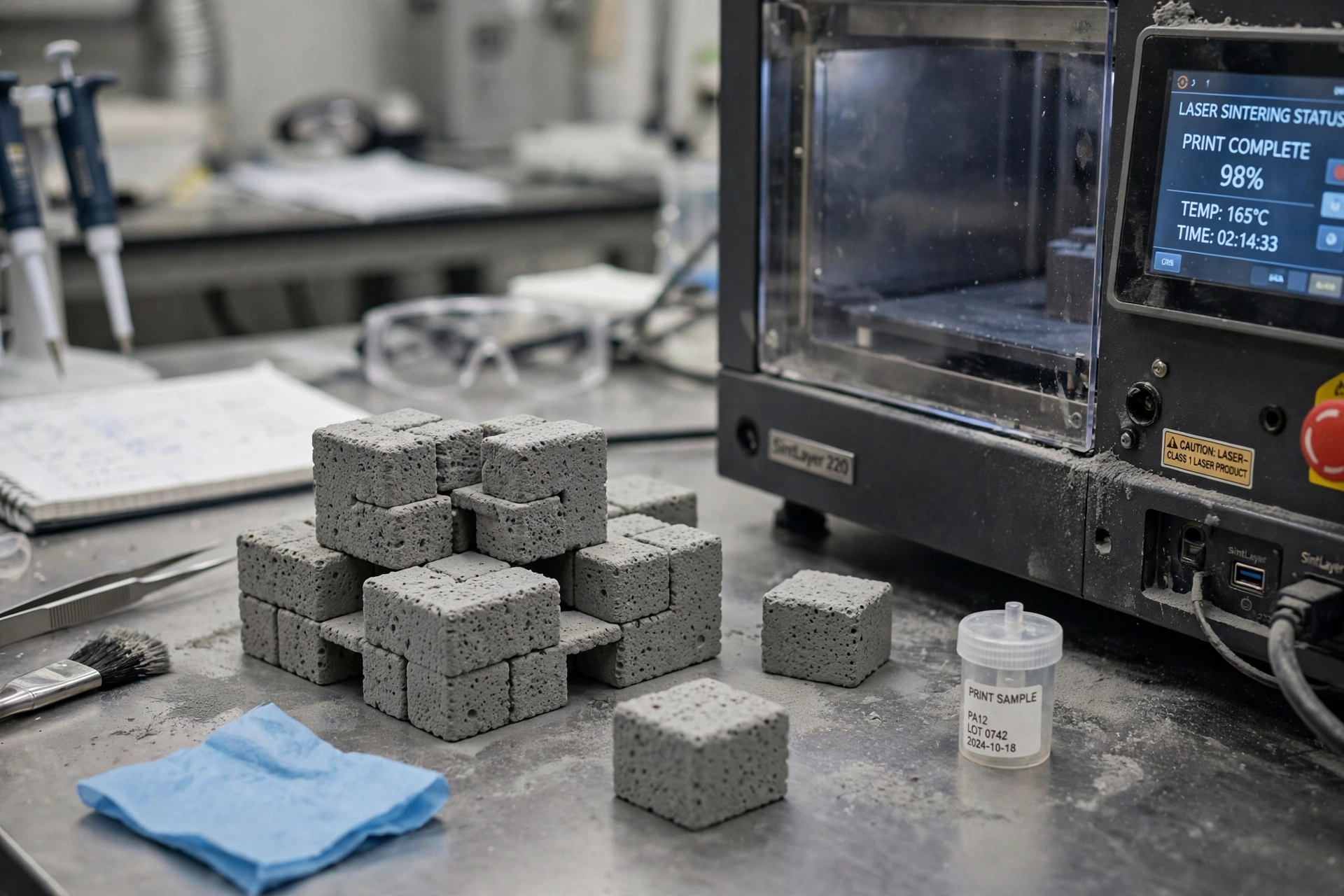
Researchers at the University of Arkansas have demonstrated that lunar regolith—the fine, jagged dust that covers the moon—can be 3D-printed into interlocking bricks without any binding agent. The work, published in the journal npj Advanced Manufacturing, utilized a technique called laser powder bed fusion, where a high-powered laser fuses layer upon layer of regolith simulant into solid shapes. The resulting blocks, shaped like crosses and the letter H, fit together like LEGO pieces, allowing for reconfigurable assembly without additional joining materials.
The significance lies in what the bricks do not contain. Previous approaches to lunar construction have relied on binders—substances that hold the regolith together—but those binders would have to be transported from Earth, defeating the purpose of using local materials. "There's nothing else it's binding to," said Cole McCallum, the study's first author, who was an undergraduate at Arkansas at the time. "The regolith powder is binding to itself." The researchers used Lunar Highlands Regolith Simulant, a commercially available material designed to mimic the samples Apollo astronauts brought home, and achieved a peak compressive strength of about 3.4 megapascals.
[Challenges and Considerations]
The caveats are important, and the researchers are careful to name them. The sintered blocks are more porous and structurally weaker than materials made with binders. McCallum noted that while the structures are self-supporting, he "would be hesitant to say our process could be used for something that's supporting other loads at this moment yet." The team also has not tested the approach in vacuum or microgravity, the two environmental conditions that would define any actual lunar construction. These are not small hurdles; they are the difference between a promising laboratory result and a working building technique.
What the study does establish is a proof of concept: that pure lunar regolith, without additives, can be formed into reconfigurable building blocks using a relatively low-power light source. This matters because it points toward a future in which a lunar base grows not by hauling prefabricated modules from Earth but by using the material already present—the dust that has accumulated over billions of years of impacts, the surface that has been waiting.
[The Broader Context of Lunar Exploration]
The blocks are small, a few centimeters wide, but the principle scales. The broader context is a renewed international interest in lunar settlement, with NASA's Artemis program and China's own lunar ambitions both pointing toward a sustained human presence on the surface. The question of how to build there is not peripheral; it is central. Every gram of material not launched from Earth is a gram of payload capacity freed for something else—scientific instruments, life support, the ordinary stuff of living. The Arkansas research is one small contribution to that larger effort, a demonstration that the moon's own surface might become the foundation of its habitation.
The images in this article are AI-generated and do not depict the actual research or materials.
Published by Banx Network. This article is part of the Banx decentralized media programme, powered by the BXE token on the XRP Ledger.