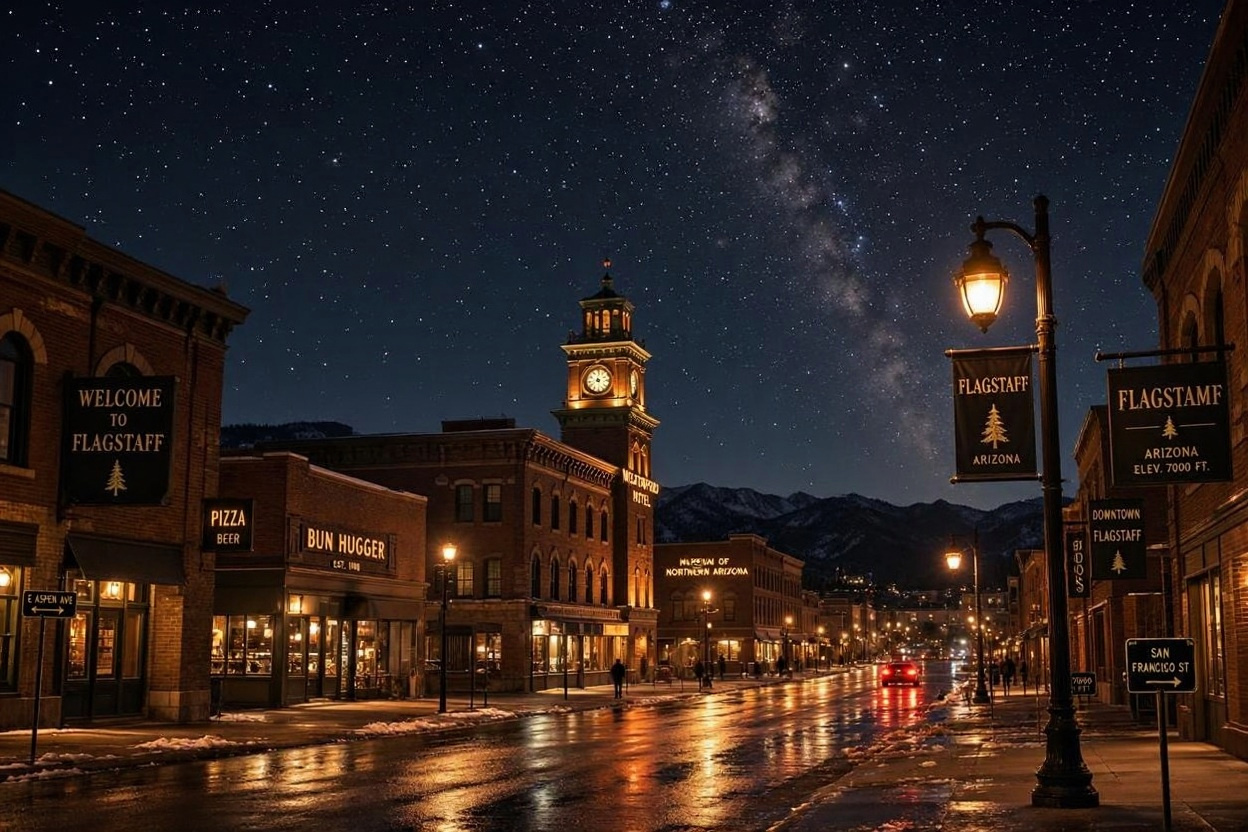
Key Highlights
- Flagstaff became the first International Dark Sky City in 2001.
- The city passed the world's first outdoor lighting ordinance in 1958.
- Switching to amber streetlights can reduce sky glow by up to 90%.
Flagstaff, Arizona, is a city that embraces darkness as a civic virtue rather than a void. With a population of approximately seventy-seven thousand, this mountain town has made a conscious choice to minimize artificial light pollution, creating a serene environment that allows the night sky to shine. This commitment to darkness is not merely aesthetic; it is rooted in a rich history of astronomical research and community health.
In 1958, Flagstaff took a pioneering step by enacting the world’s first outdoor lighting ordinance. This initiative was primarily driven by the needs of the Lowell Observatory, which required dark skies for astronomical observations. Over the years, this ordinance evolved into a defining characteristic of the city, culminating in Flagstaff being designated the first International Dark Sky City in 2001. Recently, it was honored as Dark Sky Place of the Year by DarkSky International, highlighting its ongoing commitment to preserving the night sky.
The technical aspects of Flagstaff's dark sky initiative are as fascinating as its history. The city employs warm amber streetlights instead of harsh blue-white lights, which scatter less in the atmosphere. Additionally, fixtures are designed to direct light downward, minimizing upward glare. According to Dr. Danielle Adams of the Flagstaff Dark Skies Coalition, the transition from broadband white LEDs to narrow-band amber lights can reduce sky glow by as much as ninety percent, significantly enhancing the visibility of celestial bodies.
However, the significance of this initiative extends beyond mere aesthetics or technical specifications. Dr. Adams emphasizes the detrimental effects of artificial light on human health, including disrupted melatonin production, which can increase cancer risk and affect metabolic health. The impact on wildlife is equally concerning; for instance, baby sea turtles, which have historically relied on the brightest horizon to find their way to the ocean, are now misled by artificial lights. Migratory birds, too, struggle to navigate through illuminated urban landscapes. Thus, the preservation of the night sky is not just about beauty; it is about maintaining ecological balance and human well-being.
Flagstaff's journey toward becoming a dark sky city has not been without its challenges. The transition required patience and community engagement, as residents occasionally debate the use of outdoor lighting for personal properties, including holiday decorations. Dr. Adams candidly acknowledges, "We're not all the way perfect, but we're pretty darn good." This acknowledgment reflects the ongoing nature of dark sky stewardship, which is less about achieving perfection and more about fostering a culture of awareness and responsibility.
For visitors to Flagstaff, the rewards of this dark sky initiative are immediate and profound. At the Lowell Observatory, guests can enjoy an open-air planetarium experience, utilizing heated seats and the real night sky instead of a traditional domed screen. In the heart of downtown Flagstaff, the Milky Way is visible to the naked eye, offering a breathtaking view that many urban dwellers may never experience. Nearby, Sunset Crater and Wupatki National Monument also hold dark sky designations, showcasing the ancient landscapes framed by a starry sky that has inspired generations.
Ultimately, Flagstaff's dark sky initiative serves as a reminder of the importance of stargazing as a practice that fosters connection to the universe. The night sky, while seemingly distant, holds lessons for humanity, encouraging us to look up and appreciate the natural world around us. In a time when artificial light dominates, Flagstaff stands as a beacon of hope, demonstrating that darkness can indeed be a civic virtue.
The images accompanying this article were generated by AI.
Published by Banx Network. This article is part of the Banx decentralized media programme, powered by the BXE token on the XRP Ledger.