Key Highlights
- Study Duration:Researchers analyzed ocean temperature data from 1993 to 2023.
- Heatwave Impact:Over half of global tropical reefs experienced heatwaves in eight of the last thirteen years.
- Conservation Implications:The study challenges the assumption that deep reefs are safe havens for corals.
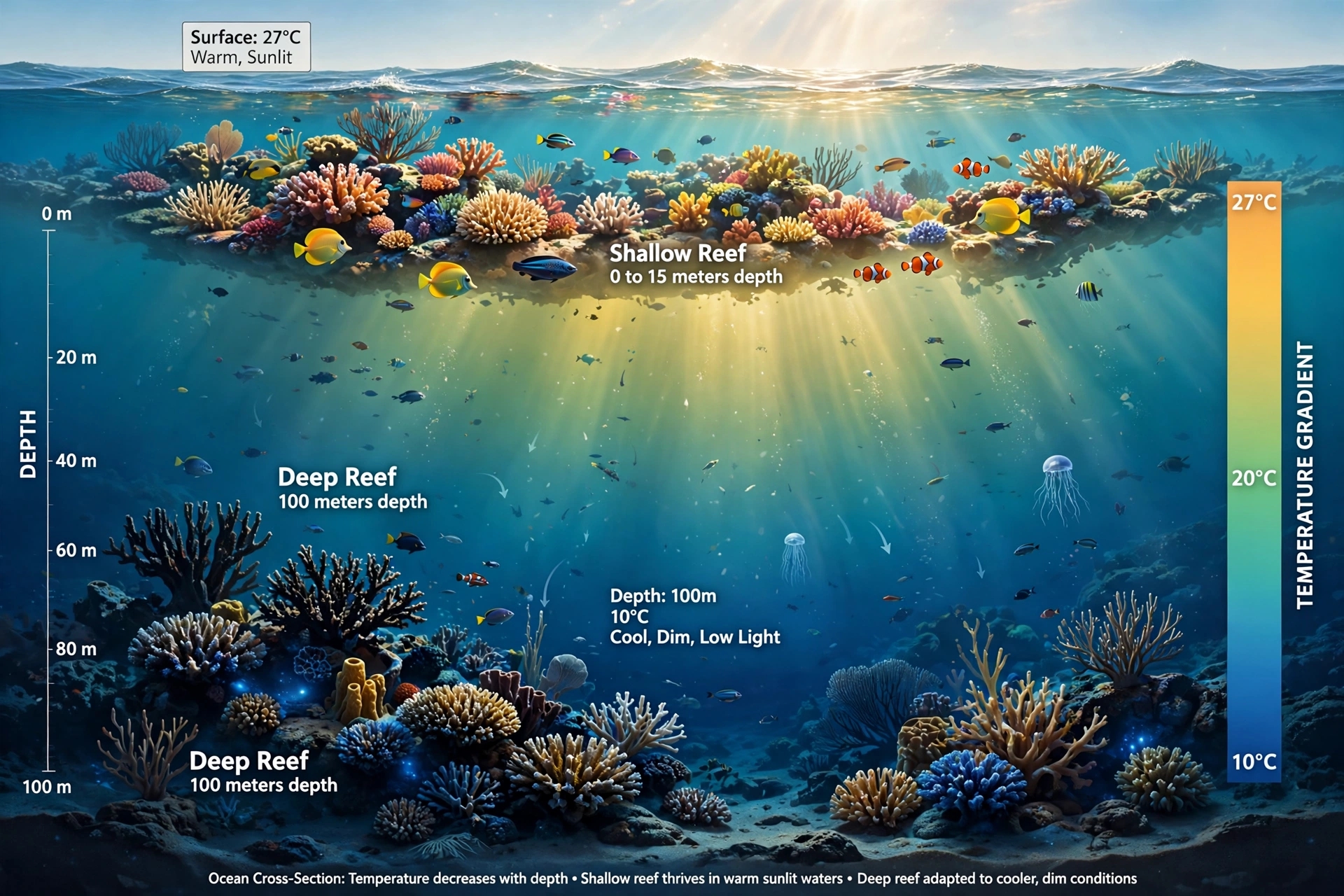
Researchers have long hoped that if the surface of the ocean becomes too warm for coral, these organisms could retreat to deeper waters, where conditions might be more favorable. This idea has shaped discussions around coral conservation, envisioning deep reefs as reservoirs of biodiversity that could repopulate shallower areas when conditions improve. However, a recent study from the Chinese Academy of Sciences suggests that this hope may be misplaced.
The study analyzed global ocean temperature simulations from 1993 to 2023, focusing on coral reef regions extending down to 150 meters. While marine heatwaves are less frequent at greater depths, their intensity—measured by temperature and duration—has increased significantly. The findings indicate that warm anomalies can now extend as deep as 150 meters, affecting mesophotic coral ecosystems that were previously considered safe.
Before 2010, deep reefs were largely insulated from prolonged heat stress, with marine heatwaves impacting less than half of global reef areas annually. However, since 2010, the situation has changed dramatically. Heatwaves have affected over half of the world's tropical reefs in eight of the thirteen years studied, with average heatwave durations at depths beyond ninety meters extending to fifteen days or more. The most severe conditions occurred during the back-to-back La Niña events from 2020 to 2023, which intensified heatwaves across all depths, impacting over 75 percent of global tropical coral reef areas.
The mechanisms behind these changes are complex. The ocean does not warm uniformly; factors such as circulation patterns, wind-driven mixing, and the depth of the thermocline influence how heat is distributed. During prolonged La Niña conditions, sustained westward winds push warm water into the western Pacific, deepening the thermocline and allowing heat to penetrate further down. Consequently, deeper reefs, which might have previously offered a thermal buffer, are now exposed to prolonged heat stress similar to that experienced at the surface.
While the researchers caution against declaring deep reefs entirely ineffective as refuges, the study underscores the need to reevaluate their potential as safe havens. The assumption that deep reefs can reliably serve as thermal refuges is no longer tenable. Instead, the potential for these ecosystems to act as seed banks or transplant sites must be assessed on a regional basis, considering local circulation patterns and the thermal tolerance of resident coral species. "Going deeper does not necessarily mean escaping the heat," stated Chunzai Wang, an oceanographer at the Chinese Academy of Sciences and co-author of the study.
The broader implications of this research are significant, especially as the planet continues to warm due to human activities. Coral reefs, which play a crucial role in supporting fisheries, protecting coastlines, and sustaining tourism, are among the most vulnerable ecosystems to climate change. This study adds another layer of urgency to the need for effective management and protection strategies for coral reefs. If deep reefs cannot be relied upon as refuges, the case for limiting surface warming becomes even more critical, as there may be no deeper sanctuary for corals to escape to.
For corals, the options are stark: they can adapt, migrate, or face bleaching and death. The new research indicates that the possibility of migrating to deeper waters may be less viable than previously thought. This finding should not lead to despair but rather serve as a call to action for increased attention and conservation efforts.
The images in this article are AI-generated and do not depict actual reef conditions or the researchers involved.
Published by Banx Network. This article is part of the Banx decentralized media programme, powered by the BXE token on the XRP Ledger.