As winter loosens its quiet grip and the evenings begin to soften, March opens its celestial diary with patient generosity. The night sky, often overlooked beneath city lights and daily urgencies, seems to breathe a little deeper this month. Above us, ancient rhythms continue without haste — shadows drift across the Moon, planets gather as if in silent conference, and familiar stars receive a passing lunar companion. It is a reminder that while our calendars turn in squares and deadlines, the sky turns in arcs and light.
This March offers nine notable sky events, each carrying its own subtle invitation to look upward.
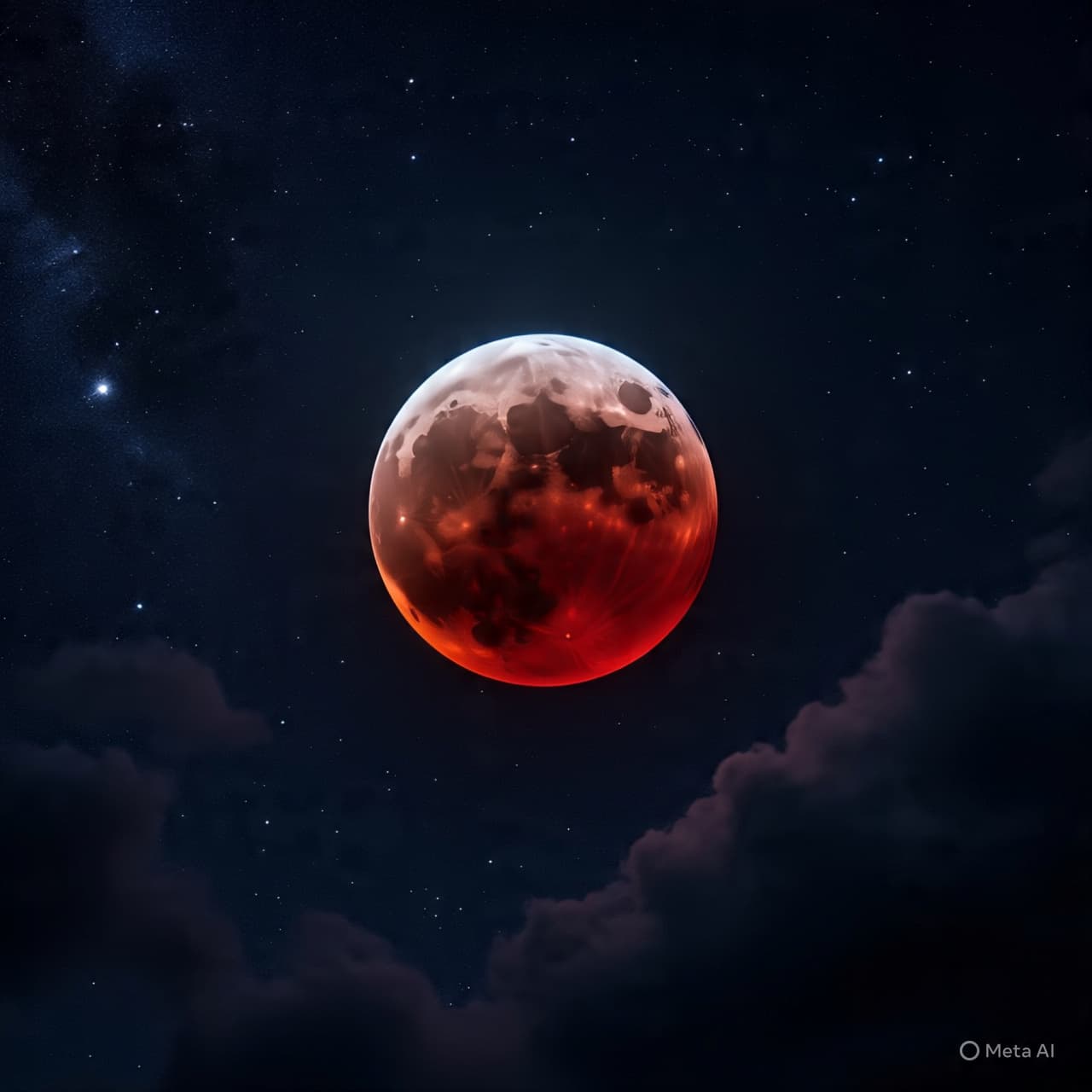
The most dramatic moment arrives with a total lunar eclipse — often called a “blood moon.” During this event, Earth passes directly between the Sun and the Moon, casting a shadow that gradually transforms the bright lunar disk into a deep copper or rust color. The red glow occurs because sunlight filters through Earth’s atmosphere, bending and scattering before reaching the Moon. Visible across large portions of the globe depending on location, the eclipse requires no telescope — only clear skies and a little patience.
Not long before and after the eclipse, the Moon continues its quiet choreography, brushing past some of the sky’s most recognizable stars. It glides near Regulus in Leo and later approaches Spica in Virgo, offering gentle pairings that binoculars can easily enhance. These encounters are not collisions or dramatic alignments, but rather visual proximities — moments when perspective brings distant objects into temporary companionship.
Adding to the month’s appeal is a planetary parade. Several planets — including Mercury, Venus, Mars, Jupiter, and Saturn — become visible within the same general stretch of sky. Some shine boldly to the naked eye, while others require binoculars or a telescope. Though the term “parade” suggests a tight line, the planets are spread across space; it is from Earth that they appear arranged in shared visibility. For skywatchers, this clustering offers a rare opportunity to observe multiple worlds in one evening.
Venus and Saturn form a particularly close pairing early in the month, hovering low near the western horizon after sunset. Venus, bright and steady, contrasts with Saturn’s softer glow. Later in March, Mars and Mercury draw near in the pre-dawn sky, presenting an early morning viewing challenge for dedicated observers.
The Moon also passes near Antares, the reddish heart of Scorpius, creating a visual echo between the star’s warm hue and the memory of the earlier blood moon. Toward mid-month, a thin crescent Moon briefly joins Mercury and Mars, forming a delicate triangle against the twilight.
March concludes its celestial offerings with the spring equinox in the Northern Hemisphere. On this day, Earth’s tilt aligns so that day and night are nearly equal in length. While not a visual spectacle like an eclipse, the equinox marks a turning point — a quiet recalibration of light and season that has guided human calendars for centuries.
Taken together, these nine events do not demand urgency. They do not compete for attention. Instead, they unfold with steady grace, reminding observers that astronomy often rewards stillness more than spectacle.
In practical terms, most of these events are visible without specialized equipment, though binoculars can enrich the experience. Exact viewing times depend on geographic location, and astronomy calendars provide detailed guidance. Weather, as always, remains the final arbiter. For those willing to step outside and look up, March offers a sky that feels thoughtfully arranged — not for drama alone, but for reflection.
AI Image Disclaimer:
Graphics are AI-generated and intended for representation, not reality.
Sources:
National Geographic Space.com Royal Museums Greenwich Time and Date Star Walk
Published by Banx Network. This article is part of the Banx decentralized media programme, powered by the BXE token on the XRP Ledger.