Mars has always carried an air of restraint. It does not reveal itself easily, offering landscapes shaped by wind and time, colored in rust and shadow. For decades, scientists have studied its surface as one might read a weathered manuscript, hoping that between the faded lines, a deeper story might still be told. Recently, that story has grown more complex.
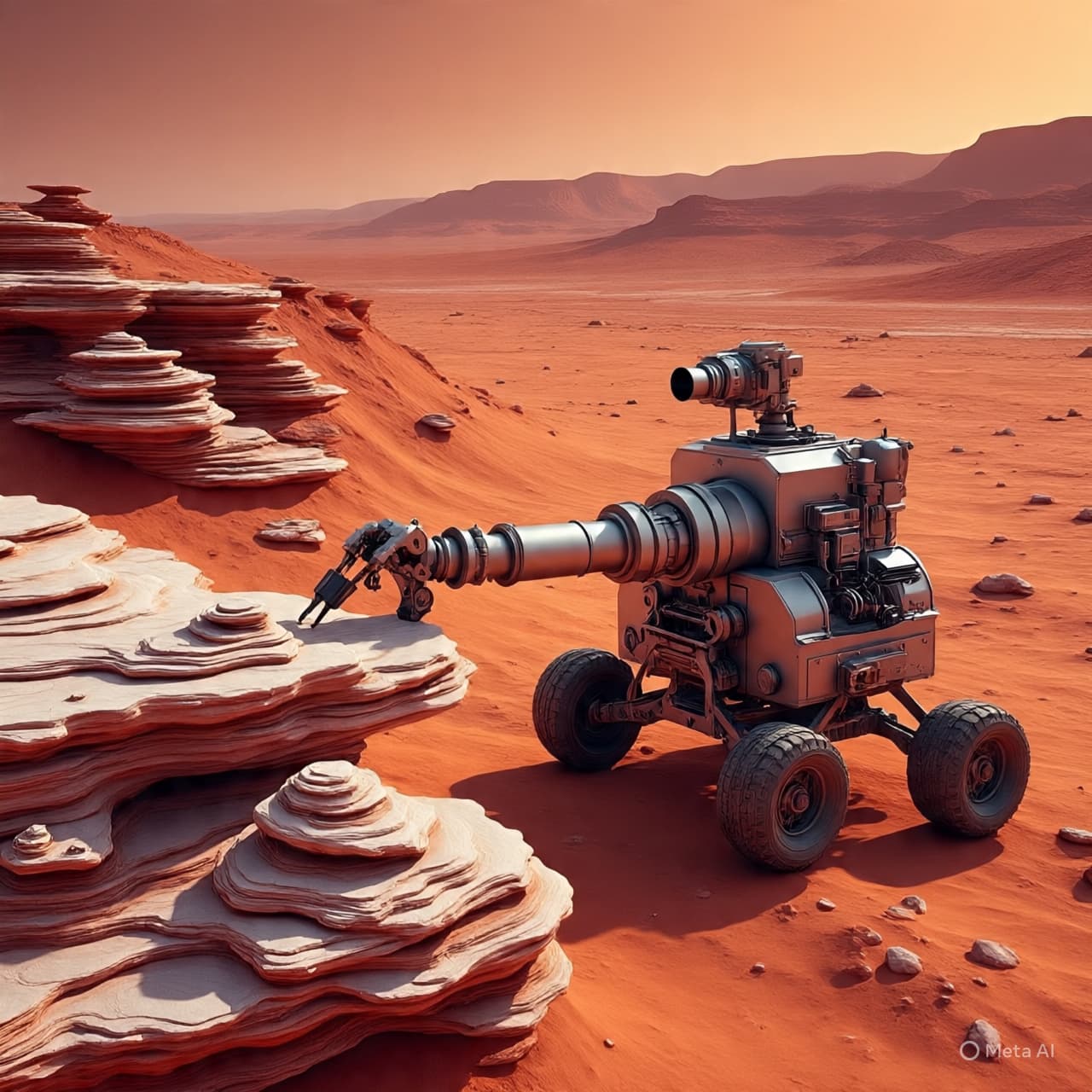
Data collected by NASA’s Curiosity rover suggest that some organic molecules found in Martian rocks cannot be fully explained by known geological processes alone. These compounds, preserved within ancient sediment layers, appear to have survived radiation, oxidation, and the planet’s long exposure to harsh conditions. On Earth, similar molecules are often linked to biological activity, but they can also arise through nonliving chemistry, leaving the question open rather than answered.
What draws scientific attention is not the presence of organics itself, but their diversity and persistence. Laboratory simulations and models indicate that standard geological reactions, such as those driven by heat or water-rock interactions, struggle to account for the full range of molecules detected. This does not imply a biological origin, researchers emphasize, but it suggests that Mars may host chemical pathways not yet fully understood.
The findings prompt a quiet recalibration of expectations. Mars, once thought chemically simple, now appears layered and nuanced, with ancient environments capable of preserving complex compounds for billions of years. These organics may have formed through a mix of processes, some familiar, others still hypothetical, shaped by conditions unique to the Red Planet’s early history.
Scientists stress caution as much as curiosity. Organic molecules are not evidence of life on their own, and the study does not claim otherwise. Instead, it highlights the limits of current models and the need for future missions that can analyze samples more precisely, ideally within laboratories on Earth.
For now, the discovery stands as a reminder that Mars continues to resist easy conclusions. As NASA prepares for sample return missions and next-generation exploration, researchers say these unexplained organics will remain a focal point, guiding questions rather than providing final answers.
AI Image Disclaimer “Visuals shown with this article were generated using AI tools and are intended for representational purposes rather than real imagery.”
Sources Nature Science NASA Scientific American Space.com
Published by Banx Network. This article is part of the Banx decentralized media programme, powered by the BXE token on the XRP Ledger.