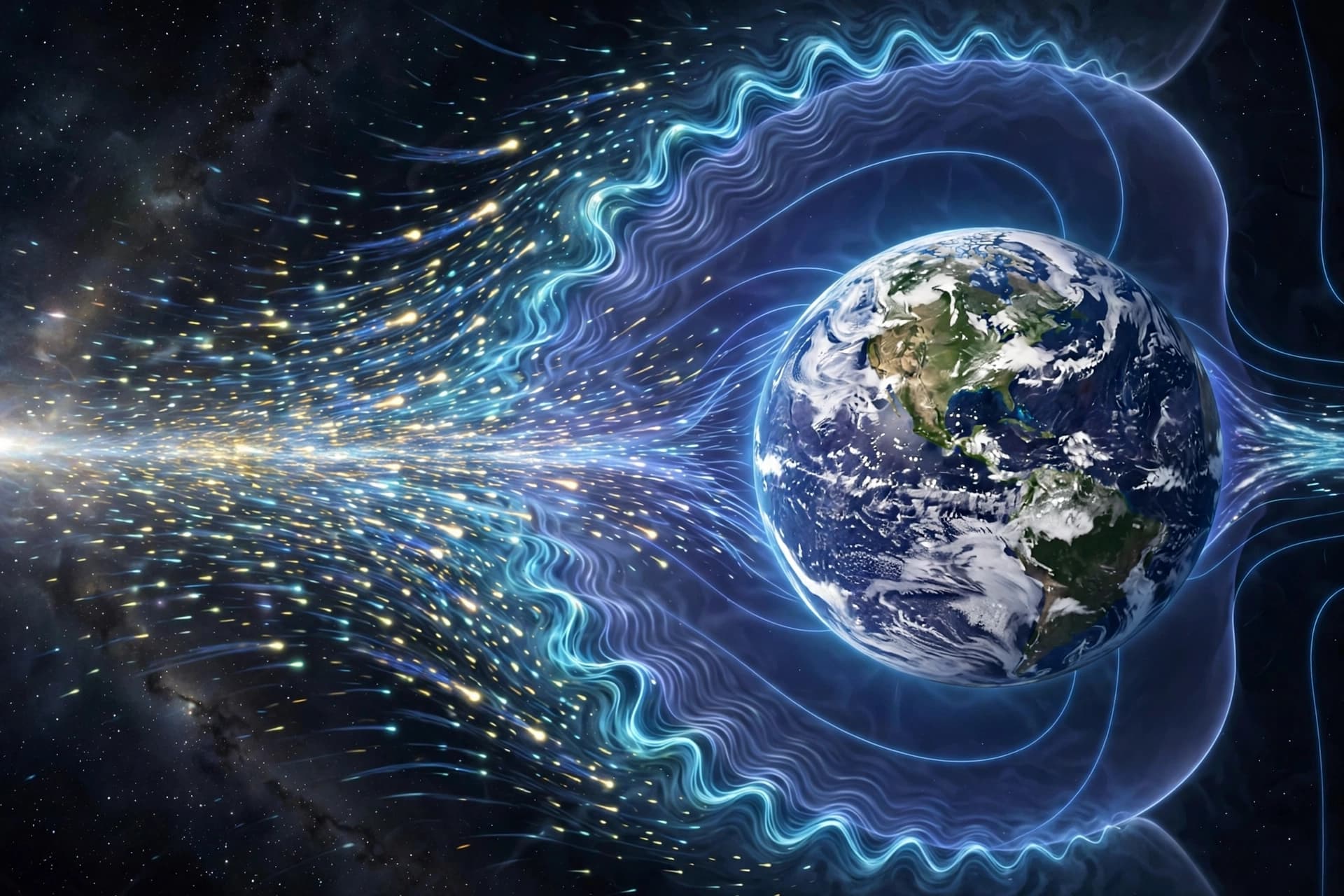
There is a boundary at the edge of Earth's magnetic shield where the solar wind—a relentless stream of charged particles from the Sun—meets the invisible barrier that protects our planet. Along that boundary, giant waves form and roll, sometimes growing strong enough to transport solar plasma and energy into near-Earth space. For the first time, scientists have mapped where these waves appear and why, and the findings could improve our ability to forecast the space weather that threatens satellites, communications, and power grids.
The waves are known as Kelvin-Helmholtz waves, and they form where the fast-moving solar wind brushes past the outer edge of Earth's magnetosphere. A new study led by researchers at the University of Oulu in Finland found that these waves do not form evenly around Earth. Instead, their strength and location depend on how the solar wind's magnetic field drapes around Earth's own magnetic field .
The research, published in Geophysical Research Letters, used computer simulations to show that the strongest wave activity forms in the winter hemisphere—the side of Earth tilted away from the Sun—and shifts between the "dawnside" and "duskside" depending on the direction of the solar wind's magnetic field . The process can be compared to water flowing around a breakwater, where waves form more strongly on one side because the flow and pressure are not symmetrical .
"What makes this study unique is that we were able to show how the asymmetries arise," said Academy Research Fellow Lauri Holappa, who first noticed unusual wave patterns in magnetosphere simulations while visiting NASA in 2020 . The simulations revealed that the draped magnetic field supplies stabilizing tension that can suppress wave growth on one flank while allowing it to flourish on the other. Reversing the sideways component of the solar wind's magnetic field shifted the favored side .
The implications for space weather forecasting are significant. When Kelvin-Helmholtz waves grow strong enough, they can roll into vortices, and related processes can transport solar wind material into the magnetosphere. This exchange contributes to space weather—the changing conditions that can disrupt satellites, navigation systems, radio communications, and power grids . While the waves cannot predict exactly where a solar storm will strike, their location may reveal where solar-wind energy is most likely to enter Earth's magnetic environment .
The findings could improve space weather models by showing where solar-wind energy is most likely to enter and disturb Earth's magnetic environment. For a world increasingly dependent on satellite-based systems, understanding these boundary dynamics is not merely academic. It is a step toward anticipating the storms that can, and do, cause real disruption .
AI Image Disclaimer: This article's image is AI-generated and does not depict actual magnetospheric simulations or satellite observations.
Sources: Yahoo News Canada, Universe Space Tech, Geophysical Research Letters, University of Oulu
Published by Banx Network. This article is part of the Banx decentralized media programme, powered by the BXE token on the XRP Ledger.