There is a particular comfort in a simple theory—the kind that says if a cliff grows too tall, it will fall, and if it falls, it will expose a taller cliff behind it, and so on until the whole edifice comes down. For years, this was the story scientists told about Antarctica's ice cliffs: a runaway collapse, a domino effect written into the physics of ice. The story was frightening, and it was influential, shaping the worst-case sea-level projections that coastal cities have used to plan for the future. But a new study, built on four years of satellite data and published in the journal Science, suggests the story is not quite right.
Researchers at MIT and the Woods Hole Oceanographic Institution analyzed more than 15,000 ice cliffs across Antarctica, tracked by NASA's ICESat-2 satellite between 2019 and 2023 . What they found was not a runaway collapse but something more complicated and, in some ways, more hopeful: the tallest cliffs do collapse, and they collapse faster than models predicted. But then they stop. The retreat is short-lived. The glaciers stabilize .
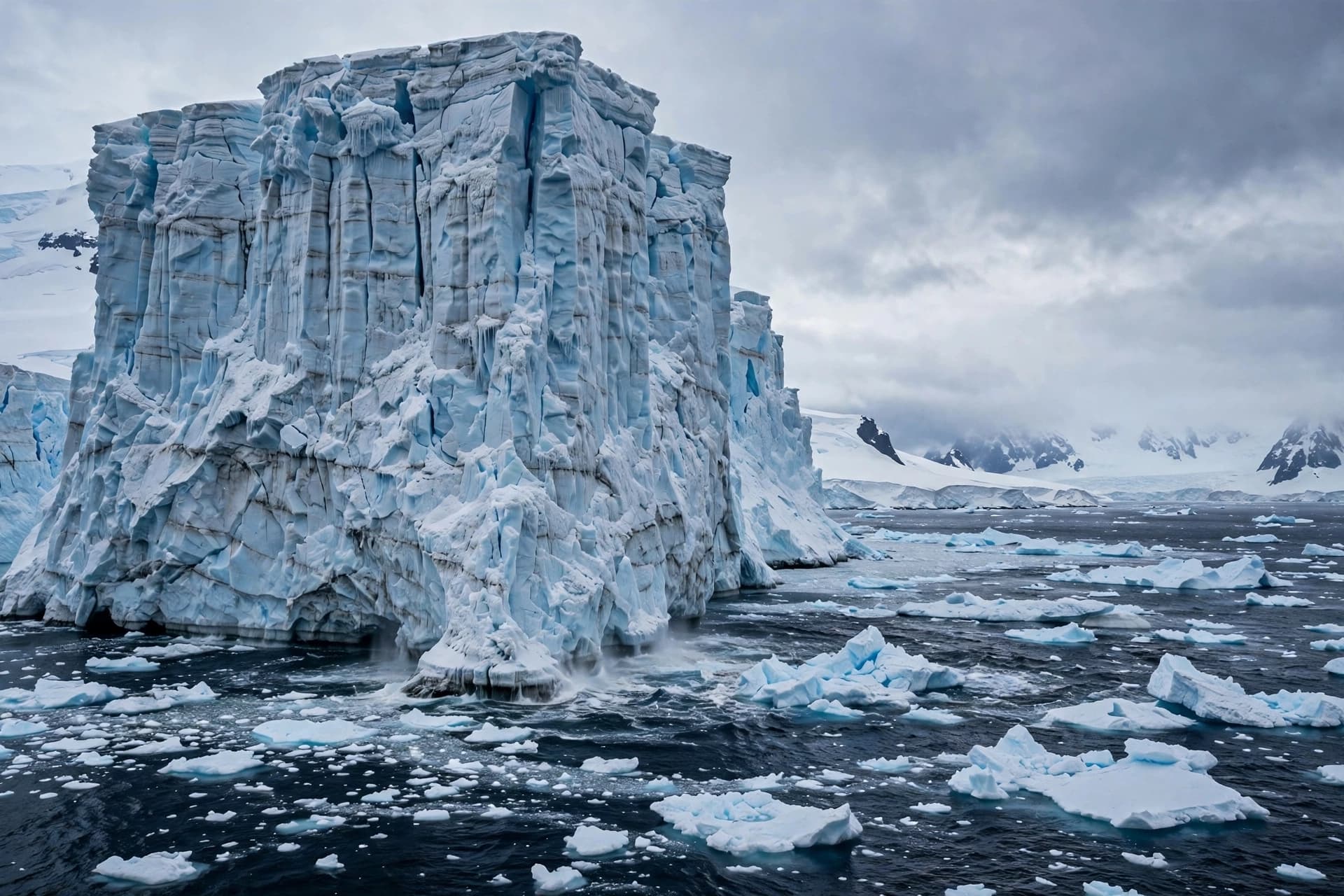
The theory that has dominated the field is called marine ice cliff instability, or MICI. It assumes that ice cliffs taller than about 100 meters—roughly the height of the Statue of Liberty—should fail under their own weight, exposing taller cliffs inland and triggering a cascade of ice loss . The concern was that if Antarctica's floating ice shelves disintegrate, the exposed cliffs could set off a self-sustaining retreat that would dramatically raise sea levels. This idea shaped the "worst-case" scenarios in IPCC reports and coastal planning documents .
What the satellite data revealed was that very few cliffs actually reach that critical height. The average ice cliff in Antarctica is about 30 meters tall. Only a small fraction exceed 100 meters . And when the researchers zoomed in on the tallest cliffs—the ones most likely to test the MICI theory—they found that while these cliffs did retreat rapidly, the retreat did not continue indefinitely. The glaciers stabilized. "We don't see this runaway effect," said Caroline Needell, the study's lead author .
The reasons appear to lie in the ice itself. As a glacier retreats, its surface can thin, lowering the height of the cliff and reducing the conditions for further collapse. The shape of the seafloor matters too—gradual slopes inland can limit how tall the next cliff becomes. And a slushy mix of broken icebergs and sea ice, called mélange, can accumulate at the front of a cliff and push back against it, providing a stabilizing buttress . These factors were largely absent from the simple models that predicted catastrophe.
The findings do not mean Antarctica is safe. The researchers emphasize that the retreat they observed was faster than models predicted, which could mean more ice loss during those periods of collapse than current projections account for . And the study examined a specific period under specific conditions. The question of what happens to the largest glaciers—Thwaites, above all—as the climate warms further remains open. Thwaites is currently buttressed by underwater ridges, but eventually it may retreat past them into deeper water, where the dynamics could change .
What has changed, for now, is the certainty of the worst-case narrative. The ice cliffs are not the simple monsters the models made them out to be. They are more complex, more contingent, more dependent on the particular geography of each glacier and the thickness of the mélange at its face. That complexity is not reassuring in itself—it means the future is harder to predict, not easier. But it does mean that the most catastrophic projections are not the only ones supported by evidence.
For the scientists who spend their careers measuring ice from space, the finding is a reminder that the planet does not always follow the scripts we write for it. The cliffs are collapsing. They are just not collapsing in the way we expected.
AI Image Disclaimer: The images accompanying this article were generated by artificial intelligence and are intended for illustrative purposes only.
Sources: MIT News, Science, New Scientist, EurekAlert (AAAS), Scinexx
Published by Banx Network. This article is part of the Banx decentralized media programme, powered by the BXE token on the XRP Ledger.