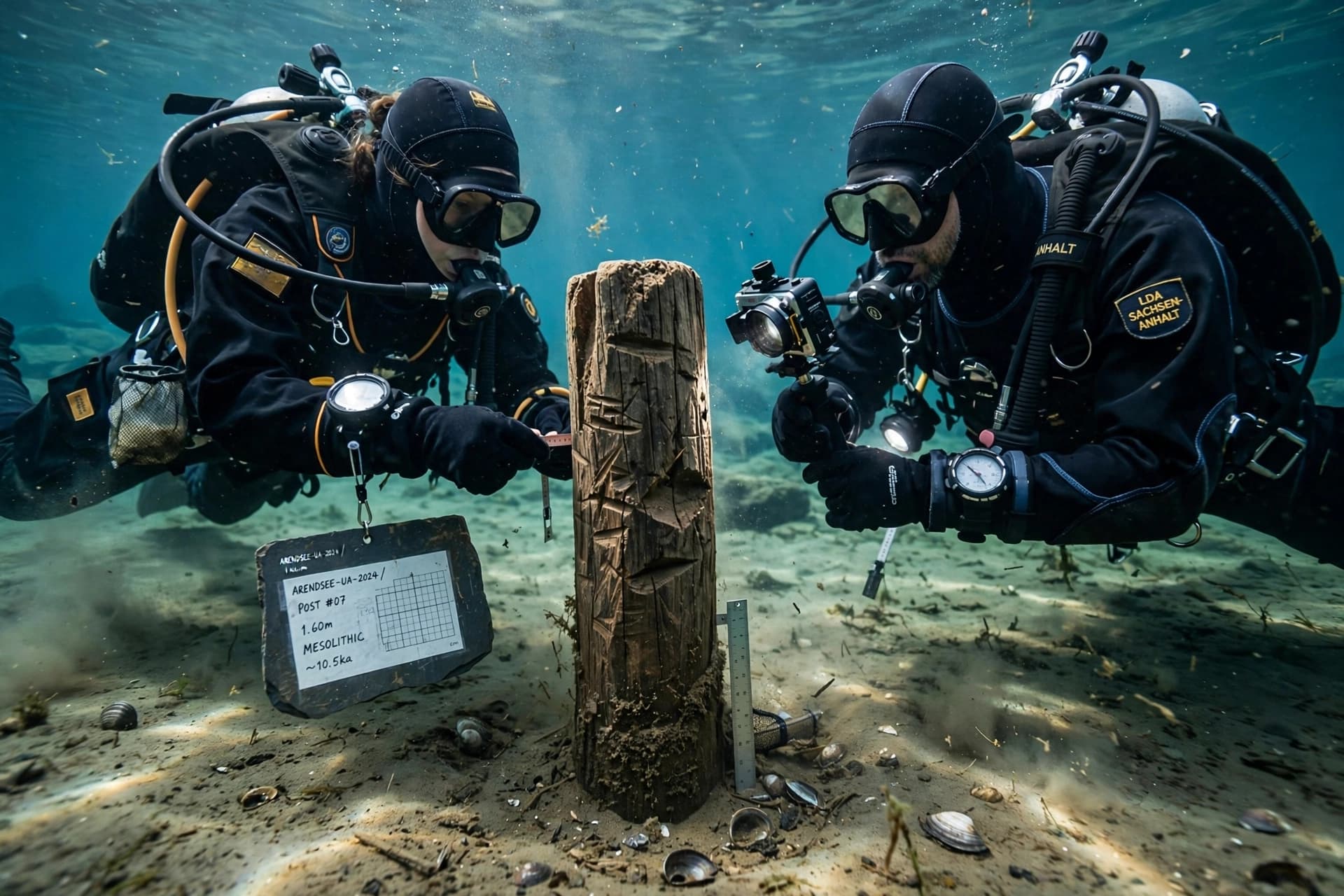
Some archaeological discoveries arrive not from a dry excavation site, but from places where water has quietly preserved what time normally erases. Beneath Lake Arendsee in Saxony-Anhalt, Germany, researchers have recovered worked pieces of wood dating to around 10,500 years ago, opening a rare window into the lives of people who lived thousands of years before farming reached the region.
The discoveries come from the Mesolithic, or Middle Stone Age, a period when communities in Central Europe generally relied on hunting, gathering and fishing rather than the permanent agricultural settlements that would later reshape the landscape. Archaeologists have found a wooden post about 1.6 meters long bearing marks of cutting and working, along with split boards measuring as much as 1.3 meters.
The wood is particularly valuable because organic material from such an early period rarely survives. Lake Arendsee has an unusual geological history: its lakebed has gradually subsided because of processes associated with an underground salt structure. That helped preserve portions of the ancient shoreline beneath sediment, where the waterlogged environment protected wooden remains from the decay that normally destroys them.
Researchers are not yet saying that the timber definitely belonged to houses. The recovered post may have served as a structural support, while the boards provide evidence of deliberate woodworking. Whether the remains formed huts, shelters, platforms, or another type of construction remains a question for further investigation.
That uncertainty is important because the discovery could challenge a familiar picture of how settled life developed in Central Europe. Archaeologists have traditionally associated substantial permanent structures and intensively occupied settlements in the region with the arrival of early farmers several thousand years later. The Arendsee material may offer evidence that some hunter-gatherer communities were engaging with their landscapes in more structured ways than the surviving archaeological record has previously shown.
The researchers are now using modern technology to understand the submerged landscape. A remotely operated underwater vehicle and high-resolution sonar scans have been used to map the former shoreline and help identify areas where additional archaeological material may remain. Precise positioning of individual finds can help researchers determine whether the pieces belong to one archaeological site or represent separate activities along the ancient lakeshore.
The significance of the discovery therefore rests not simply in the age of the wood, but in what future excavation might reveal around it. If additional structural elements are found and can be securely associated with the same period, archaeologists may gain a clearer picture of how Mesolithic communities organized their living spaces and interacted with the changing environment.
For now, Lake Arendsee has offered a carefully preserved fragment rather than a complete answer. The timber does not yet prove that permanent buildings existed there 10,500 years ago, but it provides an unusually direct record of woodworking from a period when such evidence is extremely scarce. Further research will determine how much of the ancient lakeshore still lies beneath the water.
AI Image Disclaimer: Any accompanying visual is AI-generated for illustrative purposes and does not represent an actual reconstruction unless explicitly identified as such.
Sources: State Office for Heritage Management and Archaeology Saxony-Anhalt IDW Phys.org Arkeonews Ancientist
Published by Banx Network. This article is part of the Banx decentralized media programme, powered by the BXE token on the XRP Ledger.