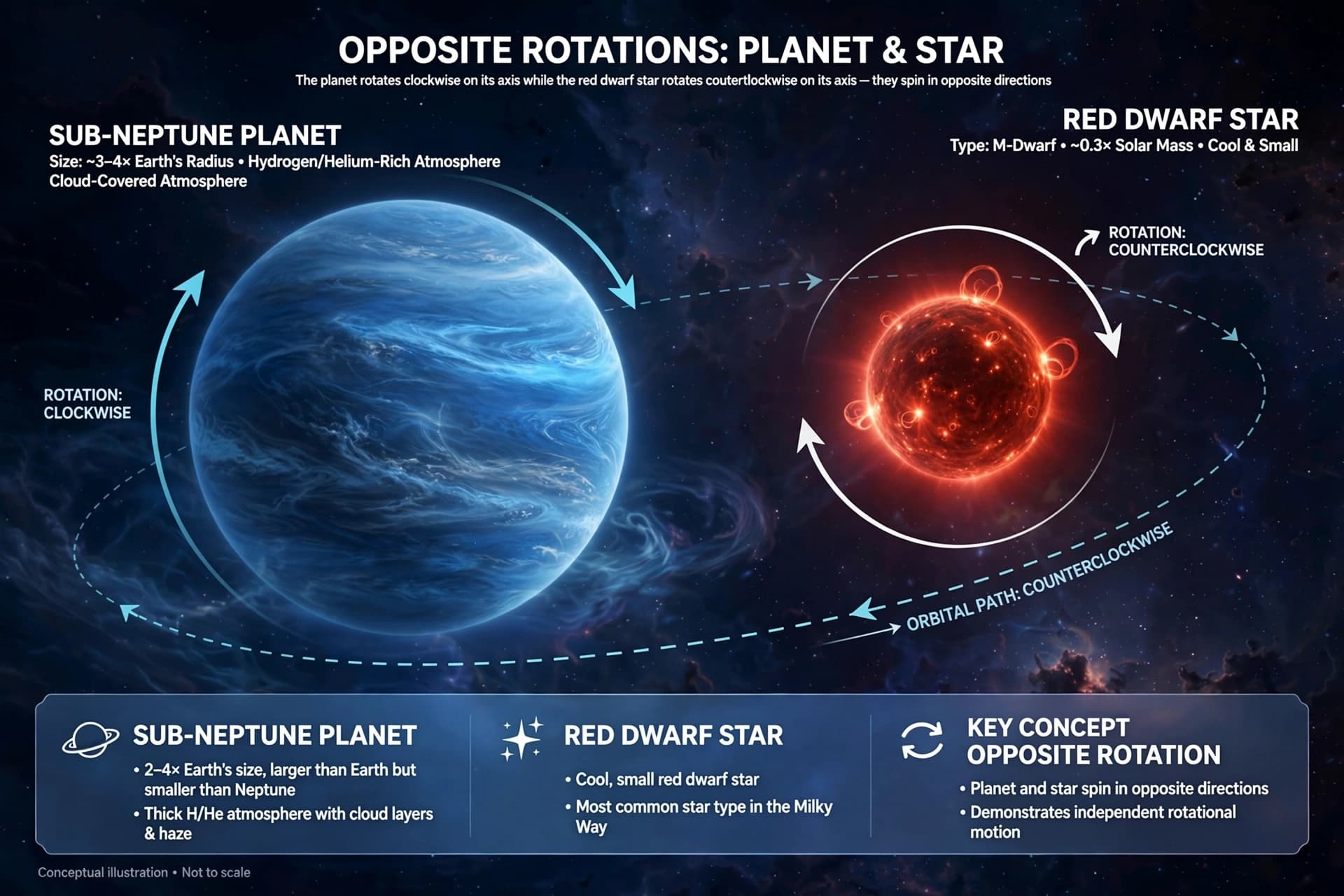
In the grand ballet of the cosmos, planets typically dance in step with their stars, orbiting in the same direction as the star’s rotation. This harmony is a relic of the solar system’s birth, where a spinning disk of gas and dust gave rise to orderly motion. However, astronomers have recently uncovered a celestial rebel: a planet orbiting its red dwarf star in the opposite direction. This discovery, involving the exoplanet GJ 3090 b, challenges our understanding of planetary formation and invites us to reconsider the chaotic forces that can shape even the smallest stellar systems.
GJ 3090 b is a sub-Neptune-sized world, roughly twice the radius of Earth, circling a small, cool M-dwarf star. What makes it extraordinary is not just its size, but its retrograde orbit—a path that runs counter to the spin of its host star. Such misalignments are rare around low-mass stars, which are generally thought to have quieter, more stable formation histories compared to their larger, more volatile counterparts. The detection of this anomaly suggests that violent gravitational interactions may be more common than previously assumed.
The leading theory for such a reversal involves a dramatic cosmic shuffle. It is possible that GJ 3090 b was once part of a multi-planet system that became unstable. Gravitational tugs between siblings could have flung one planet into a highly inclined or even reversed orbit. Alternatively, the presence of a distant, unseen companion star might have tilted the planetary plane over millions of years. These scenarios paint a picture of a dynamic past, far removed from the calm we observe today.
Red dwarfs are the most common stars in the galaxy, making them prime targets in the search for habitable worlds. Understanding the stability and architecture of their planetary systems is crucial for assessing the potential for life. A retrograde orbit does not necessarily preclude habitability, but it does indicate a history of turbulence that could have stripped away atmospheres or disrupted delicate ecological balances. It reminds us that a planet’s current state is deeply influenced by its evolutionary journey.
For astronomers, this discovery serves as a valuable benchmark. GJ 3090 b provides a unique laboratory for studying tidal interactions and orbital dynamics in extreme conditions. By observing how the planet and star influence each other, scientists can refine models of planetary migration and survival. Each data point helps to build a more comprehensive map of the diverse ways in which planetary systems can assemble and evolve.
The public fascination with "wrong-way" planets stems from their defiance of expectation. We often project our own solar system’s order onto the universe, assuming that symmetry is the norm. Discoveries like GJ 3090 b remind us that the cosmos is full of surprises, where chaos and creativity intertwine. It is a humbling lesson in the variety of natural phenomena, encouraging us to keep an open mind when exploring the unknown.
As technology improves, we will likely find more such outliers. Future missions equipped with high-precision spectrographs will be able to detect subtle wobbles in starlight, revealing hidden planets and their unusual paths. The story of GJ 3090 b is just the beginning of a deeper exploration into the architectural diversity of exoplanetary systems.
The discovery of GJ 3090 b, a planet orbiting its red dwarf star in reverse, highlights the complex and sometimes violent history of planetary systems. It challenges existing models and underscores the need for continued observation. As we look further into space, we are reminded that the universe is far more varied and unpredictable than our local neighborhood might suggest.
AI Image Disclaimer: The visual elements in this article are AI-generated illustrations depicting exoplanets and stellar orbits, not actual images of GJ 3090 b or its host star.
Sources: Nature Astronomy ArXiv Preprint The Brighter Side News
Published by Banx Network. This article is part of the Banx decentralized media programme, powered by the BXE token on the XRP Ledger.