In the deep fields captured by the James Webb Space Telescope (JWST), astronomers have encountered galaxies that defy conventional understanding. These early-universe structures appear too massive, too bright, and too mature for their age. Now, a new theory suggests that the answer lies not in the galaxies themselves, but in the stars within them. Specifically, extremely massive stars, far larger than those seen today, may be illuminating these ancient systems, resolving the mystery of their unexpected brilliance.
The "strange" galaxies observed by JWST date back to less than a billion years after the Big Bang. According to standard cosmological models, galaxies at this stage should be small and faint, still in the process of assembling. However, JWST has revealed giants that seem to have formed impossibly quickly. This discrepancy has led scientists to question whether our models of galaxy formation are incomplete or if the light we see is being misinterpreted.
Recent simulations propose that the first generation of stars, known as Population III stars, were significantly more massive than modern stars. Without heavy elements to cool the gas clouds from which they formed, these primordial stars could have grown to hundreds of times the mass of the Sun. Such behemoths would burn hotter and brighter, emitting intense ultraviolet radiation that could make entire galaxies appear more massive than they actually are.
This hypothesis offers an elegant solution to the observational puzzle. If the light from these galaxies is dominated by a few ultra-bright stars rather than billions of average ones, the total mass of the galaxy might be lower than estimated. This would align better with current theories of hierarchical growth, where small structures merge over time to form larger ones. It suggests that we are seeing the glow of stellar giants, not necessarily galactic giants.
For astrophysicists, this insight refines the interpretation of JWST data. It emphasizes the importance of stellar population models in analyzing distant light. By accounting for the unique properties of early stars, researchers can better estimate the true mass and age of these galaxies. It is a reminder that light is a complex messenger, requiring careful decoding to reveal the truth behind it.
The existence of such massive stars also has implications for the reionization epoch, a period when the first stars ionized the neutral hydrogen in the universe. Their intense radiation would have played a crucial role in clearing the cosmic fog, allowing light to travel freely. Understanding their nature helps piece together the timeline of cosmic evolution, from the dark ages to the luminous universe we see today.
Public fascination with JWST images often focuses on their beauty, but the scientific value lies in the anomalies they present. These "strange" galaxies challenge us to think deeper, to question assumptions, and to explore new physical possibilities. They serve as a catalyst for theoretical innovation, driving the field forward.
As more data becomes available, scientists will test this hypothesis against other observations. Spectroscopic analysis may reveal the chemical signatures of these massive stars, confirming their presence. Until then, the idea remains a compelling explanation for one of JWST’s most intriguing mysteries.
The theory that massive primordial stars explain Webb’s strange galaxies offers a plausible resolution to a cosmological puzzle. It highlights the dynamic nature of scientific inquiry, where new data leads to refined models. As we continue to study the early universe, each discovery brings us closer to understanding the origins of cosmic structure.
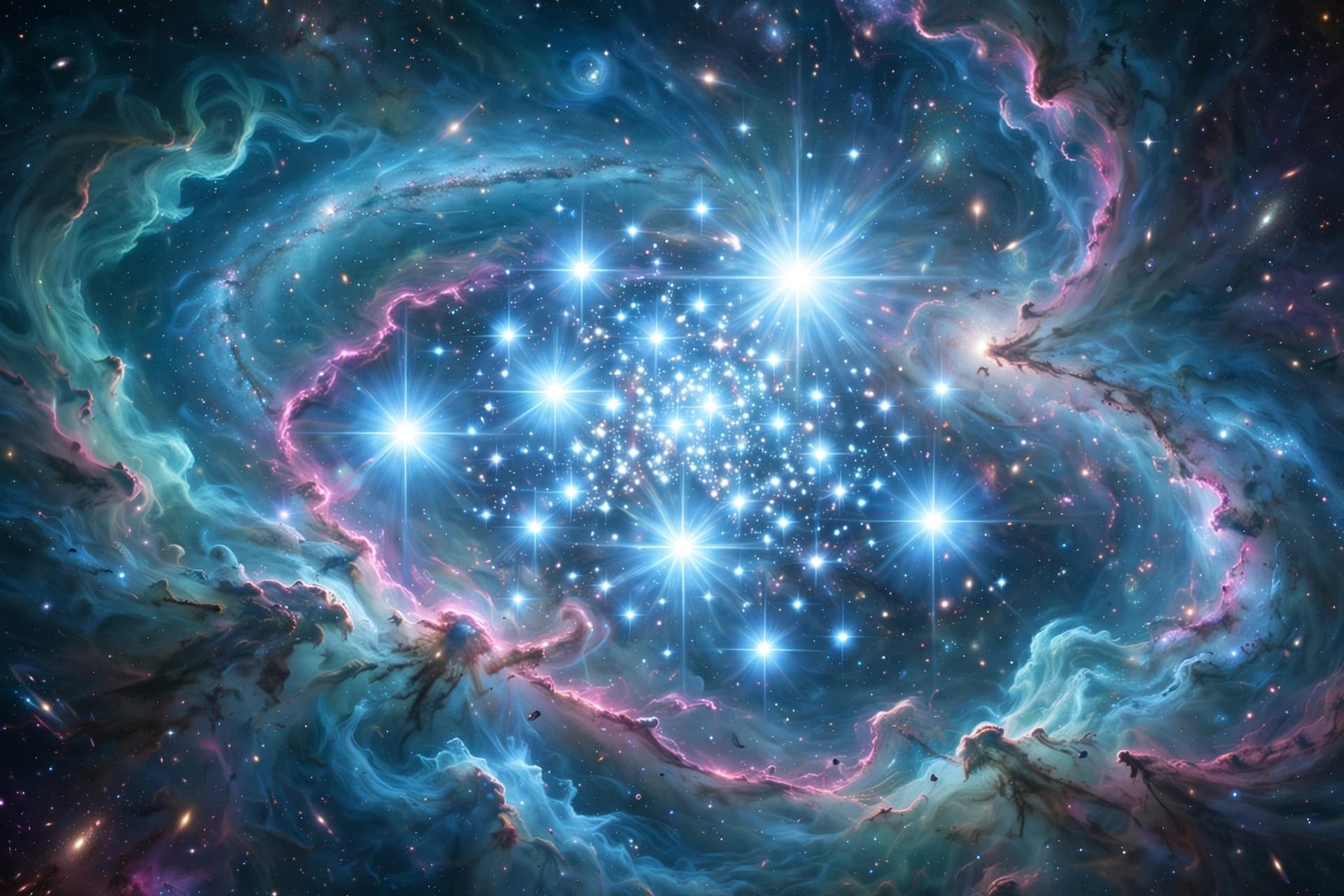
AI Image Disclaimer: The visuals in this article are AI-generated artistic interpretations of early galaxies and massive stars, not actual raw images from the James Webb Space Telescope.
Sources: Nature Astronomy Space.com NASA JWST Mission Page
Published by Banx Network. This article is part of the Banx decentralized media programme, powered by the BXE token on the XRP Ledger.