There is a particular kind of serendipity that favors the curious observer. In the rugged landscapes of Western Australia, a man seeking a quiet place to pitch his tent stumbled upon something far more significant than a scenic view. What he initially mistook for a natural depression in the earth turned out to be a massive impact crater, hidden in plain sight for millions of years. This discovery serves as a gentle reminder that the Earth still holds secrets, waiting not for high-tech satellites, but for the attentive eyes of those who wander its surface with wonder.
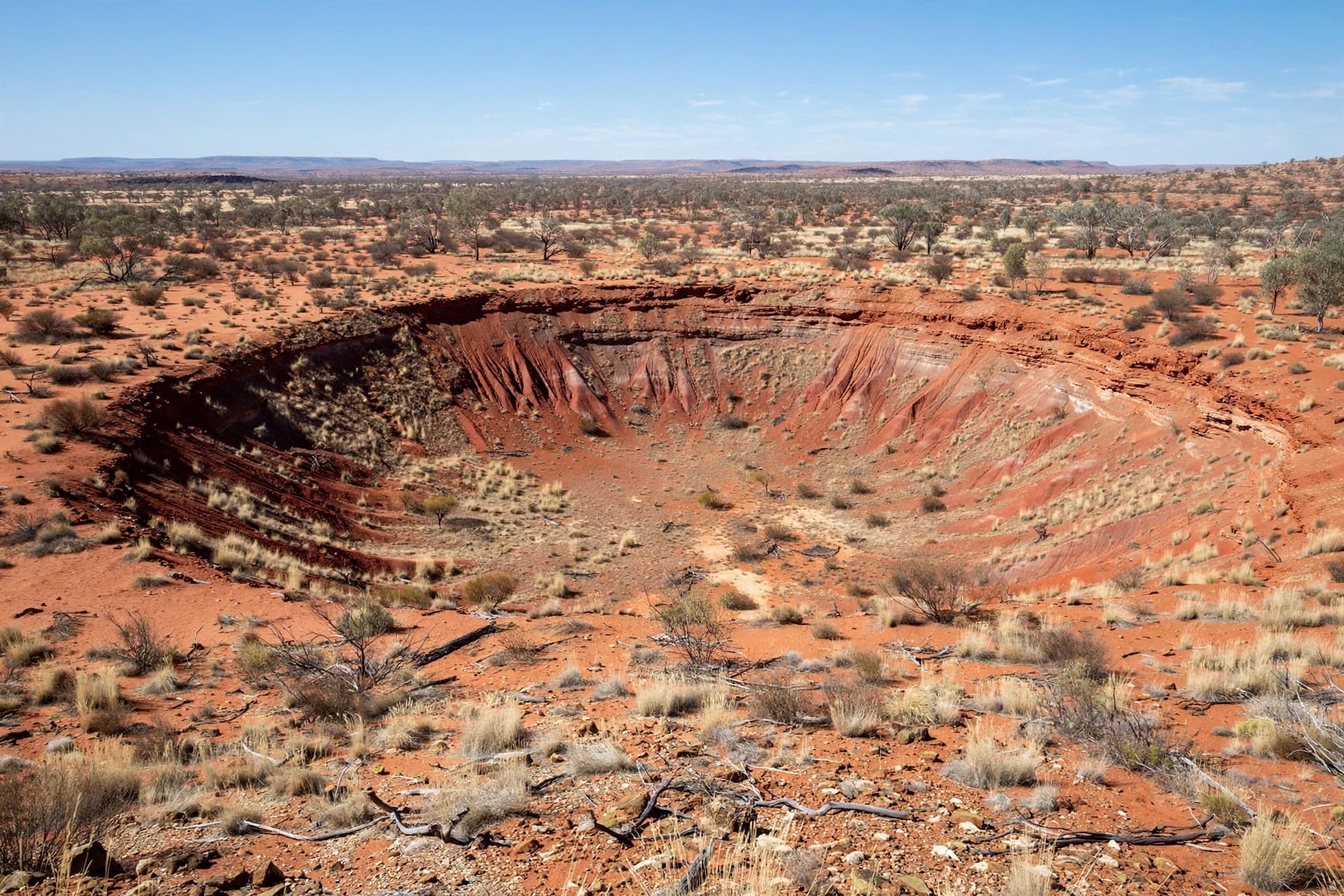
The crater, located in the remote Outback, was identified by a local resident who noticed the unusual circular formation while scouting for a camping spot. Its sheer size and distinct rim structure suggested a violent origin, prompting him to contact geological experts. Upon investigation, scientists confirmed that the feature was indeed an impact site, formed by a meteorite strike in the distant past. The discovery highlights how much of our planet’s geological history remains unmapped, particularly in vast, sparsely populated regions.
Impact craters are scars from the early solar system, when debris frequently collided with planetary bodies. While many have been erased by erosion or tectonic activity, some remain preserved in stable continental shields like those in Australia. This specific crater adds to the growing catalog of known impact sites, providing valuable data for understanding the frequency and effects of such events. Each new find helps refine models of Earth’s bombardment history, offering clues about the conditions that shaped our environment.
For the discoverer, the moment was one of humble realization. He had set out for leisure, yet found himself part of a scientific narrative. His story underscores the value of citizen science, where ordinary individuals contribute to academic knowledge through observation and curiosity. It suggests that expertise is not confined to laboratories; it can also reside in the everyday interactions people have with their surroundings.
Geologists note that the preservation of the crater is remarkable. The arid climate of the region has slowed erosion, allowing the structure to retain its shape over millennia. Studying the rocks within and around the crater can reveal information about the impactor’s composition and the energy released during the collision. These details help scientists reconstruct the event, turning a static hole in the ground into a dynamic historical record.
The discovery also invites reflection on our relationship with the land. In a world increasingly mediated by screens, direct engagement with nature can yield unexpected rewards. The camper’s find encourages others to look closely at the landscapes they traverse, recognizing that beauty and significance often coexist. It is a testament to the idea that exploration does not always require grand expeditions; sometimes, it begins with a simple desire to rest under the stars.
As research continues, the crater will likely become a site of interest for further study. It may offer insights into local geology and the broader patterns of impact distribution. For now, it stands as a monument to chance and observation, a place where the past intersects with the present in the most unexpected way. : The discovery of a massive impact crater by a camper in Australia is a charming example of accidental science. It reminds us that the Earth is full of hidden histories, accessible to those who pay attention. As we continue to explore our planet, such finds enrich our understanding of its violent and vibrant past.
AI Image Disclaimer: The visual elements in this article are AI-generated illustrations depicting Australian landscapes and geological formations, not actual photographs of the specific crater or the discoverer.
Sources: Geological Society of Australia ABC News (Australia) The Conversation
Published by Banx Network. This article is part of the Banx decentralized media programme, powered by the BXE token on the XRP Ledger.