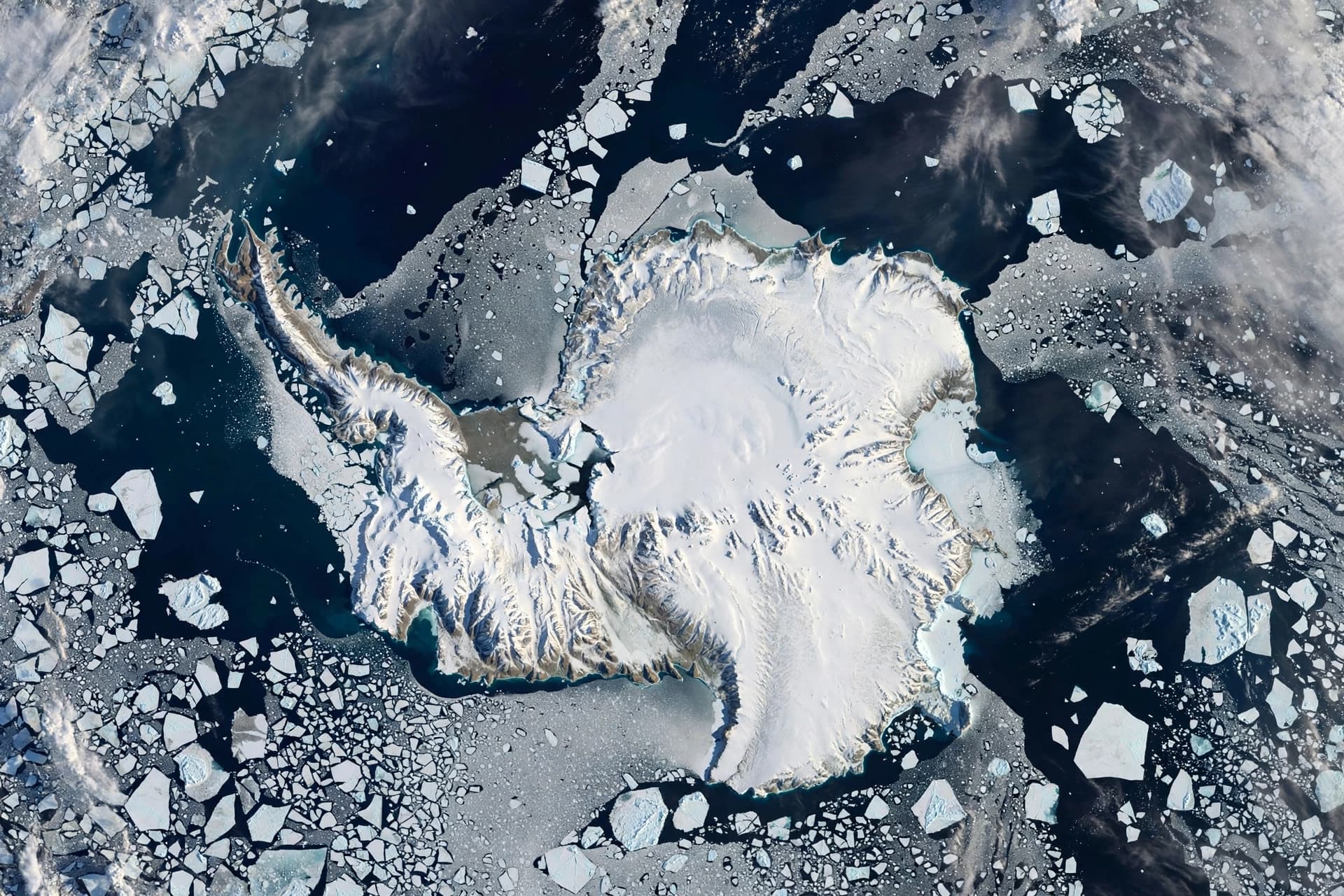
Every September, as the Southern Hemisphere winter draws to a close, the sea ice around Antarctica should reach its widest extent of the year. It is a white continental shield stretching into the darkness, a fragile and silent barrier protecting ice shelves from direct contact with waves and warm currents. Yet this year, the shield was once again smaller than expected. Satellite records confirm that Antarctic winter sea ice peaked on September 14 at just 17.59 million square kilometers—a full million square kilometers below the long-term average, an area twice the size of Spain.
This marks the fourth consecutive year that Antarctic winter sea ice has ranked among the lowest on record. Over the past four winters, the maximum extent has fallen within the four lowest levels since satellite observations began in 1979. Dr. Ariaan Purich, a Southern Ocean expert at Monash University, told The Guardian: "This isn't a one-off event anymore. The area of ocean covered by sea ice is not behaving as it used to. We're seeing low winter ice year after year, and that indicates sea ice is behaving differently because we've warmed the climate. This is not a future problem. This is a now problem."
Antarctic sea ice has large annual swings. It melts to under 2 million square kilometers in summer and expands to more than 17 million square kilometers in winter. But recent records show both winter and summer lows being broken, raising concerns that global warming may be driving these losses. Walt Meier, a senior scientist at the National Snow and Ice Data Center, noted that although the center had delayed declaring the maximum due to "a lot of underlying variability," ice continued to decline after September 14, and he believes "the maximum has been reached."
This year's situation was also influenced by wind changes associated with El Niño patterns in the tropical Pacific. Dr. Phil Reid of the Australian Bureau of Meteorology explained that El Niño tends to shift how storm systems move around Antarctica, causing some storms to stall and churn the sea ice below. But he added that even without El Niño, "I think we'd still be in a similar situation… it's a bit disturbing. The atmosphere will wobble, but ultimately thermodynamics wins. If the water is too warm, you won't have as much sea ice."
The loss of sea ice does not directly raise sea levels, since it floats on the ocean. But it exposes ice shelves to waves and warmer water, weakening them and accelerating the flow of continental ice sheets toward the ocean—the true giants capable of pushing global sea levels higher. Sea ice is also critical habitat for algae and krill, the base of the Antarctic food web. Unstable sea ice has also raised concerns for species like emperor penguins that depend on ice for breeding.
Dr. Will Hobbs, an Antarctic sea ice expert at the University of Tasmania, noted that since peaking earlier this month, Antarctic sea ice has been declining "faster than usual." "We may be facing another low summer, and that's when it becomes really concerning," he said. Referring to the impact on ice shelves, he added: "How sensitive is the global climate system to this loss of sea ice? We're still trying to quantify that. But the system is changing faster than we understand it."
Scientists remain cautious, saying more years of observation are needed to determine whether this is a "structural shift" rather than part of natural variability. Yet four consecutive years of low values form a sequence that is hard to ignore. As a white boundary that has existed for millions of years retreats year after year, what it brings is not only a changing landscape but also an answer—being written in real time—about how Earth's climate system responds to human activity.
AI Image Disclaimer: The visual elements in this article were generated by artificial intelligence and are used for illustrative purposes only.
Sources: The Guardian, Carbon Brief, National Snow and Ice Data Center, Monash University, University of Tasmania
Published by Banx Network. This article is part of the Banx decentralized media programme, powered by the BXE token on the XRP Ledger.