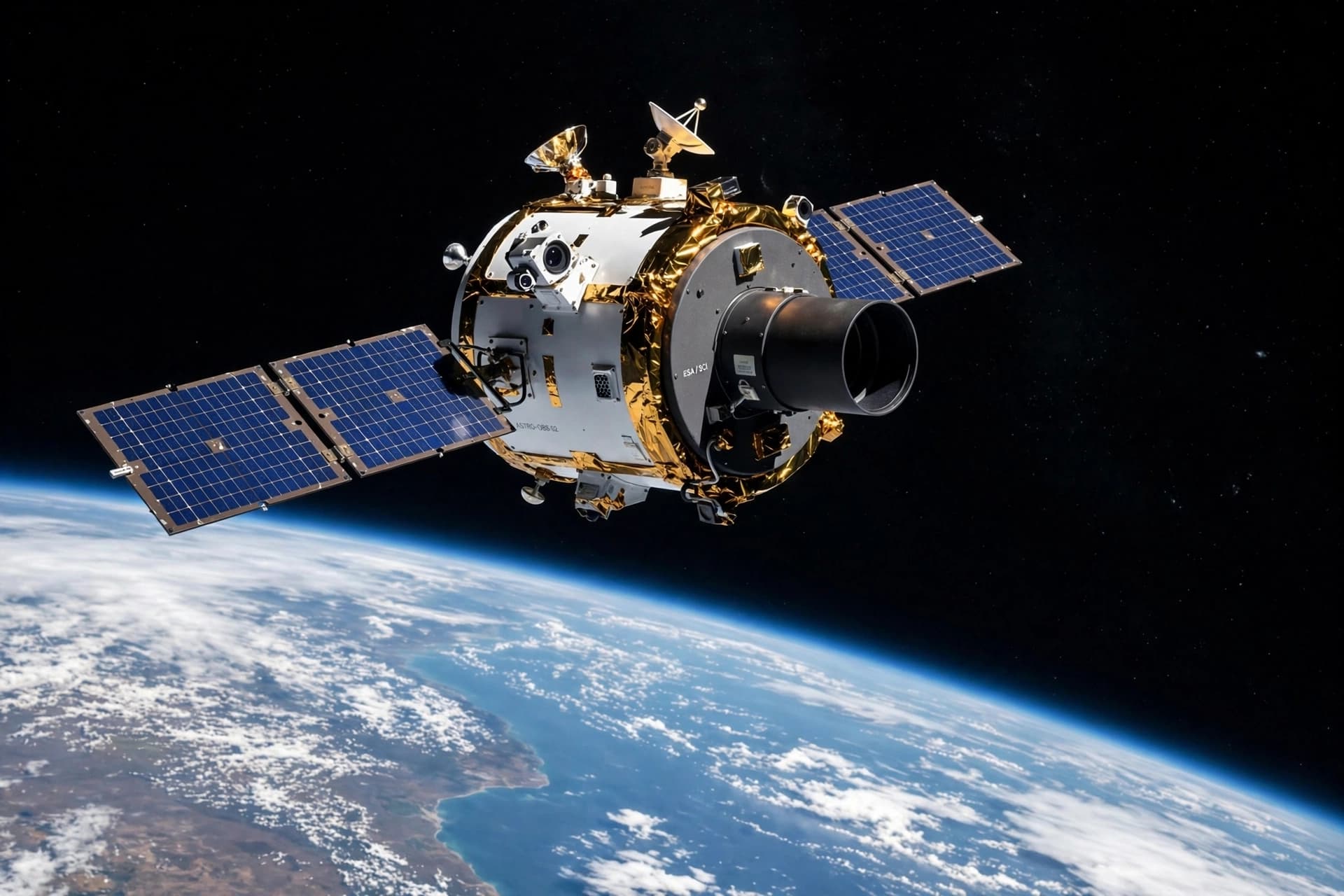
There is a peculiar sadness in watching something built to look outward find itself pulled inward. For nearly twenty-two years, a small observatory named for a fast-flying bird has done exactly what its name suggests: pivoting quickly, catching the briefest flashes from the most violent corners of the cosmos, then passing the alert to other telescopes before the light fades. It was never the largest or the most famous instrument in NASA's fleet, but it served as a kind of lookout—the first to see, the first to tell. Now, its orbit is sinking, and the end is measured not in years but in weeks.
The Neil Gehrels Swift Observatory, launched in November 2004 at a cost of $364 million, was designed to chase gamma-ray bursts, the most powerful explosions in the universe . Its ability to slew rapidly and point with precision made it an essential first responder for the global astronomical community, a sentinel that could witness a fleeting event and then direct ground-based observatories and other space telescopes to follow its lead . Over more than two decades, it observed exploding stars, flaring black holes, asteroids, and comets, compiling a scientific legacy that few missions of its size could match.
The trouble was not with Swift's instruments but with the thin breath of atmosphere still present at its altitude. Solar activity had intensified in recent years, heating the upper atmosphere and increasing drag on the telescope. Its orbit, once a comfortable 600 kilometers above Earth, had been steadily decaying . By late 2025, NASA's analysis suggested a fifty percent chance Swift would reenter by mid-2026, and a ninety percent chance before the end of 2027 .
Faced with that timeline, NASA turned to a private company, Katalyst Space Technologies, for a rescue. The plan was ambitious: build a small spacecraft called LINK in under a year, launch it, rendezvous with Swift, and boost the aging observatory back to a higher orbit . NASA contributed $30 million to the effort, and Katalyst worked against a clock that would not slow down .
LINK launched on July 3, 2026, but trouble arrived almost immediately. Electronic problems disabled two of the three reaction wheels needed to orient the spacecraft. Then a faulty valve sent LINK spinning uncontrollably, disrupting communications . Engineers eventually regained control, but the maneuvers had consumed most of the satellite's propellant. By August, the rescue was called off . LINK continued operating for a few more weeks, practicing approaches and deploying its robotic arms, before it reentered Earth's atmosphere on September 25 .
NASA's Shawn Domagal-Goldman acknowledged the disappointment but framed the effort as worthwhile. "From the beginning, this was a high-risk, high-reward mission," he said in a statement. "Without intervention, Swift was going to re-enter the atmosphere by year's end" . He noted that the attempt advanced American spacecraft servicing technology and tested how the agency might extend the lives of satellites in low Earth orbit.
Swift is now back to doing science for the short time it has left. As of late September, it was orbiting at about 325 kilometers, and NASA expects observations will become impossible once it drops below 300 kilometers, likely in early to mid-October . The observatory is expected to burn up in Earth's atmosphere in early November. NASA is already considering how to fill the gap left by its departure.
AI Image Disclaimer: The images accompanying this article were generated by artificial intelligence and are intended for conceptual illustration only.
Sources: CNN, The Hindu, IFLScience, Vietnam.vn, NASA Technical Reports Server
Published by Banx Network. This article is part of the Banx decentralized media programme, powered by the BXE token on the XRP Ledger.